


The most common types of therapy are cognitive behavioral therapy (CBT), dialectical behavior therapy (DBT), psychodynamic therapy, humanistic therapy, and integrative therapy, which blends more than one approach. Each one works on a different part of the problem: your thoughts, your behaviors, your past experiences, or your relationships. Most therapists use more than one, and most of the different types of therapy can happen one-on-one, in a group, or with your family.
This guide explains what each type is, what it helps with, and how to tell which one fits you. It's written for adults who are thinking about therapy for their mental health, for substance abuse, or for both, and for the family members trying to help them. If you'd rather ask a person, call (951) 307-9554. A real person will answer, day or night.
Key Takeaways
- Therapy, also called psychotherapy or talk therapy, is a group of treatments that help a person identify and change troubling emotions, thoughts, and behaviors.
- The American Psychological Association sorts the approaches into five broad categories: psychodynamic therapy, behavior therapy, cognitive therapy, humanistic therapy, and integrative therapy.
- Cognitive behavioral therapy has the largest research base. A review of 269 meta-analyses called the evidence for it very strong.
- Dialectical behavior therapy was built for emotions that feel too big to manage. Motivational interviewing was built for people who feel two ways about changing.
- Across every type of therapy studied, a good working relationship with your therapist goes along with better results.
- You don't have to pick the right type before you start. A good clinician picks with you and changes course if it isn't working.
What Is Therapy
Therapy is a treatment where you work with a trained professional to change the thoughts, feelings, and behaviors that are getting in the way of your life. The National Institute of Mental Health describes psychotherapy as a variety of treatments that aim to help a person identify and change troubling emotions, thoughts, and behaviors. Most of it happens one on one with a licensed mental health professional or in a group.
The goals are simple to say and hard to do alone: get relief from symptoms, keep up or improve daily functioning, and improve quality of life. People start therapy for many reasons. Some are dealing with long-term stress, a loss, or problems at home. Some have symptoms they can't explain, like changes in sleep, low energy, or worry that won't go away. Some have been told by a doctor that they may have one of the mental health conditions that therapy treats. Some are trying to stop drinking or using.
Therapy and medication are the two most common forms of mental health treatment, and they're often used together. There's no formal approval process for therapies the way there is for medications. What we have is research. For many therapies, studies involving large numbers of people have shown that the treatment works, and those are the ones called evidence based. This guide sticks to those.
If you're still deciding whether therapy is worth your time, start with our chapter on the benefits of therapy.
The Five Main Types of Psychotherapy
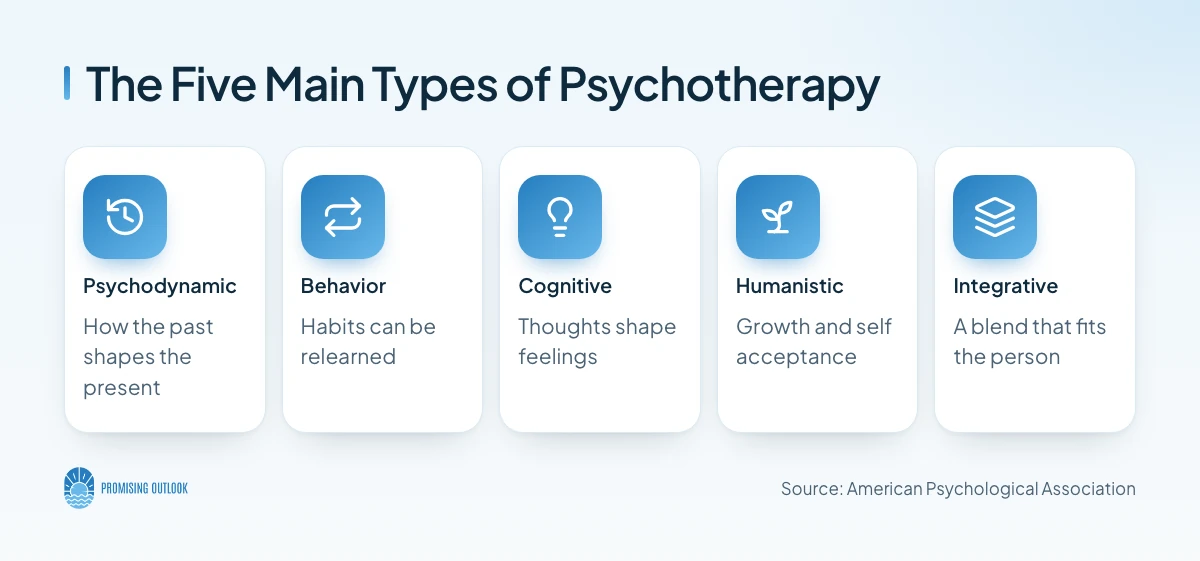
There are hundreds of named therapies, and that's where most people get lost. It helps to know that nearly all of them belong to a handful of families. The American Psychological Association groups the types of psychotherapy into five broad categories.
| Category | The main idea | Examples |
|---|---|---|
| Psychodynamic therapy | Problem behaviors, feelings, and thoughts have unconscious meanings and motivations. Finding them changes them. | Psychoanalysis, psychodynamic psychotherapy |
| Behavior therapy | Behaviors are learned, so they can be unlearned and replaced. | Exposure therapy, skills practice |
| Cognitive therapy | What people think shapes how they feel and what they do. | Cognitive therapy, rational emotive behavior therapy |
| Humanistic therapy | People have the capacity to make rational choices and grow to their full potential. | Person-centered therapy, Gestalt therapy, existential therapy |
| Integrative therapy | No single approach fits everyone, so the therapist blends elements from several. | Most therapy as it's practiced today |
Two things are worth knowing about this list. First, the most widely used therapy today, cognitive behavioral therapy, is a merger of the second and third families. Second, the fifth family is the most common one in real life. Many therapists use a mix of techniques, and NIMH notes that therapists may use one primary approach or bring in elements from several depending on their training, the condition being treated, and the needs of the person in front of them.
The sections below walk through the types of therapy you're most likely to be offered, starting with the ones we use every day at Promising Outlook.
Cognitive Behavioral Therapy
Cognitive behavioral therapy (CBT) is a structured type of talk therapy that focuses on the relationships among your thoughts, feelings, and behaviors. It targets current problems and symptoms, and it works by changing the patterns that keep those problems going. It's the therapy most people have heard of, and for good reason: it has been tested more than any other.
How CBT Works
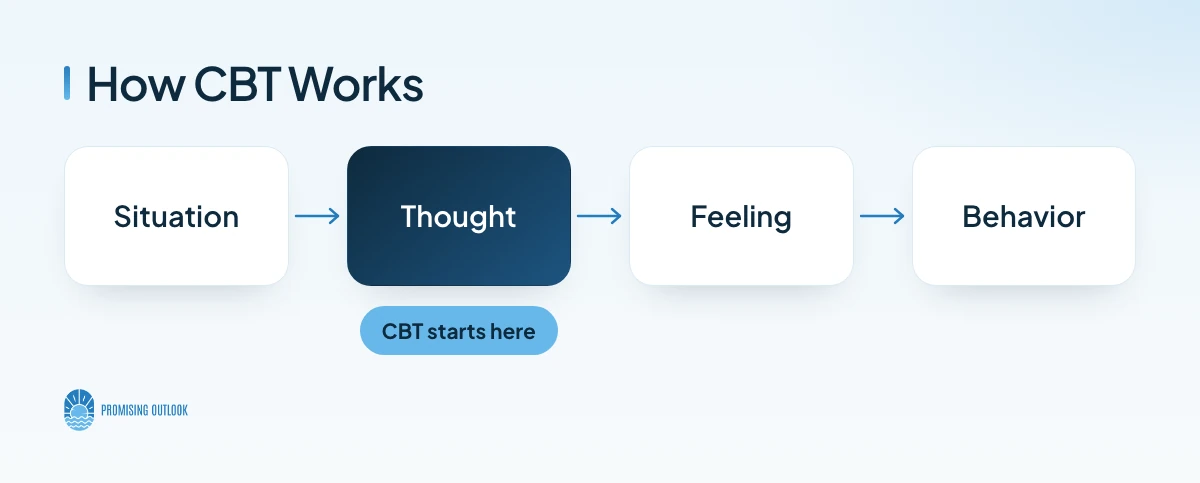
CBT starts from a plain observation. A situation happens, you have a thought about it, the thought produces a feeling, and the feeling drives what you do next. Most of those thoughts are automatic. NIMH describes the work as helping a person become aware of automatic ways of thinking that are inaccurate or harmful, question those thoughts, understand how they affect emotions and behavior, and change self-defeating behavior patterns.
Here's what that looks like. Someone three weeks sober has a drink at a family party. The automatic thought is, "I already blew it, so the week is ruined." The feeling is shame. The behavior is drinking for four more days. In CBT, you and your therapist slow that chain down. You catch the thought, test whether it's true, and practice a different response until it becomes the new habit. Negative thought patterns lose their grip when you can see them coming.
CBT is active. You'll learn new skills, practice them between appointments, and track what happens. Our chapter on what cognitive behavioral therapy is goes through the techniques one at a time.
What CBT Helps With
A 2012 review in Cognitive Therapy and Research identified 269 meta-analyses of CBT and looked closely at 106 of them. They covered substance use disorder, depression, anxiety disorders, eating disorders, insomnia, personality disorders, anger and aggression, general stress, and chronic pain, among others. The authors concluded that the evidence base for CBT is very strong.
That range is why CBT shows up in so many places. The same core skills that help with anxiety also help with anger management skills and with problem solving techniques you can use the same day. CBT is one of the main therapies in our programs, and you can read how we use it on our online CBT page.
Exposure Therapy
Exposure therapy is a type of CBT used mostly for anxiety disorders, phobias, and post traumatic stress disorder. Avoiding what scares you brings relief in the moment and makes the fear bigger over time. Exposure therapy reverses that. In NIMH's words, a person spends brief periods in a supportive environment learning to tolerate the distress caused by certain items, ideas, or imagined scenes, and over time the fear tied to those things goes down.
It's done in steps, at a pace you agree to, with a therapist beside you. Nobody is thrown into the deep end.
Rational Emotive Behavior Therapy
Rational emotive behavior therapy (REBT) is one of the earliest forms of cognitive therapy. It was developed by Albert Ellis, whom the American Psychological Association names alongside Aaron Beck as a major figure in cognitive therapy. REBT goes after rigid beliefs, the "musts" and "shoulds" that turn a bad day into proof that you're a failure. The therapist is direct about it, and many clients like that.
Dialectical Behavior Therapy
Dialectical behavior therapy (DBT) is a form of cognitive behavioral therapy built for people who feel emotions very intensely. It was developed by psychologist Marsha Linehan. "Dialectical" means two things that seem opposite can both be true. In DBT, the two things are acceptance and change: you're doing the best you can, and you need to do better. DBT teaches skills for both halves.
The Four DBT Skills
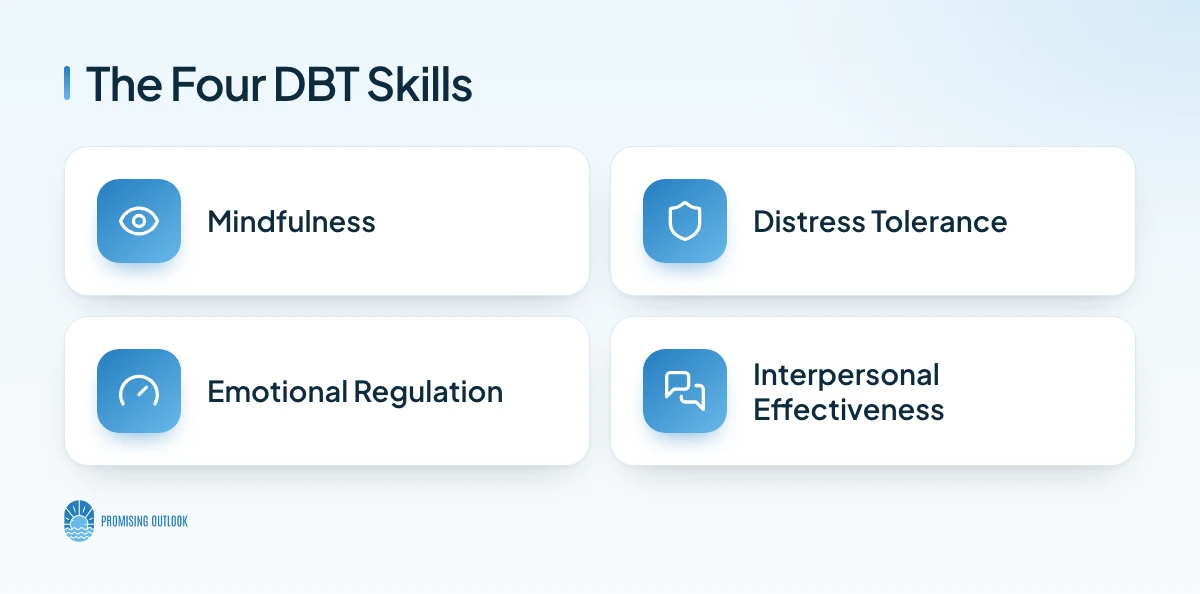
Dialectical behavioral therapy is taught as a set of skills, usually in a group, and practiced in daily life.
What DBT Helps With
DBT was first created for borderline personality disorder, and it's still one of the best studied treatments for it. A Cochrane review of psychological therapies for borderline personality disorder found that DBT and mentalization based therapy were the two most studied approaches, and that therapy in general may be more effective than usual treatment at reducing symptom severity and depression while improving day-to-day functioning.
Since then, DBT has been used well beyond that one diagnosis. The skills are useful for anyone whose difficult emotions lead to actions they regret, which includes many people living with addiction, trauma, and mood disorders.
DBT vs CBT
DBT grew out of CBT, so they share a lot. The difference is where each one puts its weight.
| CBT | DBT | |
|---|---|---|
| Main focus | Changing thought patterns and behaviors | Accepting emotions and changing behaviors |
| Best known for | Depression and anxiety | Borderline personality disorder and intense emotions |
| How it's taught | Individual or group work on thoughts and habits | Skills groups plus individual work |
Our chapter on what DBT is covers the skills and the comparison in full. If you want to see how the skills groups run in our programs, that's on our online DBT therapy page.
Motivational Interviewing
Motivational interviewing (MI) is a counseling style for people who aren't sure they want to change. SAMHSA's treatment guidance on motivation quotes the definition from its founders: a person-centered counseling style for addressing the common problem of ambivalence about change.
Ambivalence means feeling two ways at once. Part of you wants to stop drinking. Part of you can't picture a Friday night without it. That's normal, and SAMHSA is clear that it should be treated as a normal part of change and not as denial. In MI, the counselor doesn't argue or lecture. They ask open questions, listen closely, and reflect back what they hear, especially in the moments when you talk yourself toward change. The reasons that end up mattering are yours.
MI is short, respectful, and often the first therapy a person meets in addiction treatment. A related approach, motivational enhancement therapy, uses the same style in a set number of meetings. Read more in our chapter on what motivational interviewing is.
Whatever got you here is a good enough reason. If you want to talk it through with someone, call (951) 307-9554.
Psychodynamic Therapy
Psychodynamic therapy looks at how your past shapes your present. The American Psychological Association describes it as changing problematic behaviors, feelings, and thoughts by discovering their unconscious meanings and motivations. In practice, that means talking openly with a therapist and noticing the patterns that keep repeating: the same fight in every relationship, the same reaction to every boss, the same way of pulling back when someone gets close.
It's less structured than CBT. There are no worksheets. The therapist listens for themes, points out what you may be avoiding, and helps you connect certain feelings and certain behaviors today to past experiences you may not have thought about in years. The goal is self-awareness that leads to real change. Psychodynamic psychotherapy usually happens once or twice a week and can be short-term or open-ended.
Some people assume this kind of therapy has no science behind it. That isn't what the research shows. A review in American Psychologist found that the effects of psychodynamic therapy are as large as those reported for other evidence-based therapies, and that people who receive it keep their gains and appear to continue to improve after treatment ends.
Psychoanalysis
Psychoanalysis is the original form, the one people picture with a couch. It's more intensive, often several times a week for years, and it puts heavy focus on the unconscious mind. Few people need it. Modern psychodynamic therapy keeps the insight and drops most of the time commitment.
Mentalization-Based Therapy
Mentalization-based therapy grew out of the psychodynamic tradition. It helps people understand what's going on in their own mind and in other people's minds, which makes relationships less confusing and reactions less extreme. Along with DBT, it's one of the two most studied therapies for borderline personality disorder.
Humanistic Therapy
Humanistic therapy starts from the belief that you're the expert on your own life. The American Psychological Association says this approach emphasizes people's capacity to make rational choices and develop to their maximum potential, with concern and respect for others as central themes. The therapist isn't there to diagnose and fix. They're there to help you see yourself clearly and move toward personal growth.
Three forms of humanistic therapy have been especially influential.
Person-Centered Therapy
Person-centered therapy, developed by Carl Rogers, rests on the idea that people change when they feel accepted. The therapist offers empathy, honesty, and what Rogers called unconditional positive regard: you're treated with respect no matter what you say. You lead. The therapist follows and reflects. Motivational interviewing borrowed this stance, and so do many therapists who would never call themselves humanistic.
Gestalt Therapy
Gestalt therapy focuses on the here and now. Instead of talking about a feeling, you're asked to notice it as it's happening: where it sits in your body, what you want to do with it, what you're avoiding. It stresses awareness and taking responsibility for your own choices.
Existential Therapy
Existential therapy deals with the big questions: freedom, responsibility, meaning, and the fact that life is short. It's useful when the problem isn't a symptom so much as a question, like "What am I doing with my life now that I'm sober?" If that question sounds familiar, our post on how to find yourself in recovery is a good companion.
Interpersonal Therapy
Interpersonal therapy is a short term therapy that focuses on your interpersonal relationships and the life events that affect your mood. It was developed to treat depression. The work centers on one or two areas, such as grief, a conflict with someone important, a major life change, or isolation. You and your therapist look at how those areas connect to how you feel, and you practice new ways of communicating.
It's a good fit when your low mood clearly tracks with what's happening between you and other people.
Acceptance and Commitment Therapy
Acceptance and commitment therapy (ACT) teaches psychological flexibility. Instead of fighting painful thoughts and feelings, you learn to make room for them and keep moving toward what matters to you. The "acceptance" half is about dropping the struggle with your own mind. The "commitment" half is about choosing actions that match your values, even on hard days.
ACT belongs to the cognitive and behavioral family, and many therapists blend it with CBT.
Mindfulness Based Therapies
Mindfulness means paying attention to the present moment on purpose, without judging it. NIMH lists mindfulness and relaxation techniques, such as meditation and breathing exercises, among the elements therapists use. Several therapies are built around the skill, and DBT uses it as its foundation.
In addiction treatment, the best known version is covered in our guide to mindfulness based relapse prevention, which teaches people to notice a craving, watch it rise, and let it pass without acting on it. The same skills help with everyday pressure, and our guide to stress management skills shows how.
Trauma Focused Therapies
Some therapies were built specifically for trauma and post-traumatic stress disorder (PTSD). The American Psychological Association's PTSD guideline strongly recommends cognitive behavioral therapy, cognitive processing therapy, cognitive therapy, and prolonged exposure, and it conditionally recommends a few others. Here are the three you'll hear about most.
Cognitive Processing Therapy
Cognitive processing therapy is a specific type of CBT. It helps people learn to challenge and change unhelpful beliefs related to the trauma, such as "It was my fault" or "No one can be trusted."
Prolonged Exposure
Prolonged exposure is another specific type of CBT. It teaches people to gradually approach trauma-related memories, feelings, and situations they've been avoiding. By facing them, a person learns that the memories and reminders aren't dangerous and don't need to be avoided.
EMDR
Eye movement desensitization and reprocessing (EMDR) is a structured therapy in which a person briefly focuses on the trauma memory while following a back-and-forth stimulus, usually eye movements. The guideline describes this as being associated with a reduction in how vivid and emotional the memory feels. EMDR is a reprocessing therapy, so it asks for less talking about the event than other approaches do. We don't offer EMDR at Promising Outlook.
To understand the condition itself, start with our guide to what PTSD is or our chapter on unresolved trauma. If you're looking for care, see how we approach virtual PTSD treatment.
Creative and Body-Based Therapies
Not every therapy runs on conversation. Art therapy and music therapy use making and listening as a way into feelings that are hard to put into words. Animal-assisted therapy brings a trained animal into the room to help people feel calm enough to open up. Somatic therapy focuses on sensations in the body to release tension and settle the nervous system. Play therapy does similar work for children, who show what they feel through play long before they can explain it.
These approaches have fewer studies behind them than CBT does, and they're usually added to talk therapy, not used in place of it. We treat adults 18 and older, and our programs are built on the talk therapies described above.
Therapy Formats
The type of therapy is one choice. The format is another. Therapy may be provided to individuals, couples, families, or members of a group, and the same approach can be delivered in more than one format. CBT, for example, works one on one and in a group.
Individual
One client, one therapist, a private conversation. This is where you work on the things you aren't ready to say in front of anyone else, and where your plan gets adjusted to you. In our programs, every client can meet weekly with a therapist and with a counselor. Our page on individual therapy explains how those meetings fit into the week.
Group
Group is several clients and one or two clinicians working on a shared topic. People are often nervous about it and then surprised by it. There's something that happens when a stranger describes your exact week that no therapist can produce alone. Group is also where skills from CBT and DBT get practiced out loud, with people who will notice if you aren't there tomorrow. It's the heart of our programs.
Family
Family therapy treats the family unit as the client. Family therapists look at communication patterns and the roles each person has taken on, like the fixer, the peacekeeper, or the one nobody worries about. Addiction and mental health problems pull everyone in the house into new roles, and those roles tend to stick after the crisis ends. Bringing family members into the work, with the client's signed permission, helps the whole house change together. See how we run online family therapy, and read our chapter on building a support system for the people outside your family.
Types of Therapy for Mental Health Conditions
No therapy is right for everything, and NIMH points out that the type of treatment is often matched to the specific condition. The table below shows which types of therapy for mental health are most commonly used for which concerns, based on the sources cited in this guide.
| Concern | Therapies commonly used |
|---|---|
| Anxiety disorders and phobias | Cognitive behavioral therapy, exposure therapy |
| Depression | Cognitive behavioral therapy, interpersonal therapy, psychodynamic therapy |
| Post traumatic stress disorder | Cognitive processing therapy, prolonged exposure, trauma focused CBT |
| Borderline personality disorder and intense emotions | Dialectical behavior therapy, mentalization based therapy |
| Substance use | Motivational interviewing, cognitive behavioral therapy, family therapy |
| Anger | CBT based anger management |
A table like this is a starting point. Two people with the same diagnosis can need different things, and many people have more than one concern at once. If anxiety or depression is the main thing you're facing, you can read about our virtual anxiety treatment and our online depression therapy in California.
Types of Therapy for Addiction
Addiction treatment uses the same therapies described above, pointed at a specific job: helping you stop, and helping you stay stopped.
- Motivational interviewing comes first for many people, because the decision to change has to be yours.
- Cognitive behavioral therapy teaches you to spot the thoughts and situations that lead to using and to respond differently.
- Dialectical behavior therapy gives you coping skills for the feelings that used to send you straight to a drink or a drug.
- Family therapy repairs trust and gets everyone working from the same plan.
- Group therapy replaces isolation with people who understand.
Many people who struggle with substance abuse also live with depression, anxiety, or trauma. When that's true, treating one and ignoring the other doesn't work for long. Our guide to co-occurring disorders explains why, and the chapter on integrated treatment explains what treating both at the same time looks like. You can also see how we handle virtual dual diagnosis treatment.
Therapy is also where the plan for afterward gets built. Our chapter on how to stay sober picks up where this section leaves off, and our virtual addiction treatment page shows how the therapies fit together in a program.
Therapy and Medication
Therapy and medication aren't competitors. NIMH notes that psychotherapy can be used as an alternative to medication or alongside it, and that even when medication relieves symptoms, therapy can help with specific issues such as self-defeating ways of thinking, fears, problems with other people, or trouble coping at home or at work.
Whether medication belongs in your plan is a decision to make with a prescriber who knows your history. For some conditions, the two together do more than either alone. Our page on psychiatric medication management explains how that works alongside therapy.
How to Choose a Type of Therapy
Here's the part most guides skip. The type of therapy matters less than most people think, and the person you do it with matters more.
A meta-analysis in the journal Psychotherapy pulled together 295 studies covering more than 30,000 people and looked at the alliance, meaning the working relationship between client and therapist. A stronger alliance went along with better results, and that held across treatment approaches, across countries, and whether therapy happened face to face or over the internet. NIMH says the same thing in plainer words: rapport and trust are essential.
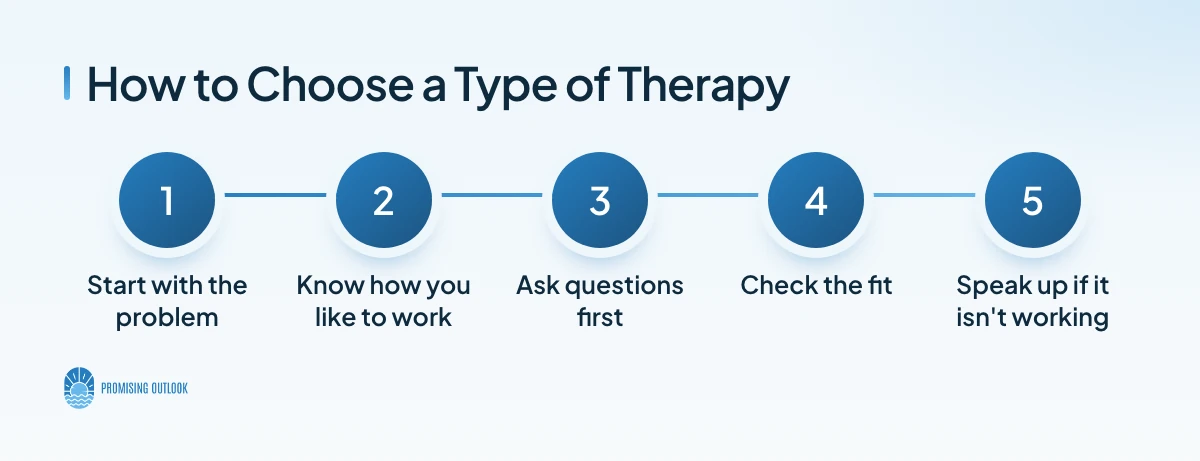
So choose in this order.
- Start with the problem. Use the table above to see which therapies are commonly used for what you're dealing with.
- Think about how you like to work. If you want tools and homework, CBT and DBT will feel right. If you want to understand why you are the way you are, psychodynamic or humanistic therapy may suit you better.
- Ask questions before you commit. NIMH suggests asking about the therapist's credentials and experience, what approach they'll use and why, what the goals are, how progress will be measured, and what happens if you aren't getting better.
- Pay attention to the fit. After a few meetings, you should feel heard and you should understand the plan.
- Speak up if it isn't working. It's fine to try a different approach or a different therapist. A good one won't take it personally.
How much therapy you need matters too. Weekly appointments are enough for many people. Others need more structure, with therapy several days a week. Our guides to what an IOP is and inpatient vs outpatient rehab explain the levels of care. If cost is the worry, our guide to insurance for rehab covers what plans usually pay for.
What Therapy Looks Like at Promising Outlook
Promising Outlook is a Joint Commission-accredited virtual program for adults in California, based in Riverside. We treat addiction and mental health at the same time, over live video, and we've been doing it for ten years.
Our clinicians use cognitive behavioral therapy, dialectical behavior therapy, motivational interviewing, and motivational enhancement therapy, in group and one-on-one, with family therapy when you want your family involved. Our Clinical Director, Deneen "Dean" Watson, LMFT, also works in family systems therapy, rational emotive behavior therapy, existential therapy, and psychodynamic therapy, so the approach can bend to fit the client.
Groups meet Monday through Friday, with a morning group at 9:00 a.m., a midday group at 12:00 p.m., and evening groups at 5:00 p.m. Each group runs 45 to 50 minutes with a check-in before and after. You join from your phone or computer. You can read about the full schedule on our virtual IOP page, or see all of our online therapy in California.
You don't need to know which type of therapy you need before you call. That's our job. Call (951) 307-9554 and a real person will answer, day or night. You can also verify your insurance, and we'll tell you what your plan covers. We're in network with Aetna, Blue Shield, Cigna, Health Net, Tricare, and United.
Frequently Asked Questions
What are the main types of therapy?
The American Psychological Association groups therapy into five broad categories: psychodynamic therapy, behavior therapy, cognitive therapy, humanistic therapy, and integrative therapy. The specific therapies most people are offered, such as cognitive behavioral therapy, dialectical behavior therapy, and interpersonal therapy, each come from one or more of those families.
What is the most common type of therapy?
Cognitive behavioral therapy (CBT) is the most widely used and most studied type of therapy. A 2012 review identified 269 meta-analyses of CBT across problems including depression, anxiety disorders, and substance use disorder, and concluded the evidence base is very strong. Many therapists blend CBT with other approaches.
What is the difference between CBT and DBT?
CBT focuses on changing unhelpful thoughts and behaviors. DBT is a form of CBT that adds acceptance: it teaches mindfulness, distress tolerance, emotional regulation, and interpersonal effectiveness for people whose emotions feel overwhelming. CBT is best known for depression and anxiety. DBT is best known for borderline personality disorder.
Which type of therapy is best for anxiety?
Cognitive behavioral therapy is the therapy most often used for anxiety, and exposure therapy, a type of CBT, is commonly used for phobias and specific fears. In exposure therapy, a person gradually faces what they fear in a supportive setting until the fear goes down. A clinician can tell you which fits your anxiety.
What type of therapy is used for addiction?
Addiction treatment commonly uses motivational interviewing to build a person's own reasons for change, cognitive behavioral therapy to handle triggers and cravings, dialectical behavior therapy for coping with strong emotions, and group and family therapy for support. When depression, anxiety, or trauma is also present, both are treated together.
How do I know which type of therapy I need?
Start with what you want help with and how you like to work. Structured, skills-based therapies like CBT and DBT suit people who want tools. Psychodynamic and humanistic therapy suit people who want insight. A licensed clinician can assess you and recommend an approach, and it's fine to change if the first one isn't helping.
Does the type of therapy matter more than the therapist?
Both matter, but the relationship carries a lot of weight. A meta-analysis of 295 studies and more than 30,000 people found that a stronger working relationship between client and therapist went along with better outcomes across treatment approaches. Trust and feeling understood are worth looking for.
Can therapy be done online?
Yes. Therapy can be delivered over live video, by phone, or in person, and NIMH notes that technology has made treatment available in places where mental health professionals aren't physically close by. Our chapter on whether virtual treatment is effective looks at the research.
Does insurance cover therapy?
Most health plans include some coverage for mental health and substance use treatment, but what you pay depends on your plan and whether the provider is in network. Our chapter on in network vs out of network explains the difference, and a real person on our team can check your plan for you.
Sources
- National Institute of Mental Health. Psychotherapies.
- American Psychological Association. Different approaches to psychotherapy.
- Hofmann SG, et al. The Efficacy of Cognitive Behavioral Therapy: A Review of Meta-analyses. Cognitive Therapy and Research, 2012.
- Storebø OJ, et al. Psychological therapies for people with borderline personality disorder. Cochrane Database of Systematic Reviews, 2020.
- Substance Abuse and Mental Health Services Administration. Enhancing Motivation for Change in Substance Use Disorder Treatment, Chapter 3. TIP 35, 2019.
- Shedler J. The efficacy of psychodynamic psychotherapy. American Psychologist, 2010.
- American Psychological Association. PTSD Treatments, Clinical Practice Guideline.
- Flückiger C, et al. The Alliance in Adult Psychotherapy: A Meta-Analytic Synthesis. Psychotherapy, 2018.
