


Cognitive behavioral therapy (CBT) is a structured, goal focused type of talk therapy that helps people change the thoughts and behaviors that are keeping them stuck. It's built on a simple idea: your thoughts, emotions, and behaviors are connected, so changing one changes the others. CBT is an evidence based form of psychotherapy, one of the most studied in modern psychotherapy, and it's used for depression, anxiety disorders, addiction, and many other mental health conditions.
This chapter explains what CBT is, how it works, the main CBT techniques, and what it's like in practice. It's part of our guide to the common types of therapy.
What Is Cognitive Behavioral Therapy
Cognitive behavioral therapy combines two older approaches. Cognitive therapy, developed by psychiatrist Aaron Beck in the 1960s, looks at what people think. Behavioral therapy looks at what people do. Cognitive behavioral therapy (CBT) works on both at once, so that healthier thinking leads to healthier behaviors.
The American Psychological Association says CBT rests on a few core principles:
- Psychological problems are based, in part, on faulty or unhelpful ways of thinking.
- Psychological problems are based, in part, on learned patterns of unhelpful behavior.
- People can learn better ways of coping, which relieves symptoms and helps them become more effective in their lives.
Two things set CBT apart from other therapy. First, CBT focuses on what's going on in your life now, more than on how you got here. Second, it's meant to make you your own therapist. You learn skills in the room and practice them at home, so the gains don't depend on staying in therapy forever. That's why CBT is often a short term treatment. CBT aims to give you tools you keep, and the approach focuses on skill building more than on talking things through.
How CBT Works
CBT starts with a chain. Something happens. You have a thought about it. The thought sets off a feeling. The feeling drives a behavior. Most of the time the thought is automatic, and you don't notice it. You only notice the feeling, the emotional distress that seems to come from nowhere.
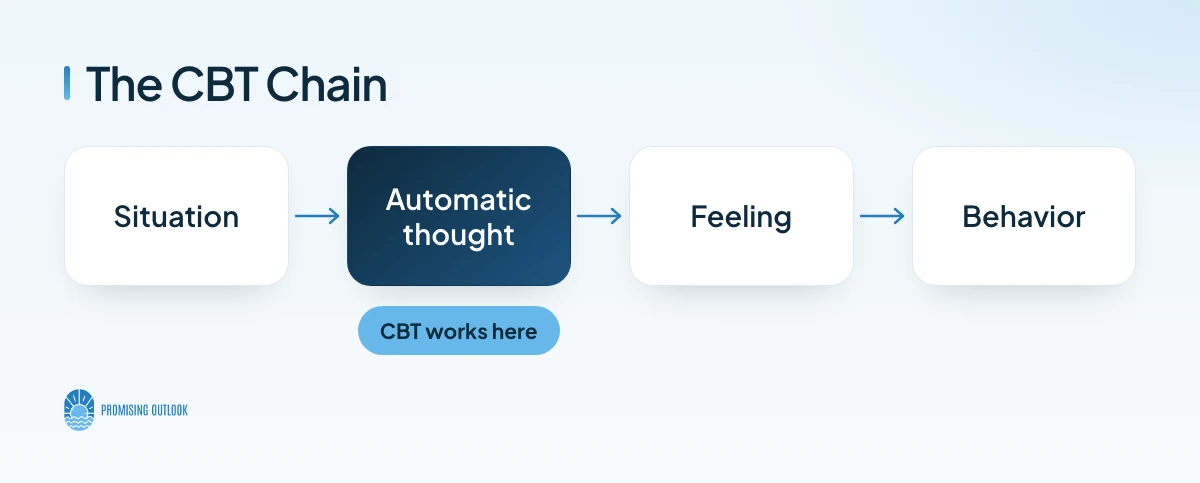
The National Institute of Mental Health describes the work of CBT as helping a person become aware of automatic ways of thinking that are inaccurate or harmful, question those thoughts, understand how they affect emotions and behavior, and change self-defeating patterns.
Here are two cognitive behavioral therapy examples.
| Example 1 | Example 2 | |
|---|---|---|
| Situation | A friend doesn't text back | A craving hits after a hard day |
| Automatic thought | "She's done with me." | "I can't get through tonight without a drink." |
| Feeling | Hurt, anxious | Panic, hopelessness |
| Behavior | Pull away from everyone | Drink |
| CBT response | Check the evidence. She's been busy all week. | Test the thought. You've gotten through hard nights before. Call someone and wait twenty minutes. |
Nothing about the situation changed. The thought did, and the rest of the chain followed.
Cognitive Distortions
Negative thinking tends to fall into patterns. Therapists call them cognitive distortions.
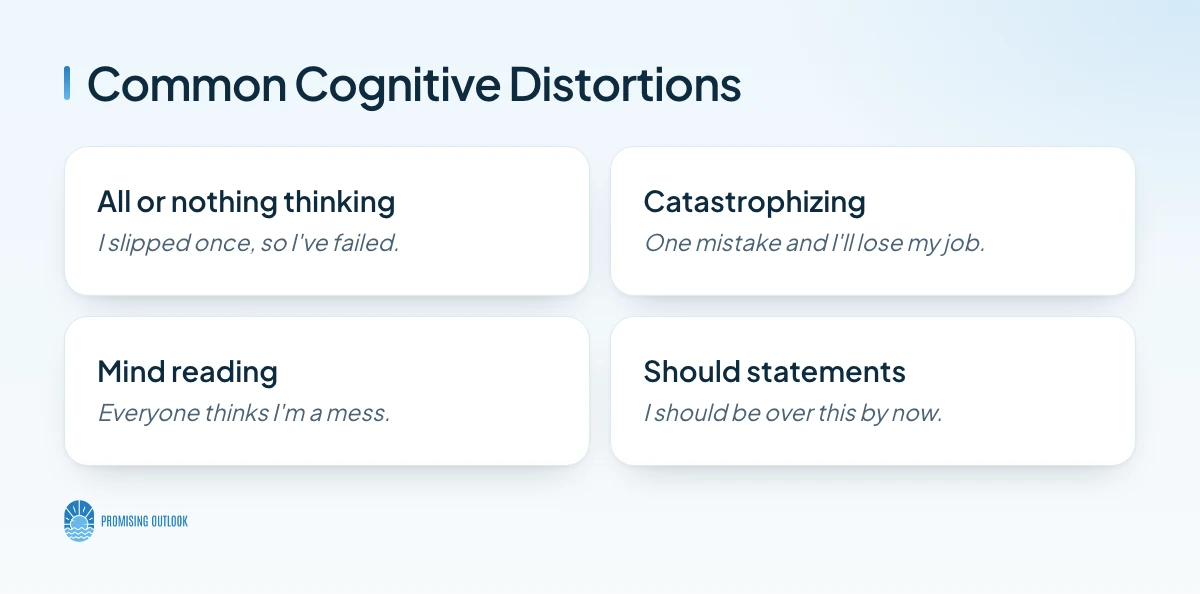
Beck noticed that people with depression often hold negative beliefs in three areas at once: about themselves, about the world, and about the future. He called this the cognitive triad. CBT teaches you to spot negative thought patterns and irrational beliefs like these and check them against the facts. Harmful thoughts lose power once you can name them.
CBT Techniques
CBT is a toolbox. Your therapist picks the tools that fit your treatment plan, and may blend them with other techniques. These are the ones used most.
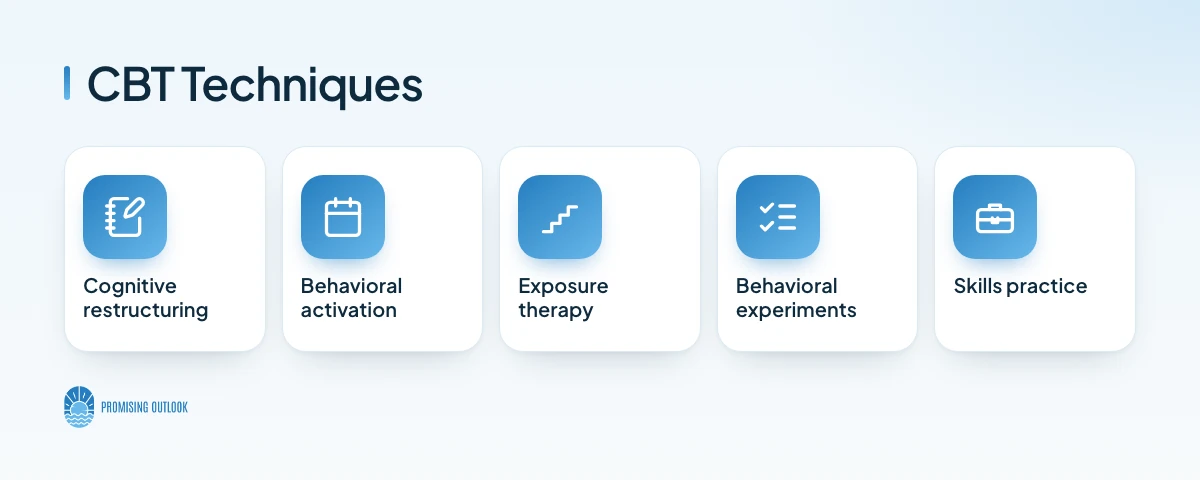
Cognitive Restructuring
Cognitive restructuring is the core skill. You write down a troubling thought, look at the evidence for and against it, and come up with a more accurate one. The goal isn't to swap negative thoughts for positive ones. The goal is thinking that's true, because accurate thoughts produce calmer emotional responses.
Behavioral Activation
Depression tells people to do less, and doing less makes depression worse. Behavioral activation breaks that loop by scheduling small activities that bring a sense of pleasure or accomplishment, whether you feel like it or not. Action comes first. Motivation follows.
Exposure Therapy
Exposure therapy is used for anxiety disorders, panic disorder, social anxiety, obsessive-compulsive disorder, and post-traumatic stress disorder. NIMH describes it as spending brief periods in a supportive environment learning to tolerate the distress caused by certain items, ideas, or imagined scenes until the fear goes down. Feared situations are faced step by step in a controlled environment. It's gradual, planned, and done with a therapist's support.
Behavioral Experiments
A behavioral experiment tests a belief in real life. If you believe "If I speak up in group, people will judge me," you speak up once and see what happens. Evidence from your own life is more convincing than anything a therapist can say.
Skills Practice
CBT also teaches practical skills: problem-solving skills for stressful situations, relaxation techniques for the physical symptoms of anxiety, and role-playing to prepare for hard conversations. Our posts on problem solving techniques and how to reduce stress cover several you can try today.
What CBT Treats
The evidence for CBT is broad. A review of 269 meta-analyses examined CBT for substance use disorder, depression, anxiety disorders, eating disorders, insomnia, personality disorders, anger, general stress, and chronic pain, and concluded that the evidence base is very strong. The American Psychological Association notes that in many studies CBT has been as effective as, or more effective than, other forms of psychological therapy or psychiatric medications.
In everyday practice, cognitive behavior therapy is an effective treatment for many mental health disorders and mental health challenges, including:
- Depression, including major depressive disorder
- Anxiety disorders, panic disorder, and social anxiety
- Post-traumatic stress disorder
- Obsessive-compulsive disorder
- Alcohol and drug use problems
- Anger and stress
In addiction treatment, CBT helps people identify the thoughts and situations that lead to using and plan a different response. It's also the backbone of relapse prevention, and our chapter on how to handle a relapse uses the same thinking. See how we use CBT for addiction and mental health on our online CBT page.
What CBT Is Like
CBT asks for active participation. A typical meeting has a rhythm: check in on the week, review what you practiced, work on one problem, and agree on what to practice next. Between meetings, you might keep a thought record, try a behavioral experiment, or schedule activities. People who do the practice tend to get more out of it. Your treatment plan gets adjusted as you go.
The American Psychological Association describes the relationship as collaborative. You and a licensed therapist work out an understanding of the problem together and decide on a strategy. A good CBT therapist explains why you're doing each exercise.
CBT can happen one-on-one or in a group, in person or over live video. At Promising Outlook, it's part of our virtual groups and individual therapy for adults in California, Monday through Friday. If you want to know whether it fits, call (951) 307-9554. A real person will answer, day or night.
CBT and Other Therapies
CBT has several close relatives. Dialectical behavior therapy grew out of CBT and adds acceptance and emotional regulation skills for people with overwhelming emotions. Motivational interviewing often comes before CBT, because it helps a person decide they want to change before they learn how.
CBT isn't the right fit for everyone. Some people want to explore past experiences more than CBT does, and some need medication alongside therapy. What matters is your mental health and well being, not loyalty to one method. If you're still deciding, our chapter on the benefits of therapy is a good next read.
We're in network with Aetna, Blue Shield, Cigna, Health Net, Tricare, and United. Call (951) 307-9554 or verify your insurance and a real person will tell you what your plan covers.
Frequently Asked Questions
What does CBT stand for?
CBT stands for cognitive behavioral therapy. "Cognitive" refers to thoughts and beliefs. "Behavioral" refers to actions. CBT works on both, based on the idea that thoughts, emotions, and behaviors affect each other and that changing unhelpful thoughts and behaviors improves how a person feels and supports their overall well-being.
What is CBT used for?
CBT is used for depression, anxiety disorders, panic disorder, post-traumatic stress disorder, obsessive-compulsive disorder, eating disorders, alcohol and drug use problems, anger, insomnia, and chronic pain. A review of 269 meta-analyses concluded that the evidence base for CBT is very strong.
What are examples of CBT techniques?
Common CBT techniques include cognitive restructuring, which means testing and changing unhelpful thoughts; behavioral activation, which means scheduling meaningful activity; exposure therapy for fears; behavioral experiments; and skills such as problem solving and relaxation. A therapist chooses the techniques that fit the person's goals.
How long does CBT take?
CBT is usually a short-term treatment compared with other forms of therapy. The length depends on the problem and the person. Because CBT teaches skills you keep using, many people continue to benefit after therapy ends.
Does CBT work for addiction?
Yes. Cognitive behavioral therapy has been studied for substance use disorder and is widely used in addiction treatment. It helps people recognize the thoughts and situations that lead to using, practice new coping skills, and plan for high-risk moments. It's often combined with motivational interviewing and group therapy.
What is the difference between CBT and DBT?
CBT focuses on changing unhelpful thoughts and behaviors. Dialectical behavior therapy is a form of CBT that adds acceptance, mindfulness, and skills for managing intense emotions. CBT is best known for depression and anxiety. DBT is best known for borderline personality disorder.
Sources
- American Psychological Association. What Is Cognitive Behavioral Therapy?
- National Institute of Mental Health. Psychotherapies.
- Hofmann SG, et al. The Efficacy of Cognitive Behavioral Therapy: A Review of Meta-analyses. Cognitive Therapy and Research, 2012.
