


PTSD, or post-traumatic stress disorder, is a mental health condition that can develop after you live through or witness something terrifying, like an assault, a serious accident, combat or abuse. Instead of fading over time, the fear stays. You may relive the event, avoid reminders of it, feel on edge and see yourself or the world differently than before.
The good news is that PTSD is common and very treatable. Therapies focused on trauma help many people feel safer and more in control within a few months. At Promising Outlook, our virtual PTSD treatment brings that care to adults across California by live video, along with treatment for any drinking or drug use that's come along with it.
This guide answers what is PTSD in plain terms, then covers how common it is, what causes PTSD, the symptoms, the types of PTSD, how it's diagnosed and the treatments with the best evidence. Two chapters go deeper on unresolved trauma and on trauma and addiction.
Key Takeaways
- PTSD is a condition in which fear and stress from a traumatic event stay long after the danger has passed.
- About 6 in 100 people in the U.S. will have PTSD at some point, and women are about twice as likely as men to develop it.
- Symptoms fall into four groups: re-experiencing, avoidance, arousal and changes in mood and thinking.
- Trauma-focused talk therapies such as cognitive processing therapy and prolonged exposure have the strongest research support.
- PTSD often occurs with depression and substance use, and treating them together works best.
- Federal guidelines say a co-occurring substance use disorder shouldn't keep someone from trauma treatment.
What Is PTSD
Post-traumatic stress disorder is a condition that can develop after a shocking, scary or dangerous event. The National Institute of Mental Health explains that it's natural to feel afraid during and after a traumatic situation, and that most people recover from those reactions over time.1 People whose symptoms continue may be diagnosed with PTSD.
Fear is part of the body's built-in alarm system. When you're in danger, your brain floods your body with stress hormones so you can fight, run or freeze. In PTSD, that alarm keeps going off after the danger is gone. Your body reacts to a smell, a sound or a crowded room as if the original threat were happening again.
Having PTSD is not a sign of weakness, and it doesn't mean you handled the event badly. Anyone can develop it, at any age. It's an injury to the way your brain processes threat and memory, and like other injuries, it can heal with the right care.
How Common Is PTSD
PTSD affects millions of people. The VA's National Center for PTSD reports that about 6 out of every 100 people in the U.S. will have PTSD at some point in their lives.2 In any given year, about 5 out of every 100 adults have it, and in 2020 that added up to about 13 million Americans.
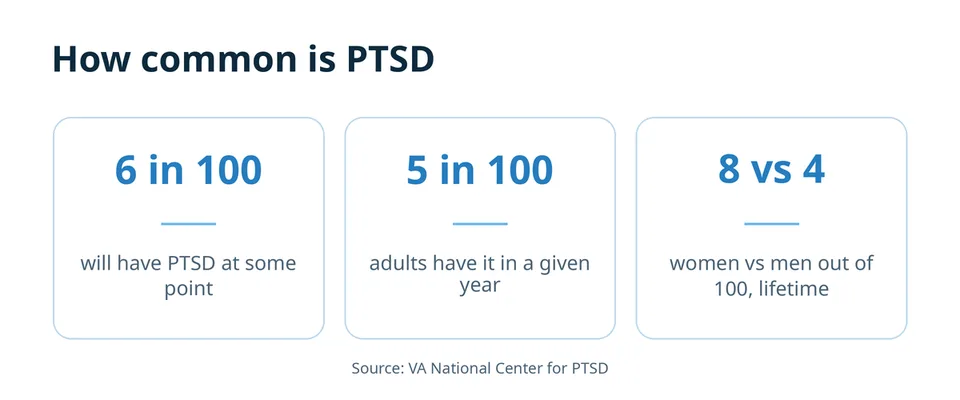
Women are more likely to develop PTSD than men. The National Center for PTSD reports that about 8 of every 100 women and 4 of every 100 men will have PTSD at some point. It links that gap in part to women's higher rates of experiences like sexual assault. Most people who go through a trauma do not develop PTSD, which is why understanding risk and protective factors matters.
What Causes PTSD
The cause is going through, witnessing or learning about a traumatic event. The National Institute of Mental Health notes that it can follow combat, assault, accidents or disasters, and that learning a close relative or friend was harmed can also trigger it.1 Common examples of events that can lead to PTSD include:
- Physical or sexual assault, including childhood abuse.
- Domestic violence or long-term abuse in a relationship.
- Serious car crashes and other accidents.
- Combat and military service.
- Natural disasters, fires and mass violence.
- Sudden, violent or unexpected death of a loved one.
- A life-threatening illness or medical emergency.
Exposure to trauma is one factor in who develops PTSD. Two people can go through the same crash and have very different reactions weeks later. That difference comes down to risk factors and resilience factors, which the next section covers.
Risk Factors and Resilience Factors
Some things make PTSD more likely after a trauma, and others make it less likely. The National Institute of Mental Health lists both.1 The table below puts them side by side.
| Raises the Risk of PTSD | Lowers the Risk of PTSD |
|---|---|
| Earlier trauma, especially in childhood | Support from friends, family or a support group |
| Being hurt, seeing others hurt or killed, or feeling intense fear or helplessness | Having healthy coping strategies |
| Little or no social support afterward | Feeling at peace with how you acted during the event |
| Extra stress afterward, like job loss or a death, or a personal or family history of mental illness or substance use | Being prepared to respond to upsetting events |
Notice how much of the second column is about support and skills. That's encouraging, because those are things people can build, even after a trauma. It's also part of why treatment that adds support and coping skills can make such a difference.
PTSD vs a Normal Stress Reaction
Almost everyone has strong reactions after a trauma. Trouble sleeping, jumpiness, upsetting memories and feeling numb are all common in the first days and weeks. The National Institute of Mental Health describes these as natural reactions and notes that most people recover from them over time.1
The difference with PTSD is time and impact. Symptoms last more than a month, and they're strong enough to interfere with relationships, work or daily routines. They may also get worse rather than better as weeks pass. If you're unsure which describes you, an assessment with a mental health professional can help you sort it out.
Symptoms of PTSD
PTSD symptoms usually begin within three months of the event, though they sometimes appear much later.1 The National Institute of Mental Health groups them into four kinds. The table below explains each one with examples.
| Symptom Group | What It Feels Like | Examples |
|---|---|---|
| Re-experiencing | The trauma intrudes on the present | Flashbacks, nightmares, upsetting memories, a racing heart or sweating at reminders |
| Avoidance | Steering clear of anything that brings it back | Avoiding places, people, conversations, thoughts or feelings tied to the event |
| Arousal and reactivity | Feeling on guard all the time | Being easily startled, feeling tense, trouble sleeping or concentrating, angry outbursts |
| Cognition and mood | Changes in how you see yourself and the world | Negative beliefs about yourself, guilt or blame, losing interest in activities, feeling distant from others |
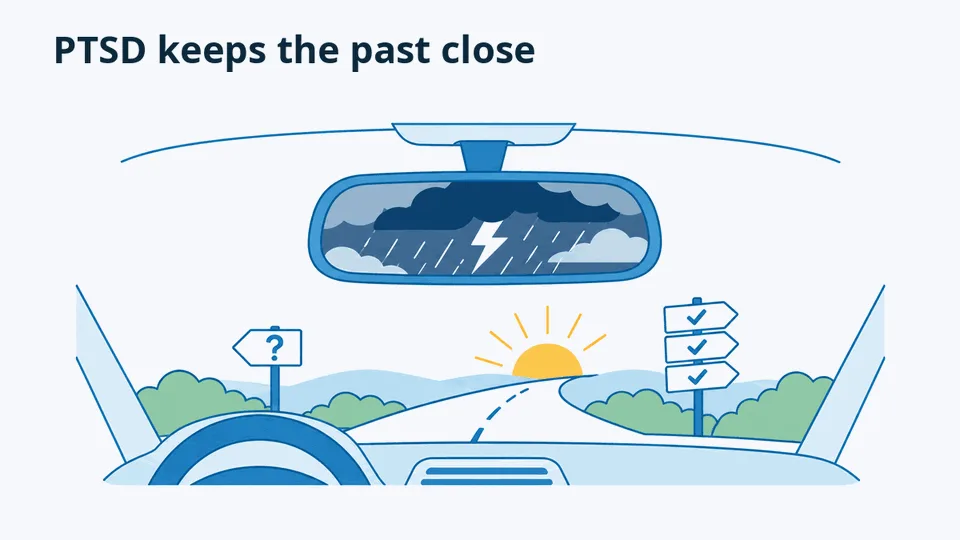
The National Institute of Mental Health notes that arousal symptoms are often constant rather than triggered by reminders. That steady sense of threat is exhausting, and it's one reason people with PTSD so often struggle with sleep, irritability and concentration at work or home.
Types of PTSD
There's one main PTSD diagnosis, but clinicians recognize a few forms and related patterns. Knowing the types of PTSD can help you put words to your own experience and understand why treatment plans differ. These are the forms you're most likely to hear about.
| Type | What Sets It Apart |
|---|---|
| PTSD | The standard diagnosis, with symptoms in all four groups lasting more than a month |
| PTSD with delayed onset | Symptoms that appear months or even years after the trauma |
| Complex PTSD | Follows long-term, repeated trauma and adds problems with emotions, self-worth and relationships |
| Dissociative subtype | PTSD plus feeling detached from your body or feeling that the world isn't real |
| PTSD with co-occurring conditions | PTSD alongside depression, anxiety or a substance use disorder |
Complex PTSD deserves a closer look. The American Psychological Association explains that complex PTSD is included in the World Health Organization's ICD-11 but not in the DSM-5.3 It usually follows prolonged trauma, often in childhood. Along with the core PTSD symptoms, it brings difficulty regulating emotions, struggles in relationships and a negative sense of self.
The dissociative subtype is part of the DSM-5. The MSD Manual describes it as PTSD with persistent or recurrent depersonalization, a feeling of detachment from your own mind or body, or derealization, a sense that your surroundings aren't real.4 The manual adds that complex trauma early in life raises the chance of this subtype.
PTSD in Children and Teens
PTSD can look different in young people. The National Institute of Mental Health notes that children under 6 may wet the bed after being toilet trained, lose the ability to talk, act out the event during play or cling to a parent.1 These signs can be easy to mistake for ordinary setbacks.
Older children and teens tend to show symptoms closer to adults'. They may also become disruptive or destructive, feel guilty for not preventing harm or have thoughts of revenge. Many adults with PTSD trace their symptoms back to trauma in childhood that was never addressed, which our chapter on signs of unresolved trauma explores.
How PTSD Is Diagnosed
A mental health professional such as a psychiatrist, psychologist or licensed therapist diagnoses PTSD through a careful interview. The National Institute of Mental Health explains that symptoms must last more than one month, be severe enough to interfere with daily life and not be caused by medication, substance use or another illness.1 For an adult, a diagnosis requires all of the following:
- At least one re-experiencing symptom.
- At least one avoidance symptom.
- At least two arousal and reactivity symptoms.
- At least two cognition and mood symptoms.
Having some symptoms in the first weeks after a trauma is normal and doesn't mean you have PTSD. If symptoms last past a month or keep getting in the way of your life, it's worth getting assessed. You don't need a formal diagnosis to start getting help.
PTSD and Other Conditions
PTSD rarely travels alone. Depression, anxiety and substance use disorders are common companions, and they can make PTSD harder to recognize and treat. NIDA's research report notes that people with PTSD may use substances in an attempt to reduce their anxiety.5
The overlap is especially clear among veterans. NIDA reports that about 1 in 5 veterans with PTSD also has a substance use disorder. The National Institute of Mental Health also lists a personal or family history of substance use among the risk factors for PTSD.1
When PTSD and addiction occur together, treating both at the same time matters. Our guide to co-occurring disorders explains why, and our chapter on PTSD and addiction covers that link in depth.
How PTSD Affects Daily Life
PTSD touches almost every part of life. Sleep suffers, so energy and patience run low. Constant alertness makes it hard to focus at work. Avoidance can shrink your world, as you skip events, routes or conversations that might bring back memories.
Relationships often take the hardest hit. Irritability, emotional numbness and pulling away can confuse the people closest to you, who may not know what's going on. Many people with PTSD say they feel cut off even when surrounded by family. Our chapter on how stress affects daily life describes how long-term stress wears on the body and mind.
Treatment for PTSD
PTSD responds well to treatment, and the best options are well studied. The 2023 VA/DoD clinical practice guideline recommends three trauma-focused talk therapies for PTSD.6 They are cognitive processing therapy, eye movement desensitization and reprocessing, and prolonged exposure. The American Psychological Association's PTSD guideline strongly recommends cognitive behavioral therapy, cognitive processing therapy and prolonged exposure.7 Here's what the main options involve:
- Cognitive processing therapy helps you challenge and change unhelpful beliefs about the trauma, such as blaming yourself.
- Prolonged exposure helps you gradually approach memories, feelings and situations you've been avoiding, so they lose their power.
- Cognitive behavioral therapy targets the links between thoughts, feelings and actions that keep symptoms going.
- Eye movement desensitization and reprocessing pairs brief focus on a trauma memory with eye movements or other back-and-forth stimulation.
We don't offer EMDR at Promising Outlook. Instead, our clinicians use cognitive behavioral approaches, along with skills-based therapies that help with emotions and stress. Our guide to common types of therapy explains how these approaches work.
Medication can help too. The National Institute of Mental Health notes that the FDA has approved two SSRI antidepressants for PTSD, and that they can ease sadness, worry, anger and emotional numbness.1 The APA guideline names sertraline and paroxetine as the two approved medicines. Other medications may help with sleep problems and nightmares.
Two more points from the VA/DoD guideline are worth knowing. It recommends secure video to deliver treatment, and it advises that a co-occurring substance use disorder should not by itself keep someone from trauma-focused therapy. In other words, you don't have to be sober for years before working on trauma, and care by video is a recognized option.
What to Expect in Trauma Therapy
Many people put off trauma therapy because they fear being forced to relive the worst moment of their lives. Good trauma therapy doesn't work that way. You set the pace with your therapist, start by building skills to calm your body and only move toward hard memories when you're ready.
The first weeks usually focus on safety, trust and understanding how PTSD works. You'll learn to notice triggers and use grounding skills when anxiety spikes. Later, therapies like cognitive processing therapy help you look at what the trauma taught you to believe about yourself and the world, and test whether those beliefs still fit. Our online CBT follows this kind of structured, step-by-step approach.
It's normal to feel a little worse before you feel better, because you're facing things you've been avoiding. That discomfort is usually short-lived, and a good therapist will check in often and adjust. Many people find the relief on the other side is well worth the effort.
Coping With PTSD Day to Day
Therapy does the deep work, but daily coping skills help you get through the hard moments in between. These skills don't erase PTSD on their own. They lower the volume on symptoms so you can function and keep showing up for treatment. These are some of the most useful:
- Grounding, such as naming five things you can see, to pull your attention back to the present.
- Slow breathing, with longer exhales, to calm a racing heart.
- A steady sleep routine, even when nightmares make bedtime hard.
- Regular movement, which helps burn off stress hormones.
- Staying connected to at least one person you trust.
- Limiting alcohol and drugs, which can deepen symptoms over time.
Skills for handling intense emotions can help too. Dialectical behavior therapy teaches distress tolerance and emotion regulation, and our online DBT therapy uses those skills in group. For more everyday tools, our guide to stress management skills is a good place to start.
Does PTSD Go Away
For many people, yes, especially with treatment. The National Institute of Mental Health notes that therapy for PTSD typically lasts 6 to 12 weeks, though it can take longer.1 The National Center for PTSD notes that many people who have PTSD recover and no longer meet the criteria for it after treatment.2
Recovery doesn't always mean the memory stops hurting. It usually means the memory no longer runs your life. Nightmares fade, triggers lose their grip and you start doing the things you'd been avoiding. Some people still have hard days around anniversaries or under stress, and they learn to handle those days with skills and support.
Without treatment, PTSD can last for years. If you've been carrying trauma for a long time, it's not too late to start. Daily habits like regular movement help too, and our post on whether exercise helps mental health covers what the research says.
PTSD in Veterans
Military service exposes people to trauma that most civilians never face, from combat to military sexual trauma. Veterans also face a higher risk of PTSD occurring with a substance use disorder, as NIDA's numbers above show. Many veterans carry symptoms for years before getting help.
Veterans and service members have several paths to care, including through the VA and through Tricare. Promising Outlook is in network with Tricare. Our chapter on the VA intensive outpatient program explains how veterans can use community care and Tricare to get outpatient treatment.
How to Help Someone With PTSD
Loving someone with PTSD can be confusing and painful. They may seem distant, angry or on edge for reasons that aren't obvious. Remember that these are symptoms. They don't show how much the person cares about you. A few approaches tend to help:
- Learn about PTSD so you can recognize symptoms rather than take them personally.
- Let them share at their own pace, and don't press for details of the trauma.
- Help them build routines around sleep, meals and activity.
- Notice triggers together and plan ways to handle them.
- Encourage professional help, and offer to help find a program.
- Get support for yourself, through therapy or a group.
If they're drinking or using more to cope, say so gently and specifically. That pattern is common with PTSD, and it's a sign both problems need care. Try to describe what you've seen without blame, such as noticing they've been drinking every night since the anniversary of the event, and ask how you can help.
Give setbacks room. Progress in PTSD often comes in waves, with good weeks followed by hard ones, especially around anniversaries, holidays or new stress. Steady support over months matters more than saying exactly the right thing in any one conversation.
PTSD Treatment at Promising Outlook
Promising Outlook treats PTSD by live video for adults across California, as part of our virtual mental health treatment. Care includes group therapy, individual therapy, family therapy and medication management. When trauma comes with drinking or drug use, the same team treats both.
Groups meet Monday through Friday at 9:00 a.m., 12:00 p.m. and 5:00 p.m. Clients in our intensive outpatient program attend three days a week. Treatment length depends on your care plan. Before finishing, every client leaves with an aftercare plan and a relapse prevention plan. Not a pamphlet. A plan.
Call us and a real person will answer, day or night. If you're ready, you can often start the same day. You can also verify your insurance online. We're in network with Aetna, Blue Shield, Cigna, Health Net, Tricare and United.
Frequently Asked Questions
What is PTSD in simple terms?
PTSD is a condition where your mind and body keep reacting as if a past trauma is still happening. After a frightening event, you may relive it, avoid reminders, feel constantly on edge and see yourself or the world more negatively. Symptoms last more than a month and get in the way of daily life.
What causes PTSD?
It's caused by living through, witnessing or learning about a traumatic event, such as assault, abuse, combat, a serious accident or a disaster. Whether someone develops it depends on risk factors like earlier trauma and little support, and on protective factors like social support and coping skills.
What are the types of PTSD?
The main forms are standard PTSD, PTSD with delayed onset, complex PTSD and the dissociative subtype. Complex PTSD follows long-term, repeated trauma and adds problems with emotions, self-worth and relationships. The dissociative subtype adds feelings of detachment from yourself or your surroundings. PTSD also often occurs with depression or substance use.
What are the main symptoms of PTSD?
Symptoms fall into four groups. Re-experiencing includes flashbacks and nightmares, and avoidance means steering clear of reminders. Arousal includes being easily startled, tense or unable to sleep. Changes in mood and thinking include guilt, negative beliefs and losing interest in activities you used to enjoy.
How long does PTSD last?
It varies. Without treatment, PTSD can last for years. With trauma-focused therapy, which typically runs 6 to 12 weeks or longer, many people improve a great deal and some no longer meet the criteria for PTSD. Ongoing skills and support help people handle hard days afterward.
What is the best treatment for PTSD?
Trauma-focused talk therapies have the strongest support. Federal and APA guidelines recommend cognitive processing therapy, prolonged exposure and cognitive behavioral therapy, and the VA/DoD guideline also recommends EMDR. Two SSRI medicines are FDA-approved for PTSD and can help, often alongside therapy.
Can you have PTSD and addiction at the same time?
Yes, and it's common. People with PTSD may use alcohol or drugs to calm anxiety or block memories, and about 1 in 5 veterans with PTSD also has a substance use disorder. Treating both together works best, and federal guidelines say substance use shouldn't keep someone from trauma treatment.
Can PTSD be treated online?
Yes. The 2023 VA/DoD clinical practice guideline recommends secure video to deliver PTSD treatment. Many people find it easier to attend consistently from home, especially when travel, work or anxiety about leaving the house make in-person care hard to keep up.
Sources
- National Institute of Mental Health. Post-Traumatic Stress Disorder.
- U.S. Department of Veterans Affairs, National Center for PTSD. How Common Is PTSD in Adults?
- American Psychological Association, Monitor on Psychology. Complex PTSD. 2025.
- Spiegel D. Dissociative Subtype of Posttraumatic Stress Disorder. MSD Manual Professional Version, 2025.
- National Institute on Drug Abuse. Common Comorbidities with Substance Use Disorders Research Report. 2018.
- Defense Health Agency. Psychotherapy for Treatment of Posttraumatic Stress Disorder, summarizing the VA/DoD Clinical Practice Guideline for PTSD, 2023.
- American Psychological Association. Clinical Practice Guideline for the Treatment of PTSD: Treatments.
