


Mindfulness based relapse prevention, often called MBRP, is a group program that blends mindfulness meditation with classic relapse prevention skills. It teaches you to notice cravings, thoughts and feelings without reacting on autopilot. Instead of fighting an urge or giving in to it, you learn to watch it rise and fall, then choose what to do next.
This chapter is part of our guide to relapse prevention. Mindfulness skills also sit at the heart of dialectical behavior therapy, and our online DBT therapy teaches them in group for adults across California.
Key Takeaways
- MBRP combines mindfulness practice with cognitive behavioral relapse prevention.
- Urge surfing, a core skill, treats a craving like a wave that rises, peaks and falls.
- In a 2014 trial in JAMA Psychiatry, MBRP led to fewer days of drug use and less heavy drinking than standard relapse prevention at 12 months.
- A 2021 Cochrane review found mindfulness-based programs may slightly reduce days with substance use compared with other treatments.
- Mindfulness works best as one part of a full recovery plan, not on its own.
What Is Mindfulness Based Relapse Prevention
MBRP is an aftercare program built for people who have finished initial treatment for a substance use disorder. Researchers at the University of Washington describe it as group-based aftercare that combines practices from mindfulness-based programs with cognitive behavioral relapse prevention.1 The goal is to help you stay sober by changing how you relate to cravings and hard emotions.
In the original research program, MBRP ran as eight weekly groups of about two hours each. Each group included guided meditations of 20 to 30 minutes, skill practice and discussion. Themes included the automatic pilot of addiction, mindfulness in high-risk situations, balancing acceptance and action, self-care and compassion, and social support.
Between groups, participants practiced at home with audio-recorded meditations and tracked their daily cravings and mood. That steady daily practice is what turns mindfulness from an idea into a skill you can use when it counts.
How Mindfulness in Recovery Works
Much of addiction runs on autopilot. A trigger shows up, a craving follows and you act before you've had a chance to think. Mindfulness in recovery works by slowing that chain down, so there's a pause between the urge and the action.
In that pause, you can notice what's actually happening in your body and mind. You might see that the craving is a tight chest, a restless feeling in your hands and a thought that says you deserve a drink. Once you see those pieces clearly, they feel less like orders and more like passing experiences.
The Bowen trial authors suggest that mindfulness practices may help people tolerate discomfort from cravings and negative emotions, which are common causes of relapse.1 In other words, mindfulness doesn't make cravings disappear. It makes them easier to sit with until they pass.
What Is Urge Surfing
Urge surfing is one of the best-known mindfulness skills for recovery. It was developed by psychologist Alan Marlatt, a pioneer in addiction treatment, at the University of Washington as part of mindfulness based relapse prevention.2 The idea is to picture a craving as a wave and ride it out rather than fighting it or giving in.
The UC Irvine Susan Samueli Integrative Health Institute describes four stages of an urge. The table below shows them and what to do at each one.
| Stage | What Happens | What to Do |
|---|---|---|
| Trigger | A craving or urge appears | Notice it and name it: this is an urge |
| Rise | The craving grows stronger | Breathe and stay with the sensations without acting |
| Peak | The craving is at its most intense | Remind yourself that this is the top of the wave |
| Fall | The craving weakens and fades | Notice the relief and that you got through it |
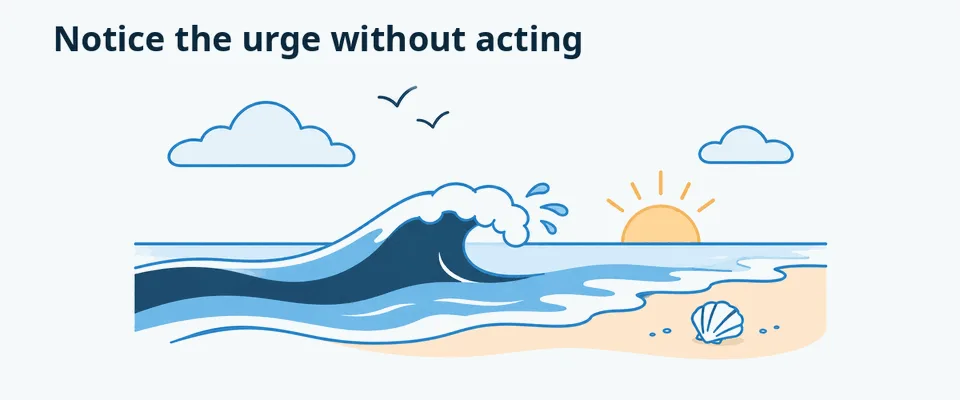
Many cravings feel like they'll keep building forever unless you act. With practice, you learn that they crest and fade on their own. Each time you ride one out, the next one feels a little less powerful.
How to Urge Surf Step by Step
You can practice urge surfing anywhere, and it gets easier with repetition. Start with small urges, like the urge to check your phone, so the skill is ready when a big craving hits. These steps are adapted from the UC Irvine guide:2
- Sit comfortably and let go of any tension you can.
- Notice the feelings and physical sensations of the urge, like tightness, restlessness or heat.
- Stay with the experience without acting on it.
- Picture the urge as a wave that rises, crests and falls.
- Use your breath like a surfboard to steady yourself.
- Get curious about what you really need, such as rest, connection or relief from stress.
- Respond to yourself with kindness rather than judgment.
- Notice that you rode the urge without acting, and that you can do it again.
If the feelings get overwhelming, return your attention to your breath for a few moments, then go back to the sensations. Some people set a timer for 15 or 20 minutes, which makes the wave feel easier to wait out.
What the Research Shows
The best-known study of MBRP was a randomized trial published in JAMA Psychiatry in 2014. Researchers assigned 286 people who had finished initial treatment to MBRP, standard cognitive behavioral relapse prevention or treatment as usual, which included 12-step programming and education.1 They followed participants for 12 months with self-reports and drug and alcohol testing.
At six months, both MBRP and standard relapse prevention lowered the risk of relapse to drug use and heavy drinking compared with treatment as usual. Standard relapse prevention delayed the first drug use a bit longer. At 12 months, though, MBRP participants reported significantly fewer days of substance use and less heavy drinking than either other group. The authors concluded that MBRP offered added long-term benefit.
The broader evidence is more modest. A 2021 Cochrane review of 40 randomized trials found that mindfulness-based programs may slightly reduce days with substance use compared with other treatments, though the evidence on other outcomes, including craving, was very uncertain.3 Few studies reported on adverse effects, so the review could draw limited conclusions about safety.
Put simply, mindfulness is a useful tool with real but modest effects. It seems to work best as part of a fuller plan that includes therapy, support and, when it fits, medication.
Mindfulness Skills You Can Start Today
You don't need a formal program to start building mindfulness skills. A few minutes a day adds up, especially if you practice when you're calm so the skills are ready when you're not. These simple practices are a good place to begin:
- Breath counting. Count ten slow breaths, then start over whenever your mind wanders.
- Body scan. Move your attention slowly from your feet to your head, noticing sensations without judging them.
- Noticing five things. Name five things you can see, four you can hear and three you can feel.
- Mindful pause. Before you react to a trigger, take three slow breaths and ask what you need.
- Daily check-in. Rate your craving and mood once a day to spot patterns early.
Mindfulness is also a strong stress-management tool, and stress is one of the most common relapse triggers. Our chapter on how to reduce stress pairs well with these practices.
Mindfulness and DBT
Dialectical behavior therapy, or DBT, treats mindfulness as its core skill. DBT teaches you to observe and describe what you're feeling, tolerate distress without making it worse and regulate strong emotions. Those same skills help with cravings, which often ride on intense feelings like anger, shame or panic.
Many people find DBT a natural next step after learning urge surfing. Our chapter on what dialectical behavior therapy is explains how it works and who it helps.
Where Mindfulness Fits in Your Recovery Plan
Mindfulness belongs in your relapse prevention plan as one of your go-to coping skills. Write down when you'll practice each day, which skill you'll use for cravings and who you'll call if a wave feels too big. It pairs well with other tools, like the HALT check and calling the people in your support system.
It also helps after a slip. Mindfulness teaches you to look at what happened with curiosity rather than shame, which makes it easier to learn from a setback and keep going. If you've recently used, our chapter on what to do after a relapse walks through the next steps. For the long view, see how to stay sober through each stage of recovery.
Mindfulness Skills at Promising Outlook
At Promising Outlook, mindfulness and DBT skills are part of group therapy in our virtual IOP for substance use. You practice urge surfing, grounding and distress tolerance with people working on the same things, then use them in daily life and bring back what happened.
Groups meet Monday through Friday at 9:00 a.m., 12:00 p.m. and 5:00 p.m., by live video for adults across California. Individual therapy is part of care too, and our online therapy in California includes several approaches beyond mindfulness. Every client leaves with an aftercare plan and a relapse prevention plan.
Call us and a real person will answer, day or night. Same-day starts are often possible. You can also verify your insurance online. We're in network with Aetna, Blue Shield, Cigna, Health Net, Tricare and United.
Frequently Asked Questions
What is mindfulness based relapse prevention?
Mindfulness based relapse prevention, or MBRP, is a group aftercare program that combines mindfulness meditation with cognitive behavioral relapse prevention. It teaches people in recovery to notice cravings and emotions without reacting on autopilot. In research, it ran as eight weekly two-hour groups with daily home practice.
What is urge surfing?
Urge surfing is a mindfulness skill developed by psychologist Alan Marlatt. You picture a craving as a wave that rises, peaks and falls, and you ride it out by noticing the sensations and breathing through them instead of acting. With practice, cravings feel less powerful and easier to wait out.
Does mindfulness help prevent relapse?
It can. In a 2014 JAMA Psychiatry trial, MBRP led to fewer days of drug use and less heavy drinking than standard relapse prevention at 12 months. A 2021 Cochrane review found mindfulness programs may slightly reduce days with substance use. Effects are modest, so mindfulness works best within a full plan.
How long does a craving last?
Cravings rise, peak and then fade, much like a wave. How long one lasts varies by person and situation, and the urge can ease on its own. Setting a timer for 15 or 20 minutes while you urge surf or do something else can make the wait feel manageable.
Is mindfulness the same as meditation?
Not exactly. Meditation is one way to practice mindfulness, usually by focusing on the breath for a set time. Mindfulness is the broader skill of paying attention to the present moment without judgment, which you can practice anywhere, including while walking, eating or riding out a craving.
Can I practice mindfulness in recovery on my own?
Yes. Simple practices like breath counting, body scans and urge surfing can be done anywhere for a few minutes a day. Many people find it easier to build the habit in a group or with a therapist, especially early in recovery, and then keep practicing on their own.
Sources
- Bowen S, et al. Relative Efficacy of Mindfulness-Based Relapse Prevention, Standard Relapse Prevention, and Treatment as Usual for Substance Use Disorders: A Randomized Clinical Trial. JAMA Psychiatry, 2014.
- UC Irvine Susan Samueli Integrative Health Institute. Urge Surfing in the New Year: Resolving to Ride the Waves of Change. 2024.
- Goldberg SB, et al. Mindfulness-Based Interventions for Substance Use Disorders. Cochrane Database of Systematic Reviews, 2021.
