


IOP stands for intensive outpatient program, a structured treatment for addiction or mental health that meets several days a week while you live at home. Adults in an IOP usually get at least nine hours of care each week, mostly group therapy, plus individual counseling and family involvement. It gives more support than weekly therapy without a hospital or residential stay.
This guide explains what IOP is, who it helps, what a week looks like, how it fits with other levels of care, and what the research says about whether it works. Throughout, we'll use real details from our own virtual IOP in California, which meets over live video five days a week.
Key Takeaways
- An intensive outpatient program is treatment several days a week while you keep living at home.
- Adult IOPs provide at least nine hours of care a week, built around group therapy.
- IOP fits people who need more than weekly therapy but don't need detox or round-the-clock care.
- A major research review rated the evidence for substance use IOPs as high and found outcomes comparable to inpatient care for people whose needs could be met in IOP.
- IOP treats addiction, mental health conditions, or both at the same time.
- Most health plans cover IOP when a clinician finds it medically necessary.
What Is IOP
IOP is a level of care that sits between weekly outpatient therapy and full-time treatment. You attend scheduled groups and therapy several days a week, then go home, to work or to school. The program gives you structure, a group and a treatment team, while you keep practicing new skills in the life you're trying to change.
The word "intensive" refers to the hours. SAMHSA describes intensive outpatient treatment for adults as a minimum of nine hours of care per week, built from individual counseling, group therapy, family education and case management.1 Many programs meet about three days a week for about three hours a day, though some meet more often.
The word "outpatient" means you don't stay overnight. That's the main difference from inpatient or residential treatment, where you live at the facility. For many people, being able to sleep in their own bed, see their kids and keep their job is what makes treatment possible at all.
What Is an Intensive Outpatient Program Used For
An intensive outpatient program is used to treat substance use disorders, mental health conditions, or both together. A review published in Psychiatric Services describes substance use IOPs as direct care for people who don't need medical detox or 24-hour supervision, offered as an alternative to inpatient and residential treatment.2
Mental health IOPs follow the same structure for conditions like depression, anxiety and trauma. UChicago Medicine notes that an IOP for mental health usually involves about 9 to 15 hours a week of group and individual therapy, along with medication management, education about the condition and coping skills.3 Many programs, including ours, treat both at once, because addiction and mental health conditions so often show up together.
Our guide to co-occurring disorders explains why treating both at the same time matters, since the two tend to feed each other when only one is addressed. If one condition is your main concern, our virtual IOP for substance use and our virtual IOP for mental health describe each track's focus.
Who an IOP Is For
An IOP is for adults who need more help than a weekly therapy visit but are safe and stable enough to live at home. It also fits people whose lives can't pause for a month away, such as parents, caregivers and people who need to keep working. TRICARE's description of who qualifies is a clear summary: people with a psychiatric or substance use disorder who don't need to be in a hospital full-time but need more care than regular outpatient visits offer.4
People come to IOP from many directions, and there's no single path in. These are some of the situations where people often start one:
- Weekly therapy hasn't been enough to stop drinking or drug use
- Depression or anxiety is getting worse even with regular therapy
- Someone is stepping down after residential care, a hospital stay or a partial hospitalization program
- A person has relapsed and wants structure again without leaving work or family
- A court, probation officer or employer has asked for treatment, and the person is safe at home
An IOP isn't the right first step for everyone. Someone who needs medical help to stop drinking or using certain drugs safely may need detox first, and someone in a mental health crisis or without a safe place to live may need a higher level of care. UChicago Medicine notes that IOP can serve as a step before inpatient care or a step down after it.3
What Is an IOP Program Like
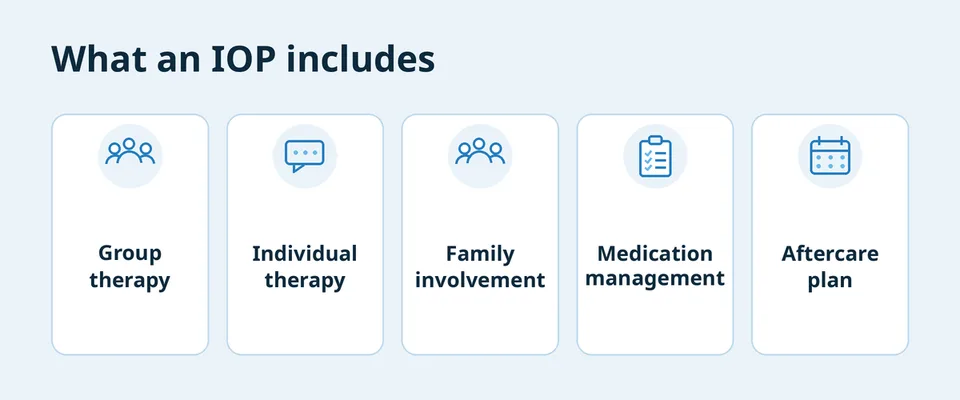
An IOP program is built around group therapy, with individual and family work woven in. Group is where most of the change happens: you hear from people dealing with the same things, practice being honest, and learn skills you can use that night. Individual time lets you work on what you don't want to share in group.
The table below shows the main parts of a typical IOP and what each one is for:
| Part of the Program | What It Is | Why It Matters |
|---|---|---|
| Group therapy | Several groups a week, led by a clinician | Skills, support and accountability from peers |
| Individual therapy | One-on-one time with a therapist or counselor | Private work on personal issues and goals |
| Family involvement | Family therapy or education, with consent | Helps the people at home understand and support recovery |
| Medication management | Visits with a prescriber when needed | Treats depression, anxiety, or opioid and alcohol use disorder |
| Case management and aftercare | Help with practical needs and next steps | A plan for staying well after the program ends |
Most IOPs use proven therapies inside those groups. Cognitive behavioral therapy (CBT) focuses on the thoughts behind your actions, dialectical behavior therapy (DBT) teaches skills for strong emotions and relationships, and motivational interviewing helps people find their own reasons to change. Our guide to the types of therapy explains each one.
What a Day in IOP Looks Like
A day in IOP follows a steady routine, and knowing it ahead of time takes some of the fear out of starting. Here's what a morning group looks like at Promising Outlook, in order. Other programs differ in the details, but the shape is common.
- Group starts at 9:00 a.m. on a Google Meet link, from your phone or computer, with about five minutes for people to join.
- Everyone checks in: how they're doing today and something they took from yesterday.
- If someone brought up something hard the day before, the group asks how it went.
- The first group topic runs 45 to 50 minutes, with room for clients to bring their own input.
- After a break and a second check-in, a second 45 to 50 minute group follows.
- After a final break, the group comes back for 15 to 20 minutes to close out and decide together what to talk about tomorrow.
That last step matters more than it sounds. When the group picks tomorrow's topic, it belongs to the people in it. Clients who come in quiet often end up being the ones who ask everyone how yesterday went.
What a Week in IOP Looks Like
A week in IOP usually means three or more program days, spread out so you have time to practice between groups. At Promising Outlook, IOP clients attend three days a week, and they can choose a morning group at 9:00 a.m., a midday group at 12:00 p.m., or one of two evening groups at 5:00 p.m.
Here's an example of how one person's week might look in an evening IOP. It's a sample to show the rhythm, not a fixed schedule, and the days between groups matter as much as the groups themselves. That's when you try the skill you talked about, notice what gets hard, and bring it back to the group.
| Day | Daytime | Evening |
|---|---|---|
| Monday | Work | IOP group at 5:00 p.m. |
| Tuesday | Work, individual therapy at lunch | Practice a skill from group |
| Wednesday | Work | IOP group at 5:00 p.m. |
| Thursday | Work | Recovery meeting or family time |
| Friday | Work | IOP group at 5:00 p.m. |
Evening groups are often what make IOP possible for people with jobs. Our chapter on evening IOP covers working while in treatment, what to tell an employer and how medical leave can help.
How IOP Fits Among Levels of Care
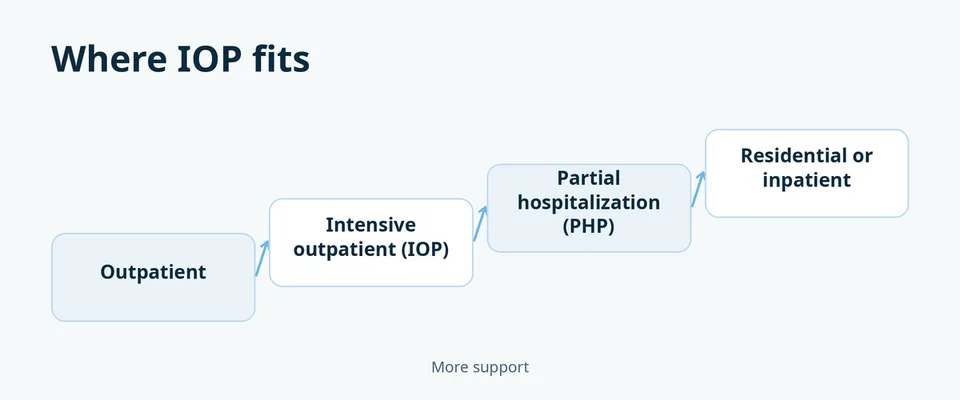
IOP is one level in a range of care that runs from weekly therapy to round-the-clock treatment. Many people move between levels over time: stepping up when they need more support and stepping down as they get stronger. SAMHSA notes that IOP works best as part of that kind of continuum.1
The levels don't compete with each other. Each one fits a different amount of need, and the right one can change over a few weeks. The table below compares the levels many people hear about:
| Level of Care | Where You Live | How Much Treatment | Who It Fits |
|---|---|---|---|
| Outpatient | At home | Usually one or two visits a week | Stable, early or step-down care |
| Intensive outpatient (IOP) | At home | At least nine hours a week | Needs more than weekly therapy, safe at home |
| Partial hospitalization (PHP) | At home | Most of the day, several days a week | Needs daily structure but not 24-hour care |
| Residential or inpatient | At the facility | Around the clock | Needs a safe setting and constant support |
The step just above IOP is a partial hospitalization program, which meets for more hours each week. Our chapter on PHP vs IOP compares the two side by side, and our virtual PHP programs page explains how we run that level.
The step below IOP is a standard outpatient program, where clients who are stable keep the structure and the group with fewer hours. For the bigger comparison between living at a facility and living at home, read our guide to inpatient vs outpatient rehab.
Does IOP Work
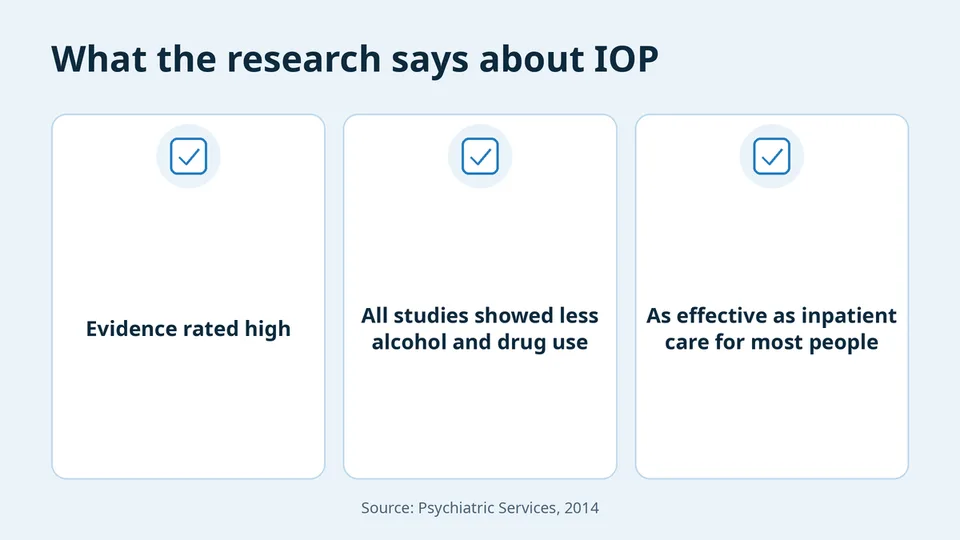
Yes, the research on IOP is strong. A review in Psychiatric Services examined randomized trials and real-world studies of substance use IOPs and rated the level of evidence as high.2 Every study it reviewed reported reductions in alcohol and drug use.
The same review found that studies comparing IOP with inpatient or residential care showed comparable outcomes. The authors concluded that IOPs are as effective as inpatient treatment for most people and recommended that public and commercial health plans cover them. SAMHSA similarly notes that, for people who are appropriately placed, IOP outcomes are comparable to residential care.1
The research also has limits. The review noted that programs define IOP in different ways and measure outcomes differently, which makes comparisons harder. And "most people" isn't everyone: someone with severe withdrawal risk or no safe place to live may need a higher level of care first.
What to Expect in Your First Week of IOP
The first week of IOP is mostly about getting comfortable and getting a plan. Many people feel nervous before their first group, and that's normal. You'll meet your counselor, finish any paperwork with someone's help, and join your first group, where you can listen more than you talk until you're ready.
Early on, your treatment team will work with you to set goals. Those goals might be about drinking or drug use, about mood, about family or work, or all of these. Our post on setting treatment goals shows how to put them into words so you can tell whether treatment is helping.
By the end of the first week, many people know the rhythm: which days they attend, who is in their group, and who to contact between groups. The first few days are usually the hardest. After that, the routine starts to do some of the work for you.
What Is Expected of You in an IOP
An IOP asks you to show up, be honest and take part. Attendance matters because the group builds on itself day to day, and people who miss groups miss the practice that makes skills stick. Most programs ask you to let them know ahead of time if you can't attend.
Programs also expect you to come to group sober. Welcome is not the same as anything goes, and showing up intoxicated isn't showing up. If you slip, the right move is to tell your counselor and talk about it, because a slip is information your team can use, not a reason to hide.
Beyond that, the main expectation is effort. You don't have to believe treatment will work, and you don't have to be here for yourself. Whatever got you here, whether that's your family, your job or a court date, is a good enough reason to do the work.
How Families Can Support Someone in IOP
Families can make a real difference during IOP, mostly by staying involved without taking over. Family therapy, with the client's signed consent, gives relatives a place to learn what the person is working on and how to respond when things get hard. NIDA notes that effective treatment addresses a person's whole life, not just their drug use.5
At home, small things help. Ask how group went, respect the schedule, and keep alcohol or drugs out of shared spaces when you can. If you're worried about something you see, say so calmly and bring it to a family session rather than handling it alone.
Why Staying Long Enough Matters
How long you stay in treatment is one of the clearest predictors of how well it works. The National Institute on Drug Abuse says remaining in treatment for an adequate period is critical, and that most people with addiction need at least three months to significantly reduce or stop their drug use.5 NIDA also notes that treatment doesn't need to be voluntary to work.
In SAMHSA's historical analysis of adults who completed substance use IOP in 2017, the median stay was 81 days.1 Promising Outlook describes its IOP as a 9- to 12-week program. Your treatment team can recommend a timeline based on your needs. Our chapter on how long IOP is explains what decides the length and what happens when a program ends.
IOP by Video and How It Compares
Many IOPs now meet over live video, so you can join group from home. The structure is the same: scheduled groups, a clinician leading them, individual and family therapy, and a plan for after. What changes is the drive, the parking lot and, for many people, how often they actually show up. For someone in a rural county or without a car, that difference can decide whether treatment happens at all.
Virtual care isn't the right fit for everyone. People who need medical monitoring, don't have a private place to talk, or do better with in-person contact may want a different setting. Our chapter on whether online therapy is effective walks through the research and who it suits.
How Insurance Covers IOP
Most health plans cover IOP when a clinician finds it medically necessary. Federal law requires Marketplace plans to cover substance use disorder treatment and mental health treatment such as psychotherapy and counseling.6 Many plans ask for approval before IOP starts, and the program usually handles that request.
Our chapter on whether insurance covers IOP explains approvals, medical necessity and what to do if a plan says no. A real person can also verify your insurance and explain your costs before you start.
How to Start an IOP
Starting an IOP is usually faster and simpler than people expect. Most programs can assess you within a day or two, and some can start you the same day. These are the usual steps:
- Call the program and talk with a real person about what's going on.
- Have your insurance checked so you know what's covered and what you'll pay.
- Complete an assessment so the team can confirm IOP is the right level of care.
- Pick a group time that fits your life.
- Join your first group and meet your counselor and therapist.
If you're helping someone else get started, you can make the first call for them and sit with them during intake. Many people come to treatment for someone else, such as a parent, a spouse, their kids or a probation officer, and that's a good enough reason to begin.
How IOP Works at Promising Outlook
Promising Outlook is a Joint Commission accredited virtual addiction and mental health program based in Riverside, serving adults 18 and older across California. Our IOP is our core program. Clients join groups over live video Monday through Friday, choosing the morning group at 9:00 a.m., the midday group at 12:00 p.m. or one of two evening groups at 5:00 p.m., and attend three days a week.
Individual therapy with a therapist and one-on-one counseling with a counselor are available every week. Family therapy is open once you've signed a release, and our prescriber manages medication for depression, anxiety and mood symptoms. Ask the team about Suboxone for opioid use disorder or Vivitrol for alcohol use disorder or relapse prevention after opioid detoxification. Before you leave, you'll have an aftercare plan and a relapse prevention plan. Not a pamphlet. A plan.
We also treat people as people. You'll have the contact information for your program director, counselors and therapists from day one, and they stay in touch between groups. Our clinicians are paid above market so they can keep their full attention on the group, and when covered treatment days run out in the middle of a month, we let clients finish the month.
If you think IOP might be what you or someone you love needs, call us. A real person will answer, day or night, and if you're ready, you can start today. We're in network with Aetna, Blue Shield, Cigna, Health Net, Tricare and United. You can also learn more about our virtual IOP or check your coverage with our team.
Frequently Asked Questions
What is IOP?
IOP stands for intensive outpatient program. It's a structured treatment for addiction or mental health that meets several days a week while you live at home. Adults usually get at least nine hours of care a week, mostly group therapy, plus individual counseling, family involvement and a plan for aftercare.
What is an IOP program like?
An IOP is built around group therapy led by a clinician, usually three or more days a week. You check in with the group, work on a topic or skill, and practice it between groups. Individual therapy, family therapy and medication management are often part of the program too.
What is the difference between IOP and outpatient?
Standard outpatient care usually means one or two therapy visits a week. IOP is more structured, with at least nine hours of care a week for adults, built around group therapy. People often step down from IOP to standard outpatient care as they get stronger.
Can I work while in IOP?
Yes. Many people keep working during IOP, especially when a program offers evening groups. You attend group a few days a week and go to work as usual. Some people also use medical leave for part of treatment, depending on their job and their needs.
How many hours a week is IOP?
For adults, IOP provides at least nine hours of care each week. Many programs meet about three days a week for around three hours a day, while others meet more often. The exact schedule depends on the program and on what your treatment team recommends.
Does IOP work?
Research says yes. A major review rated the evidence for substance use IOPs as high, found that all studies reported reduced alcohol and drug use, and concluded that IOP is as effective as inpatient treatment for most people. Results depend on staying in treatment long enough.
Is IOP covered by insurance?
Most health plans cover IOP when a clinician finds it medically necessary. Many plans require approval before you start, which the program usually requests for you. Your costs depend on your deductible, copay or coinsurance and whether the program is in network with your plan.
Is IOP the same as rehab?
IOP is one kind of rehab. People often use "rehab" to mean living at a treatment center, but rehab covers every level of care, from weekly outpatient therapy to residential programs. IOP is the outpatient version with more structure: several days of groups and therapy each week while you live at home.
Who is IOP not right for?
IOP may not be the right first step for someone who needs medical detox, is in a mental health crisis, or doesn't have a safe, stable place to live. Those people may need a higher level of care first and can step down to IOP later.
Sources
- Substance Abuse and Mental Health Services Administration. Clinical Issues in Intensive Outpatient Treatment for Substance Use Disorders. Advisory, 2021.
- McCarty D, et al. Substance Abuse Intensive Outpatient Programs: Assessing the Evidence. Psychiatric Services, 2014.
- UChicago Medicine. Should I consider an intensive mental health outpatient program if traditional therapy isn't working?
- TRICARE. Intensive Outpatient Program. 2026.
- National Institute on Drug Abuse. Principles of Drug Addiction Treatment: A Research-Based Guide (Third Edition). 2018.
- HealthCare.gov. Mental health and substance abuse health coverage options.
