


Anger management skills are practical tools that help you notice anger early, calm your body, think more clearly and respond in ways you won't regret. They include relaxation techniques, changing angry thinking, solving the problem behind the anger and communicating assertively instead of aggressively. Anger itself is normal. The goal is to keep it from running your life or hurting the people around you.
These skills can be learned at any age, and research suggests psychological treatments can reduce anger problems. If anger is causing trouble at home, at work or with the law, our online anger management classes teach them in a structured way, by live video for adults across California.
This guide explains what anger is, what anger management involves, the core anger management strategies, how anger connects to stress and substance use, and what the research says about whether it works. Two chapters go deeper: how to manage anger day to day, and a self-check for whether you have anger issues.
Key Takeaways
- Anger is a normal emotion that ranges from mild irritation to intense rage.
- Anger management teaches you to calm your body, change angry thinking and express anger assertively rather than aggressively.
- The American Psychological Association says venting anger intensely tends to increase anger and aggression rather than relieve it.
- A review of 96 studies found psychological treatments for anger are generally effective, with moderate improvements.
- The APA notes that with counseling, a highly angry person can move toward a more typical range in about 8 to 10 weeks.
- Anger is linked to stress, trauma, depression and substance use, and treating those helps anger too.
What Is Anger
The American Psychological Association, quoting psychologist Charles Spielberger, describes anger as an emotional state that varies in intensity from mild irritation to intense fury and rage.1 Like other emotions, it comes with physical changes. The APA notes that anger raises heart rate and blood pressure and increases stress hormones like adrenaline.
Anger can be triggered by outside events, like a rude driver or an unfair boss, or by inner ones, like brooding over problems or memories of past hurts. It often sits on top of other feelings. Hurt, fear, shame and helplessness can all show up as anger because anger feels more powerful than those softer emotions.
Anger isn't bad in itself. It can signal that something is wrong and motivate you to fix it. The problem is when it comes too often, too strongly or in ways that damage your health, relationships or freedom.
What Is Anger Management
Anger management is a set of skills and, often, a structured program that helps people handle anger in healthier ways. It doesn't try to make you never feel angry. Instead, it teaches you to recognize anger early, lower the physical arousal that comes with it and choose how to respond.
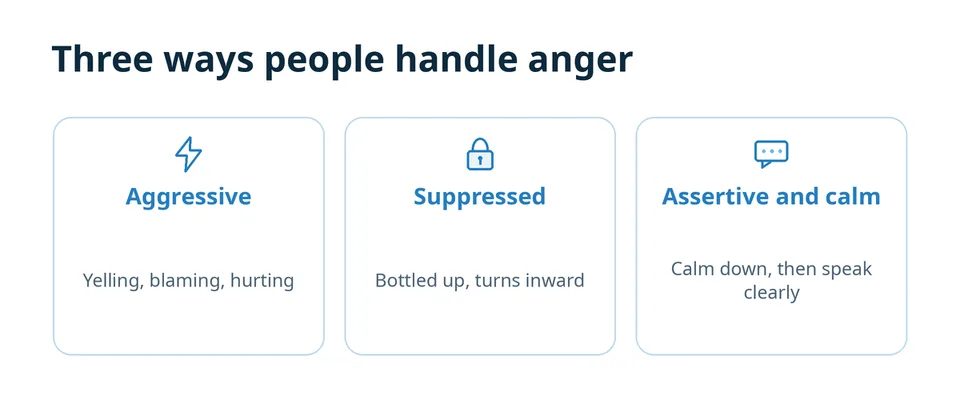
The APA describes three main ways people deal with angry feelings: expressing, suppressing and calming.1 It says expressing anger in an assertive, not aggressive, way is the healthiest approach, and notes that bottled-up anger can turn inward and may contribute to high blood pressure or depression. Anger management helps you find that assertive middle ground.
Programs can take several forms. Some people learn on their own with books or apps. Others work one on one with a therapist or join a group, sometimes because a court or employer requires it. Most programs are built on cognitive behavioral therapy.
How Anger Affects Your Health
Frequent, intense anger takes a toll on the body. The APA notes that research links anger and hostility to a higher chance of developing coronary heart disease, and to worse outcomes for people who already have heart disease.2 It adds that anger can bring stress-related problems including insomnia, digestive problems and headaches.
Part of the reason is the physical response. Each time you get angry, your heart rate, blood pressure and stress hormones rise.1 Once in a while, that's fine. Several times a day for years, it adds up, much like chronic stress. Learning to calm your body quickly is good for your heart as well as your relationships.
Suppressed anger isn't harmless either. The APA notes that anger turned inward may contribute to high blood pressure or depression. That's why anger management focuses on healthy expression, not just holding it in.
The Myth of Letting It Out
Many people believe it's healthy to let anger out by yelling, punching a pillow or venting. The research says otherwise. The APA calls this a dangerous myth and explains that letting it rip actually escalates anger and aggression and does nothing to resolve the situation.1
That doesn't mean you should bottle anger up either. The healthier path is to calm your body first, then address the problem directly and respectfully. That's the core of what anger management teaches.
Why Some People Get Angrier Than Others
Some people really do get angry more easily than others. The APA notes that some people are more hotheaded, while others are chronically irritable and grumpy.1 Several factors play a role:
- Genetics or physiology that makes some people more reactive from birth.
- Cultural messages that anger is wrong to express, so it builds up instead.
- Family backgrounds that were chaotic or not skilled at handling emotions.
Other factors make anger worse too. Long-term stress, poor sleep, chronic pain, trauma, depression and substance use can all lower your fuse. Our guide to stress management skills covers how stress and anger feed each other.
The Core Anger Management Skills
Most anger management programs teach a similar set of skills. The APA outlines several anger management strategies that help people stay in control.1 The table below summarizes them with examples.
| Skill | What It Does | Example |
|---|---|---|
| Relaxation | Calms the body's anger response | Slow breathing from the belly, repeating "take it easy" |
| Cognitive restructuring | Changes exaggerated, angry thinking | Replacing "this always happens" with "this is frustrating, and I can handle it" |
| Problem solving | Addresses the real issue behind the anger | Making a plan to deal with a recurring conflict |
| Better communication | Prevents conflicts from escalating | Slowing down, listening and responding instead of reacting |
| Humor | Takes the edge off rage | Picturing an insult literally to see how silly it is, without sarcasm |
| Changing the environment | Reduces exposure to triggers | Taking personal time, changing a stressful commute |
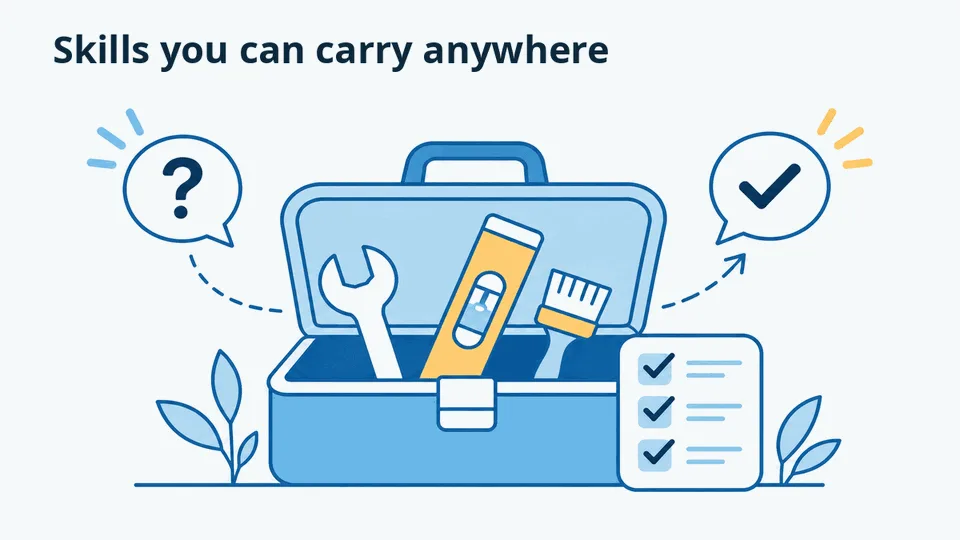
No single skill works for every person or situation. Many people do best with two or three they practice regularly, so they become automatic when anger flares.
Relaxation Skills for Anger
Relaxation is often the first skill people learn, because it's hard to think clearly when your body is flooded with anger. The APA recommends simple tools like deep breathing from the diaphragm, slowly repeating a calming word or phrase, relaxing imagery and gentle, slow movement like yoga.1
The key is practice. The APA advises practicing these techniques daily so you can use them automatically in a tense moment. Trying slow breathing for the first time in the middle of a fight rarely works. Practicing it every morning for a few weeks makes it available when you need it.
Changing Angry Thinking
Angry thinking tends to be exaggerated and absolute. The APA recommends replacing exaggerated, unhelpful thoughts with more reasonable ones, a technique called cognitive restructuring.1 Words like "never" and "always" are red flags, because they make anger feel justified and the problem feel unsolvable.
Cognitive restructuring is the skill of catching those thoughts and reshaping them. "He always disrespects me" might become "He interrupted me twice today, and I want to talk with him about it." The APA also suggests turning demands into desires, like shifting "I must get this" to "I would like this." Our chapter on what cognitive behavioral therapy is explains this approach in depth.
Problem Solving and Communication
Sometimes anger points to a real problem that needs solving. The APA suggests making a plan and checking your progress, and focusing on how you handle the problem rather than only on solving it.1 Some problems don't have quick fixes, and approaching them with your best effort is often enough to cool anger down.
Communication is just as important. The APA advises slowing down in heated discussions, thinking before you speak and listening to what's underneath the other person's words. Using "I" statements, like "I feel overlooked when plans change without notice," keeps conversations from turning into attacks. Taking a timeout before responding gives everyone a chance to cool off.
Getting Active and Avoiding Triggers
Two simple anger management strategies are often overlooked: moving your body and steering around known triggers. The APA notes that regular exercise can help you decompress and release tension.2 A brisk walk after a frustrating day can drain off the physical charge before it turns into an argument. Our post on whether exercise helps mental health explains more.
The APA also suggests identifying the things that reliably make you angry and adjusting your schedule or surroundings to reduce exposure. When rush-hour traffic sets you off, try leaving earlier or taking a different route. When conversations about money always turn into fights, plan them for a calm time rather than late at night. Letting go of past incidents helps too, since the APA cautions against dwelling on things that have already been resolved.
Distress Tolerance and Emotion Skills
Some people experience anger as a sudden, overwhelming wave that's hard to control with logic alone. For them, skills from dialectical behavior therapy can help. DBT teaches distress tolerance, which means getting through an intense moment without making it worse, and emotion regulation, which lowers how often and how strongly anger shows up.
These skills are especially useful when anger is tied to trauma, mood swings or impulsive behavior. Our chapter on what dialectical behavior therapy is explains how DBT works and who it helps.
Does Anger Management Work
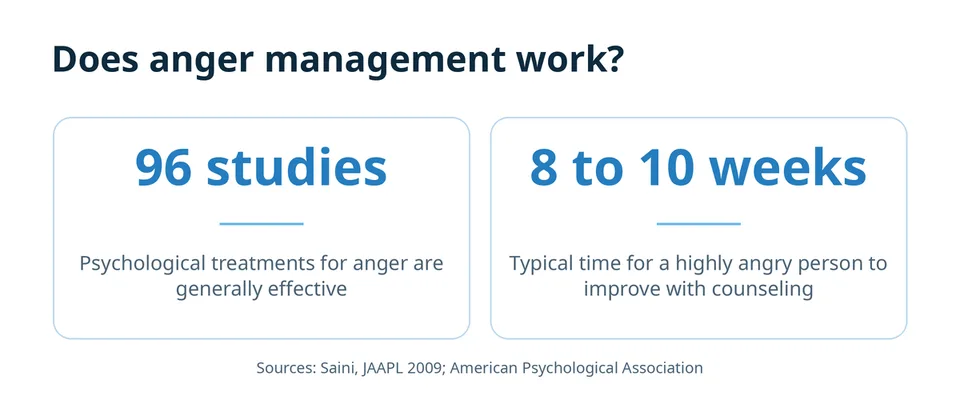
Research suggests that anger management can help. A meta-analysis published in the Journal of the American Academy of Psychiatry and the Law reviewed 96 studies with 139 treatment effects across nine types of psychological treatment for anger.3 It concluded that psychological treatments are generally effective for anger and described them as moderately successful at reducing anger problems. It also found considerable variation between specific treatments.
Anger management can also change behavior. The U.S. Department of Justice's CrimeSolutions review rates cognitive behavioral anger management for adult men as promising, citing a meta-analysis that found lower rates of violent and general reconviction among men who completed treatment.4 The APA adds that with counseling, a highly angry person can move closer to a middle range of anger in about 8 to 10 weeks, depending on the circumstances and techniques used.1
Results depend on effort and fit. People who practice skills between groups, and whose programs teach control rather than just venting, tend to do best. The APA recommends asking any therapist about their approach to make sure it focuses on control.
Anger With Stress and Substance Use
Anger rarely shows up alone. The APA notes that anger can contribute to risky behaviors, including drug and alcohol use.2 Alcohol lowers inhibitions and makes it easier for anger to turn into aggression, and withdrawal and cravings can make people more irritable.
Stress is another common partner. Chronic stress shortens your fuse, and anger adds more stress, creating a cycle. For people in recovery, anger is also a common relapse trigger, which is why our guide to relapse prevention treats it as a risk factor to plan for.
When anger comes with depression, anxiety, trauma or substance use, treating those conditions helps anger too. Working with a therapist through online therapy in California can help untangle what's driving the anger.
When Anger Causes Harm
Sometimes anger crosses into behavior that hurts other people, like threats, intimidation or violence in a relationship. That's a serious situation, and it deserves specialized help. Programs designed for this work support people who have caused harm to take responsibility and change their behavior, while also keeping the safety of people who have been harmed at the center.
For anyone in that situation, our domestic violence classes online offer structured, accountable care. If you are the person being harmed, your safety comes first, and reaching out to a trusted person or a local domestic violence program is a good first step.
Anger in Relationships and Families
Anger often does the most damage at home. The people closest to us see us at our most tired and stressed, and old conflicts can flare with little warning. Over time, frequent anger erodes trust and leaves partners and children walking on eggshells.
Repairing those relationships takes more than promising to do better. It usually means learning new ways to communicate, taking timeouts before conversations escalate and making real amends after a blowup. Children especially benefit when a parent names what happened, takes responsibility and shows what calming down looks like.
Family therapy can make this work easier. It gives everyone a safe place to talk, helps family members understand what's driving the anger and builds new patterns together. Our online family therapy brings this work into the home by live video.
Anger at Work
Work is another common setting for anger, from tight deadlines and unfair treatment to difficult coworkers and customers. An angry outburst at work can cost a job, a promotion or a professional reputation that took years to build.
The same skills apply, with a few adjustments. Notice your early warning signs and step away for a few minutes before responding to an email or a meeting comment. Write down what's bothering you and decide what you actually want to happen. Then raise the issue calmly with the right person at a good time. If work stress is constant, it may help to look at the bigger picture of your workload and boundaries.
Anger and Trauma
For many people, intense or sudden anger has roots in past trauma. Irritability and angry outbursts are among the arousal symptoms of PTSD, and unresolved hurts from childhood can make some situations feel far more threatening than they are. In those cases, anger is often a form of self-protection.
Treating the trauma underneath can bring anger down in a way that skills alone can't. Our chapter on unresolved trauma explains the signs and first steps toward healing.
Court-Ordered Anger Management
Some people start anger management because a court, employer or probation officer requires it. That can feel frustrating, but many people find the skills useful once they begin. Approaching the program with curiosity rather than resentment tends to lead to better results.
If your program is required, check the specific requirements before you enroll, such as the number of hours, whether online attendance is accepted and what proof of completion is needed. Ask the program for written confirmation that it meets those requirements. Keep copies of attendance records and completion certificates. Even when a program is required, the skills you learn belong to you and can help long after the requirement is met.
How to Help Someone With Anger Problems
If someone you love has an anger problem, start by protecting your own safety. Anger that includes threats, intimidation or violence is not something to manage alone, and reaching out for outside help is the right step.
When safety isn't at risk, choose a calm moment to talk. Describe specific situations and how they affected you, rather than labeling the person. Suggest getting help together, such as couples or family therapy, and set clear limits on what you will and won't accept. Taking care of yourself through support or therapy matters too.
Practicing Anger Management Skills Every Day
Anger management skills work best when they become part of your daily routine, not just something you reach for in a crisis. A few minutes of practice each day builds the habits that kick in automatically when anger flares. Many people find a simple routine like this helpful:
- Spend three to five minutes on slow belly breathing each morning.
- Keep a short anger log, noting what happened, how angry you felt from 1 to 10 and how you responded.
- Check in with your body at midday for early signs like a tight jaw or clenched hands.
- Get some physical activity, even a short walk.
- Review your log at night and pick one moment you'd like to handle differently next time.
After a few weeks, patterns usually show up. You may notice that anger spikes when you're hungry, tired or running late, or around certain people. Those patterns tell you where to focus your plan. They also give you something concrete to bring to a therapist or group, which makes the work faster and more personal. Small wins count, so notice the moments when you paused, breathed or walked away instead of exploding.
Building an Anger Management Plan
A written plan helps you use your skills when anger flares. Build it when you're calm, so it's ready when you're not. These steps will help:
- List your common anger triggers, including people, places, times and situations.
- Write down your early warning signs, like a hot face, clenched jaw or racing thoughts.
- Pick one calming skill to use the moment you notice those signs.
- Decide on a timeout plan, including what you'll say and where you'll go.
- Write a few balanced thoughts to replace your most common angry ones.
- Plan how you'll come back and address the problem once you're calm.
- Name one or two people you can talk to after a hard moment.
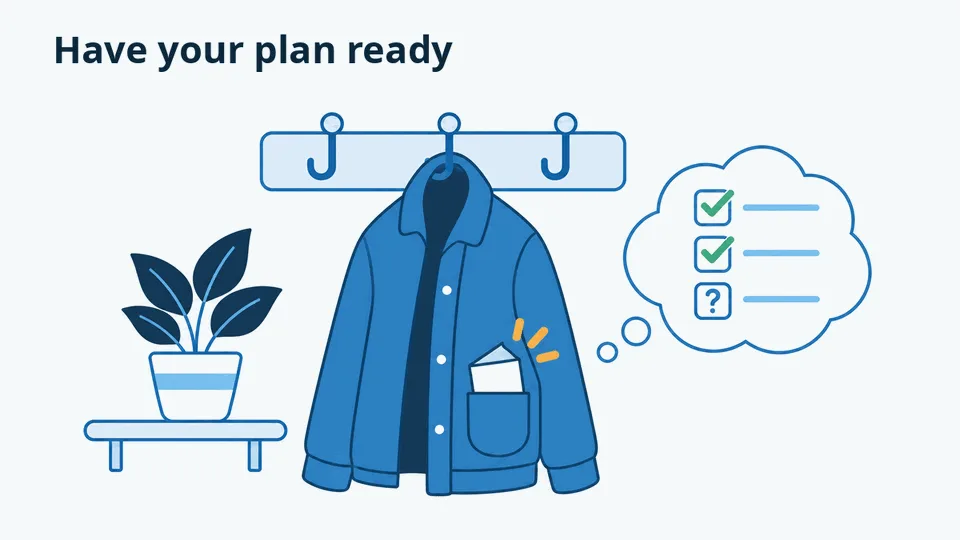
Review the plan after each flare-up. Notice what worked, what didn't and what you'd do differently. Over time, those small adjustments add up to real change.
Anger Management at Promising Outlook
Promising Outlook offers anger management by live video for adults across California, along with individual therapy, family therapy and treatment for the depression, anxiety, trauma or substance use that often comes with anger. Groups meet Monday through Friday at 9:00 a.m., 12:00 p.m. and 5:00 p.m., including evening options for people who work.
Our clinicians teach skills based on cognitive behavioral therapy and dialectical behavior therapy, and clients practice them in group before using them at home and work. We're accredited by The Joint Commission, and every client leaves with an aftercare plan.
Call us and a real person will answer, day or night. Same-day starts are often possible. You can also verify your insurance online. We're in network with Aetna, Blue Shield, Cigna, Health Net, Tricare and United.
Frequently Asked Questions
What is anger management?
Anger management is a set of skills, often taught in a structured program, that helps people handle anger in healthier ways. It teaches you to notice anger early, calm your body, change angry thinking, solve the problem behind the anger and express yourself assertively instead of aggressively.
What are the main anger management skills?
Core skills include relaxation, like slow breathing and calming phrases; cognitive restructuring, which changes exaggerated angry thinking; problem solving; better communication, including listening and using "I" statements; humor without sarcasm; and changing your environment to reduce triggers. Many people practice two or three regularly.
Does anger management work?
Yes, it can help. A review of 96 studies found psychological treatments for anger are generally effective, with moderate improvements. The APA notes a highly angry person can move toward a more typical range in about 8 to 10 weeks of counseling. Results are best with regular practice.
Is it healthy to let anger out?
Not in the way many people think. The APA says letting it rip by yelling or venting escalates anger and aggression rather than relieving it. The healthier approach is to calm your body first, then address the problem assertively and respectfully once you can think clearly.
How long does anger management take?
It varies. The APA notes that with counseling, a highly angry person can move closer to a middle range of anger in about 8 to 10 weeks, depending on the person and the techniques used. Many programs run for several weeks, with practice between groups.
Can anger management help with alcohol or drug use?
It can be part of the picture. Anger can contribute to drinking and drug use, and substances can make anger and aggression worse. Treating anger, stress and substance use together, along with any depression or trauma underneath, gives the best chance of lasting change.
Is anger a mental illness?
No. Anger is a normal emotion. But frequent, intense or out-of-control anger can be a sign of something else, like depression, anxiety, trauma, a mood disorder or substance use. If anger is causing problems in your life, a mental health professional can help figure out what's driving it.
Can I do anger management online?
Yes. Many programs, including court-ordered ones in some cases, are offered online by live video. Online groups teach the same skills and let you practice with others. Check with your court or employer if your program needs to meet specific requirements.
Sources
- American Psychological Association. Control Anger Before It Controls You. 2023.
- American Psychological Association. Strategies for Controlling Your Anger: Keeping Anger in Check.
- Saini M. A Meta-analysis of the Psychological Treatment of Anger: Developing Guidelines for Evidence-Based Practice. Journal of the American Academy of Psychiatry and the Law, 2009.
- U.S. Department of Justice, National Institute of Justice, CrimeSolutions. Cognitive Behavioral Therapy-Based Anger Management for Adult Males.
