


Your support system is the group of people you can count on to encourage you, tell you the truth and help when recovery gets hard. It usually includes some mix of family, friends, a therapist, a recovery group and a sponsor or mentor. You don't need a big one to start. You need a few people who know what you're working on and will notice if you start to slip.
This chapter is part of our guide to relapse prevention. Family is often the first place people look for support, and online family therapy can help rebuild trust and teach everyone at home how to help.
Key Takeaways
- A support system is the people who encourage, guide and hold you accountable in recovery.
- SAMHSA lists community, meaning relationships that offer support, friendship, love and hope, as one of four dimensions of recovery.
- Strong support systems include at least one group that will notice if you're not there.
- You can build a support system from scratch, one person and one group at a time.
- Family support matters, and family members need support of their own too.
What Is a Support System
It's a network of people who help you stay well. In recovery, that means people who understand what you're working toward, want good things for you and are willing to show up when it counts. Some offer practical help, some offer emotional support and some offer accountability.
Support matters because addiction thrives in isolation. Secrets, loneliness and shame make it easier to slide back toward old habits. SAMHSA's working definition of recovery lists community as one of four dimensions that support a life in recovery, describing it as relationships and social networks that provide support, friendship, love and hope.1
The NIAAA makes a similar point about alcohol, noting that the support of friends and family is important in recovery from alcohol use disorder.2 Those people won't do the work for you, but they make the work far more possible.
Who Belongs in a Support System
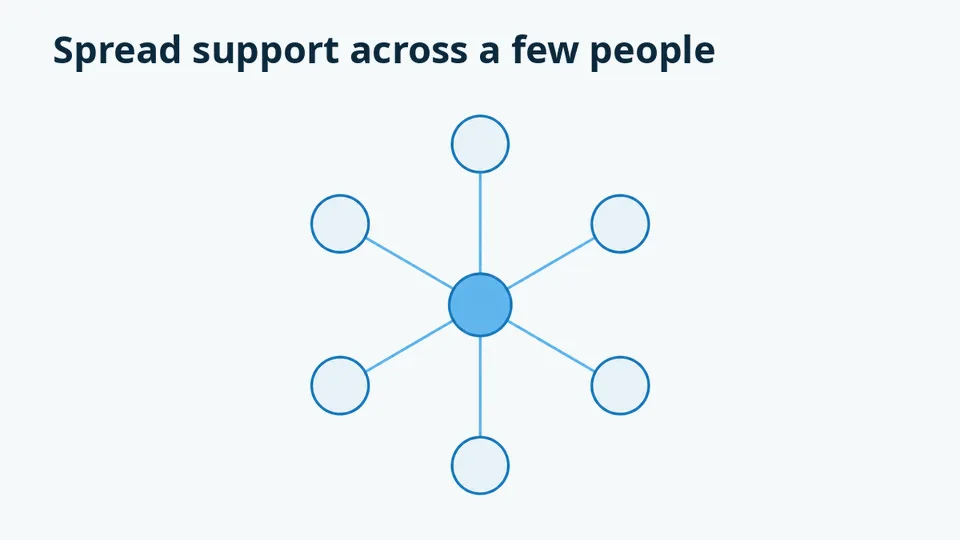
A healthy circle has several kinds of people, each playing a different role. No one person can meet every need, and spreading support across a few sources keeps you from leaning too hard on any one relationship. The table below shows common roles.
| Who | What They Offer | Example |
|---|---|---|
| Therapist or counselor | Professional guidance and a safe place to work through hard things | Weekly individual therapy |
| Treatment group | Peers who understand and notice when you're struggling | An outpatient group three days a week |
| Mutual-help group | Free, ongoing community and shared experience | AA, NA or SMART Recovery meetings |
| Sponsor or mentor | One-on-one guidance from someone further along | A sponsor you call each evening |
| Family | Daily encouragement and a stable home | A spouse who knows your plan |
| Sober friends | Fun, connection and a life outside recovery work | A Saturday hike or game night |
| Medical providers | Care for physical health and medication | A prescriber managing Vivitrol |
A Group That Will Notice If You're Not There
One of the most protective parts of your circle is a group that will notice if you're missing. That might be a treatment group, a recovery meeting, a faith community or a running club. The key is that people expect you, and they'll check in if you don't show.
That matters because one of the earliest signs of relapse is pulling away. When you start skipping groups or staying home, a group that notices can reach out before things get worse. It's hard to disappear quietly when people are expecting you on Tuesday at noon. That kind of early check-in is one of the best tools for staying sober over the long run.
How to Build a Support System From Scratch
Many people start recovery with very little support. Old friends may still be drinking or using, family relationships may be strained and it can feel like there's no one to call. That's common, and it's fixable. These steps show how to build one piece at a time:
- Start with professional support, such as a therapist or treatment program.
- Join one group and keep showing up, even when it feels awkward.
- Collect phone numbers from people in your group and save them.
- Make one call or text a day, even just to check in.
- Ask someone further along to be a sponsor or mentor.
- Reconnect carefully with family or old friends who support your recovery.
- Add one sober activity a week, like a course, a sport or volunteering.
- Let your circle grow slowly, and keep the people who keep showing up.
Building connection takes time. The first few weeks in a new group often feel uncomfortable, and that's normal. Many people find that after a month or two, the faces become familiar and the group starts to feel like theirs.
Mutual-Help Groups and Sponsors
Mutual-help groups are a free, widely available source of support. AA and NA meet in most communities and online, and SMART Recovery offers a non-twelve-step option. Many people attend more than one kind before finding the right fit.
In AA and NA, a sponsor is often a key part of a person's support. Our chapter on how to choose an AA sponsor explains what a sponsor does and how to find one. If spirituality is part of what draws you to these groups, our post on what a higher power means can help.
How Family Fits Into Your Support System
Family can be one of your greatest sources of strength, and also one of the most complicated. Years of addiction often leave hurt, mistrust and old patterns on all sides. Healing those relationships takes time and honest conversation, and it usually goes better with help.
The NIAAA offers several tips for family members supporting someone with an alcohol problem.2 It encourages them to give change time, noting that changing deep habits is hard and may take repeated efforts, to celebrate even small successes and to look after their own health. It also reminds families that their loved one is ultimately responsible for managing the illness.
Family therapy can make these changes easier. It gives everyone a safe place to talk, helps family members understand addiction and recovery, and builds new ways of communicating. Many families find it's the first time they've been able to talk about what happened without the conversation turning into a fight.
Support for Family Members
Family members need support too. Living with someone's addiction is exhausting, and many loved ones carry anxiety, anger and grief of their own. The NIAAA suggests family groups such as Al-Anon, and recommends asking for support from friends, support groups or mental health professionals, especially if you feel depressed or anxious.2
For families whose loved one isn't yet in treatment, an approach called Community Reinforcement and Family Training, or CRAFT, has strong research support. The American Psychological Association reports that across several studies, CRAFT helped about 64% to 74% of resistant loved ones enter treatment, compared with much lower rates for confrontational interventions or Al-Anon alone.3 CRAFT also teaches family members to care for their own well-being.
Signs of a Healthy Support System
Not every relationship supports recovery, even when people mean well. A healthy network makes it easier to stay sober, not harder. These signs suggest yours is working:
- You can be honest about cravings and slips without fear of being shamed.
- People respect your boundaries, including not drinking around you.
- You have more than one person to call.
- Someone would notice within a few days if you went quiet.
- You give support as well as receive it.
- You leave time with these people feeling steadier, not drained.
If someone in your life keeps pressuring you to drink or use, mocks your recovery or brings chaos every time you see them, it may be time for distance. Protecting your recovery sometimes means setting firm limits, even with people you love. And if a slip does happen, the people in your corner are the first ones to call, as our chapter on what to do after a relapse explains.
Taking Care of Yourself Along the Way
Support works best when you're also taking care of yourself. Rest, food, movement and time to recharge help you show up for others and let them show up for you. Self-care isn't selfish. It's part of what makes connection possible.
Our post on what self-care really means explains how to build those habits. Therapy is another form of support worth keeping, and our chapter on the benefits of therapy explains what it can offer beyond early recovery.
Building Support at Promising Outlook
At Promising Outlook, group therapy is the center of care, and your group will notice if you're not there. Groups meet Monday through Friday at 9:00 a.m., 12:00 p.m. and 5:00 p.m. by live video for adults across California, and each day ends with the group picking tomorrow's topic together.
Family therapy, individual therapy and medication management are built in. When you're ready to step down, our outpatient treatment program keeps you connected while you lean more on outside supports. Every client leaves with an aftercare plan and a relapse prevention plan that names the people and groups in their corner.
Call us and a real person will answer, day or night. Same-day starts are often possible. You can also verify your insurance online. We're in network with Aetna, Blue Shield, Cigna, Health Net, Tricare and United.
Frequently Asked Questions
What is a support system?
A support system is the network of people who encourage you, tell you the truth and help when life gets hard. In recovery, it often includes a therapist, a treatment group, a mutual-help group, a sponsor or mentor, family and sober friends. Each person plays a different role.
How do I build a support system in recovery?
Start with professional support, then join one group and keep showing up. Collect phone numbers, make one call a day, ask someone to be a sponsor or mentor, and reconnect carefully with supportive family and friends. Add sober activities over time and keep the people who keep showing up.
What if I don't have anyone to support me?
That's common, especially early in recovery. Start with a treatment program or therapist, then join a recovery group where people expect to see you. It can take several visits to see whether a group feels supportive and comfortable. Support can be built from scratch.
Why is a support system important in recovery?
Addiction thrives in isolation, and early signs of relapse often include pulling away from people. A support system offers encouragement, accountability and someone to call when cravings hit. SAMHSA lists community as one of four dimensions that support a life in recovery.
How can family support someone in recovery?
Learn about addiction, give setbacks room, celebrate small wins and respect boundaries like keeping alcohol out of the house. Family therapy can help everyone communicate better. Family members should also get support for themselves through groups like Al-Anon, therapy or trusted friends.
Should I cut off people who still drink or use?
Not always, but you may need distance, especially early on. If someone pressures you to use, mocks your recovery or brings chaos, it's reasonable to set firm limits or step back. You can revisit those relationships later, when your recovery feels steadier.
Sources
- Substance Abuse and Mental Health Services Administration. About Recovery.
- NIH MedlinePlus Magazine, with the National Institute on Alcohol Abuse and Alcoholism. Tips for Supporting Loved Ones With Alcohol Use Disorders.
- American Psychological Association, Monitor on Psychology. An Underappreciated Intervention. 2017.
