


Stress management skills are the habits and techniques that help you handle pressure without letting it take over your health, mood or choices. They include caring for your body, calming your nervous system, changing unhelpful thoughts, solving problems and leaning on people you trust. Like any skill, they get stronger with practice, and many people use several together.
Everyone feels stress, and some of it is useful. When it stays high for weeks or months, though, it can wear down your body and feed anxiety, depression and substance use. If stress has turned into constant worry that won't let up, our virtual anxiety treatment can help, by live video for adults across California.
This guide covers how common stress is, how it differs from anxiety, what it does to your body, the core stress management techniques and how to build your own plan. Four chapters go deeper, starting with healthy ways to cope with stress.
Key Takeaways
- Stress is a response to an outside pressure, while anxiety tends to stay even when there's no clear threat.
- In APA's 2026 Stress in America survey, 77% of U.S. adults named the cost of living as a significant source of stress.
- Long-term stress affects nearly every system in the body, from muscles and heart to digestion and sleep.
- Core skills include sleep, movement, breathing, challenging negative thoughts, problem solving, boundaries and connection.
- Stress is a common trigger for drinking, drug use and relapse.
- If stress interferes with daily life or won't go away, it's time to talk with a professional.
What Are Stress Management Skills
Stress management skills are practical tools that lower the impact of stress on your body and mind. Some work in the moment, like slow breathing when your heart starts racing. Others work over time, like steady sleep and regular exercise, by making you less reactive to the next stressful event.
The best approach combines both. In-the-moment skills help you get through a hard hour. Long-term habits raise your baseline, so hard hours come less often and pass more quickly. Together, they give you more choice in how you respond instead of reacting on autopilot.
These skills matter for everyone, but they matter even more for people in recovery from addiction or living with depression or anxiety. For many people, drinking or using once was the main way to cope with stress. Building healthier skills is a big part of staying well.
How Common Is Stress
Stress is close to universal right now. The American Psychological Association's 2026 Stress in America survey of more than 3,100 U.S. adults found that the cost of living was the most often cited source of significant stress, named by 77% of adults.1 The economy and concerns about the future of the nation were each named by 74%, money by 71% and health care by 60%.
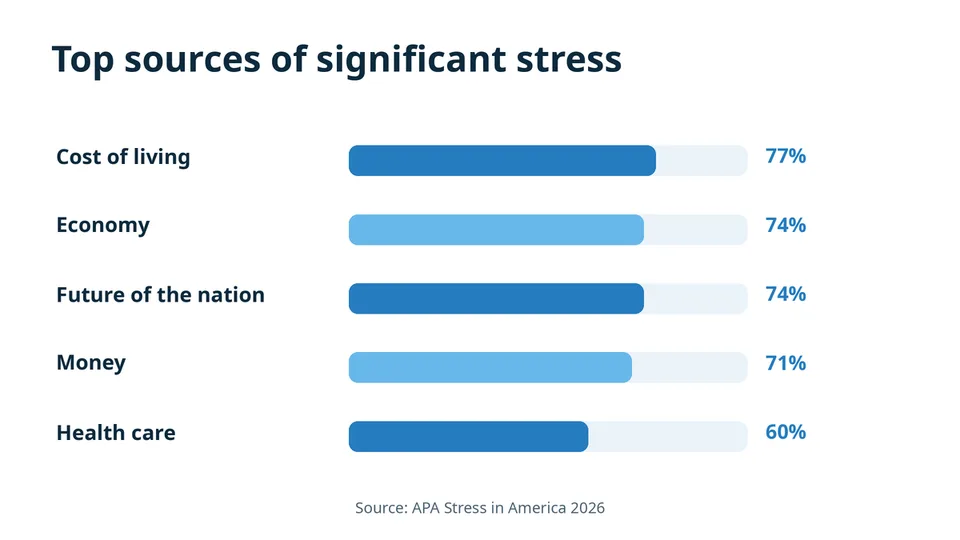
The survey also found stress is changing how people live. Nearly half, 47%, said they had pulled back from at least one form of social participation because of stress. The report notes that for many adults, stress has become part of the baseline of daily life.
That last point is important. When stress feels normal, it's easy to stop noticing how much it's costing you. Learning to spot it is the first step in managing it.
Types of Stress
Not all stress is the same. The NIMH describes stress as the physical or mental response to an outside cause, and notes that a stressor can be a one-time event or something that happens again and again over a long time.2 That difference matters, because short-term and long-term stress affect you in different ways.
Short-term stress, like a job interview or a near miss in traffic, comes on fast and fades once it's over. It can even help, by sharpening your focus and giving you energy to meet a challenge. NIMH notes that stress can be positive or negative.3 Long-term stress, like ongoing money worries, caregiving or a hard relationship, is different. It keeps your body's alarm system switched on, which is where most of the health effects come from.
Major life changes are a third kind of stress worth naming. A move, a new job, a breakup, a new baby or getting sober can all be stressful, even when the change is a good one. Expecting that stress and planning for it can make the transition easier.
Stress vs Anxiety
Stress and anxiety feel alike, but they aren't the same. The National Institute of Mental Health explains the difference in simple terms.3 The table below compares them.
| Feature | Stress | Anxiety |
|---|---|---|
| Where it comes from | A response to an outside cause, like a test or an argument | Your internal reaction to stress |
| How long it lasts | Usually goes away once the situation is resolved | A persistent sense of dread that doesn't go away |
| Is there a clear threat | Yes, something specific is causing it | Can be constant even when there's no immediate threat |
| Can it be positive | Yes, stress can be positive or negative | Usually feels negative and gets in the way |
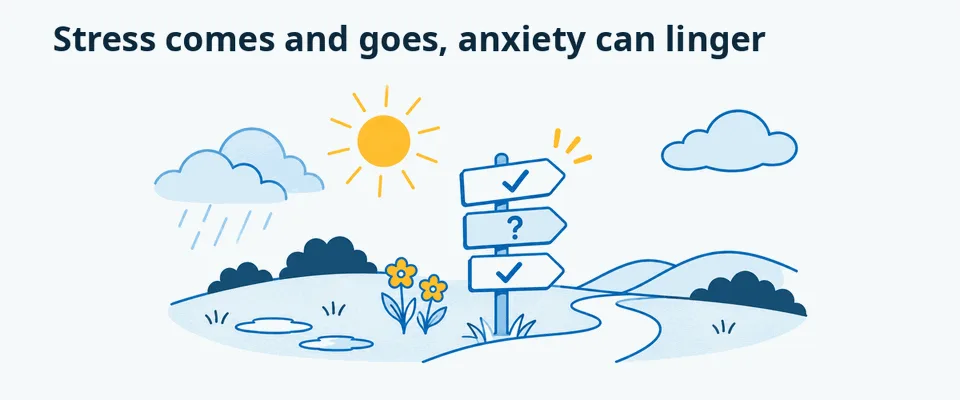
The NIMH notes that both stress and anxiety can affect your mind and body, with shared symptoms like excessive worry, tension, headaches or body pain, high blood pressure and lost sleep. If what you feel has become constant and is affecting your daily life, it may be an anxiety disorder, which is very treatable.
What Stress Does to Your Body
Stress isn't just in your head. The American Psychological Association explains that stress affects all systems of the body, including the musculoskeletal, respiratory, cardiovascular, endocrine, gastrointestinal, nervous and reproductive systems.4 The body handles short bursts well, but long-term stress can cause real harm.
When stress hits, your nervous system triggers the fight-or-flight response. Heart rate and breathing speed up, muscles tense and stress hormones like adrenaline and cortisol rise. When stress stays high, the APA notes that ongoing increases in heart rate, blood pressure and stress hormones can raise the risk of hypertension, heart attack and stroke.
Chronic stress also keeps muscles tense, which is linked to tension headaches, migraines and back pain. It can upset digestion and worsen conditions like irritable bowel syndrome. Our chapter on how stress affects the body explains each of these effects in more depth.
Signs That Stress Is Building
Stress often builds quietly until it spills over. Learning your own early signs gives you a chance to act before you're overwhelmed. The CDC lists common reactions to stress, including these:5
- Feelings of fear, anger, sadness, worry, numbness or frustration.
- Changes in appetite, energy, desire and interests.
- Trouble concentrating and making decisions.
- Nightmares or problems sleeping.
- Headaches, body pains, stomach problems or skin rashes.
- Worsening of chronic health problems or mental health conditions.
- Increased use of alcohol, tobacco or other substances.
That last sign deserves attention. If you notice yourself reaching for a drink, a pill or a cigarette more often when stress rises, it's an early warning worth taking seriously, especially if you have a history of substance use.
The Core Stress Management Techniques
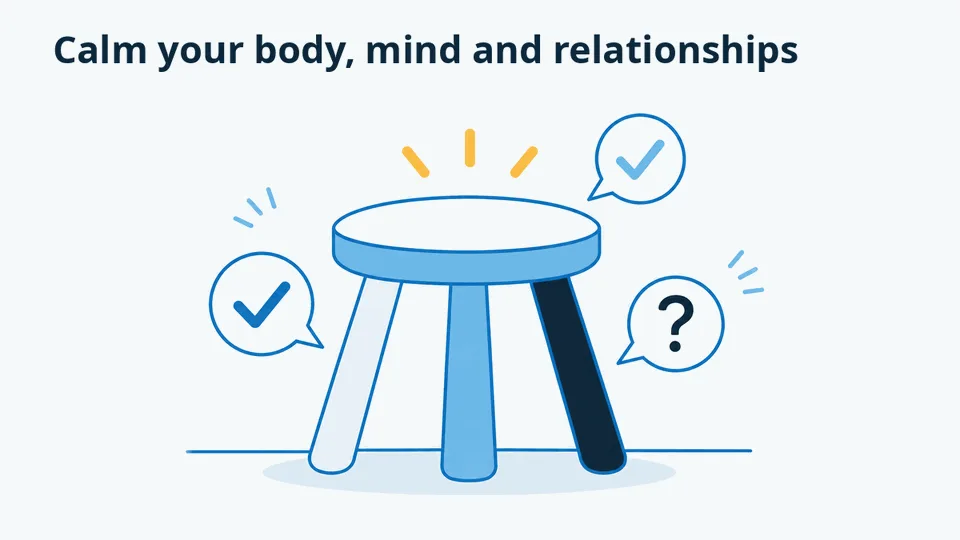
Stress management techniques fall into a few broad groups. Many people do best with at least one skill from each group, because stress affects the body, the mind and relationships at the same time. The table below gives an overview.
| Area | What It Does | Examples |
|---|---|---|
| Body | Calms the stress response and builds resilience | Sleep, exercise, meals, slow breathing, muscle relaxation |
| Mind | Changes how you think about stressors | Challenging negative thoughts, journaling, mindfulness |
| Action | Reduces the stressor itself | Problem solving, planning, setting priorities |
| Boundaries | Protects your time and energy | Saying no, limiting news and social media |
| Connection | Shares the load and adds support | Talking with friends, family, groups or a therapist |
Stress Management Skills for the Body
Your body is often the fastest way into calmer territory. Physical habits lower your overall stress load and make you more resilient to hard days. The CDC recommends a consistent sleep schedule with seven or more hours a night, about two and a half hours of physical activity a week and balanced meals.5 It also advises limiting alcohol and avoiding tobacco and vaping.
Movement deserves special mention. Regular exercise can ease feelings of stress and lift your mood. Even a short daily walk counts. Our post on whether exercise helps mental health explains what the research shows.
Breathing is the quickest in-the-moment tool. Slow breathing with a longer exhale tells your nervous system it's safe to settle. Try breathing in for four counts and out for six, for a few minutes, whenever you notice tension rising. The NIMH also suggests apps with relaxation exercises as a simple way to practice.3
Progressive muscle relaxation is another useful technique. You tense one muscle group for a few seconds, then let it go, moving slowly from your feet to your head. It teaches your body the difference between tension and relaxation, which makes it easier to let go of stress you're holding without realizing it.
Stress Management Skills for the Mind
How you think about a stressor shapes how stressful it feels. The NIMH recommends identifying and challenging negative and unhelpful thoughts as a way to cope.3 That's the core idea of cognitive behavioral therapy, one of the most widely used therapies for stress and anxiety.
In practice, it looks like this. You notice a thought like "I'll never get through this week." You ask whether it's completely true, what evidence you have and what you'd tell a friend. Then you try a more balanced version, like "This week is hard, and I've handled hard weeks before." Our chapter on what cognitive behavioral therapy is explains the method in detail.
Journaling helps too. The NIMH suggests keeping a journal to track what's stressing you. Writing things down can make a swirl of worries feel more manageable and help you spot patterns, like stress that always spikes on Sunday nights.
Mindfulness is a third mental skill. It teaches you to notice thoughts and feelings without getting swept up in them. Our chapter on mindfulness based relapse prevention shows how these skills help with cravings as well as stress.
Stress Management Strategies for Common Situations
Different stressors call for different tools. A work deadline needs a different response than a fight with your partner or a sudden craving. The table below matches some common situations with stress management strategies that tend to help.
| Situation | In the Moment | Over Time |
|---|---|---|
| Work deadline | Break the task into the next small step, take three slow breaths | Plan the week ahead, protect sleep, talk with your manager about workload |
| Money worries | Write the worry down and set a time to deal with it | Make a simple budget, call creditors early, ask about assistance programs |
| Family conflict | Take a short break before responding | Practice calm communication, consider family therapy |
| Health concerns | Ground yourself with your senses, call your provider | Keep up with checkups, build steady habits, share worries with someone |
| Cravings in recovery | Urge surf, call someone, change your setting | Follow your relapse prevention plan, stay connected to a group |
The common thread is pairing a quick tool with a longer-term change. The quick tool gets you through the moment. The longer-term change makes the next moment less intense.
Managing Stress at Work
Work is one of the most common sources of stress, whether it's heavy workloads, tight deadlines, difficult coworkers or job insecurity. You can't control everything at work, but you can usually control more than it feels like in the middle of a hard week. These habits help many people:
- Start the day by choosing the one or two tasks that matter most.
- Take short breaks every hour or two to stand, stretch or breathe.
- Step away from your desk for lunch when you can.
- Set a clear end to the workday and protect it when possible.
- Talk with your manager early if your workload isn't realistic.
If work stress is wearing you down and you're also struggling with mood or substance use, evening treatment options let you get help without leaving your job.
Problem Solving and Planning
Some stress comes from problems you can actually change. When that's true, the best stress management strategy is to take action. Breaking a big problem into small steps makes it feel less overwhelming and gives you a sense of control.
A simple approach works for most problems. Define the problem clearly, list several possible solutions, pick one to try, take the first small step and check how it went. If it didn't work, try another option. Our post on problem solving techniques walks through this process with examples.
Planning helps with stress you can see coming. Setting priorities, writing a short to-do list and blocking time for the most important tasks keeps you from feeling buried. It also helps to schedule rest and fun, not just work, so your week has room to recover.
Boundaries and Saying No
Many people carry more stress than they need to because they find it hard to say no. Boundaries protect your time, energy and health. They might sound like "I can't take that on this week" or "I need to leave by six tonight."
Boundaries apply to information too. The CDC suggests taking breaks from news and social media, which can be constant sources of stress.5 Setting specific times to check the news, rather than scrolling all day, can noticeably lower your stress level.
Stress and Sleep
Stress and sleep feed each other. Stress makes it harder to fall asleep and stay asleep, and poor sleep makes you more sensitive to stress the next day. The NIMH and the CDC both list sleep problems among common reactions to stress, and both recommend a consistent sleep routine as a way to cope.3, 5
A few habits make a real difference. Go to bed and get up at about the same time every day, even on weekends. Keep screens out of bed, and give yourself 30 minutes of quiet time before lights out. Cut back on caffeine in the afternoon, since the NIMH suggests avoiding excess caffeine.2 If worries keep you up, keep a notepad by the bed and write them down so your mind can let them go until morning.
Alcohol is a common sleep aid that backfires. It may help you fall asleep faster, but it tends to disrupt sleep later in the night. If you're using alcohol or pills to sleep, mention it to a provider.
Connection and Support
People are one of the strongest buffers against stress. Talking with someone you trust helps you feel less alone, see problems more clearly and get practical help. The NIMH and the CDC both recommend reaching out to friends and family who help you cope in positive ways.3, 5
Yet stress often pushes people to withdraw, which is exactly when connection matters most. The 2026 Stress in America survey found that 47% of adults pulled back from social participation because of stress.1 If you notice yourself isolating, try one small step toward connection, like a text, a call or showing up to a group.
Stress and Relapse in Addiction Recovery
Stress and substance use are closely linked. The CDC lists increased use of alcohol, tobacco and other substances among common reactions to stress.5 For people in recovery, stress is one of the most common relapse triggers, and old habits can feel like the fastest relief.
That's why stress management sits at the center of most relapse prevention plans. Our guide to relapse prevention explains how to build stress triggers into your plan. Anger often travels with stress, too, and our guide to anger management skills offers tools for that side of things.
Building Your Stress Management Plan
A short written plan makes you far more likely to use these skills when you need them. It doesn't need to be long. It just needs to be specific enough to follow on a hard day. These steps will help you build one:
- List your biggest current stressors at work, at home, with money and with health.
- Write down your personal early warning signs of stress.
- Pick one or two in-the-moment skills, like slow breathing or a short walk.
- Choose daily habits you'll protect, like a bedtime and some movement.
- Identify one stressor you can act on this week and the first small step.
- Name two people you'll reach out to when stress builds.
- Set a time each week to check how the plan is working.
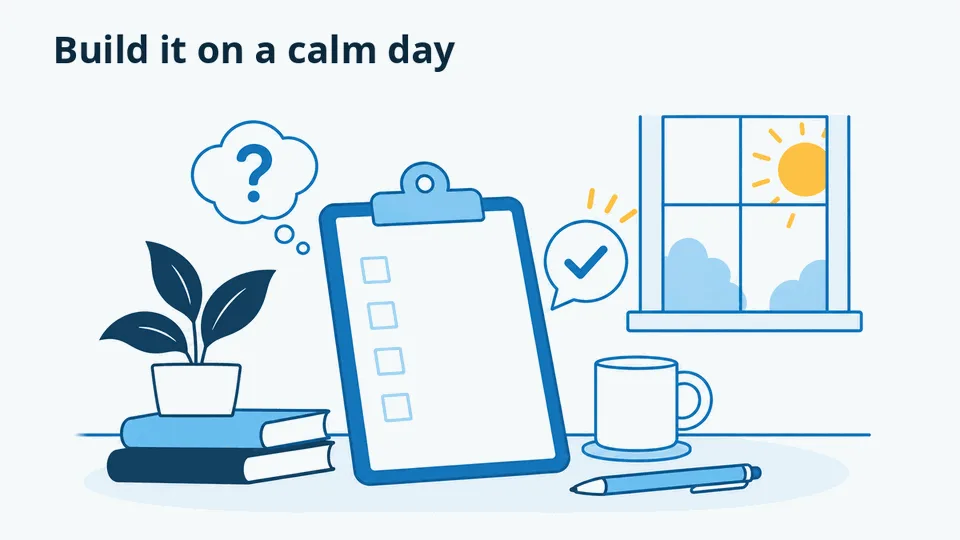
Start small. One new habit practiced every day does more than five habits you try once. As each skill becomes automatic, add the next one. Our chapters on what causes stress and how to reduce stress can help you fill in each step.
When Stress Needs Professional Help
Self-help skills go a long way, but sometimes stress is more than you can manage alone. The NIMH says that if you're struggling to cope or your symptoms don't go away, it may be time to talk to a professional.3 Signs that point to getting help include:
- Stress or worry that interferes with work, school, relationships or daily life.
- Avoiding places, people or tasks because of how anxious they make you.
- Stress or anxiety that seems to be there all the time.
- Trouble sleeping most nights for weeks.
- Drinking or using drugs to cope.
- Feeling hopeless or having thoughts of harming yourself.
Therapy can teach these skills in a structured way and help with what's underneath the stress. Working with a therapist through online therapy in California is a good fit for many people, and some benefit from more structured care.
Stress Management at Promising Outlook
At Promising Outlook, stress management skills are built into group therapy, where you practice them with others and bring back what worked. Our virtual IOP for mental health treats anxiety, depression and stress-related struggles by live video for adults across California, and the same team treats substance use when it's part of the picture.
Groups meet Monday through Friday at 9:00 a.m., 12:00 p.m. and 5:00 p.m., with two evening groups for people who work during the day. Individual therapy, family therapy and medication management are built in. Treatment length varies. Clients leave with an aftercare plan and a relapse prevention plan.
Call us and a real person will answer, day or night. Same-day starts are often possible. You can also verify your insurance online. We're in network with Aetna, Blue Shield, Cigna, Health Net, Tricare and United.
Frequently Asked Questions
What are stress management skills?
Stress management skills are habits and techniques that help you handle pressure without letting it harm your health, mood or choices. They include sleep, exercise, slow breathing, challenging negative thoughts, journaling, problem solving, setting boundaries and connecting with people you trust. Many people use several together.
What are the best stress management techniques?
Techniques with strong support include regular exercise, steady sleep, slow breathing, progressive muscle relaxation, mindfulness, challenging negative thoughts and problem solving. Connecting with supportive people and limiting news and social media also help. The best approach combines quick in-the-moment skills with long-term daily habits.
What is the difference between stress and anxiety?
Stress is a response to a specific outside cause, like a deadline or an argument, and usually fades once the situation is resolved. Anxiety is an internal reaction that can feel constant even without a clear threat. Both can cause worry, tension, headaches and sleep problems.
How does stress affect the body?
Stress triggers the fight-or-flight response, raising heart rate, blood pressure and stress hormones. Over time, chronic stress can tense muscles, cause headaches and back pain, upset digestion, disrupt sleep and raise the risk of high blood pressure, heart attack and stroke.
What are some quick ways to manage stress?
Try slow breathing with a longer exhale, a short walk, stretching or tensing and releasing your muscles. Step away from the screen for a few minutes, write down what's bothering you or text someone you trust. Even five minutes can lower the intensity of a stressful moment.
Can stress cause relapse?
Yes. Stress is one of the most common relapse triggers, and the CDC lists increased use of alcohol and other substances as a common reaction to stress. Building stress management skills and naming stress triggers in a relapse prevention plan can lower the risk.
When should I get help for stress?
Get help if stress interferes with your daily life, seems constant, causes you to avoid things, disrupts sleep for weeks or leads you to drink or use drugs to cope. A therapist can teach skills in a structured way and help with any anxiety or depression underneath.
Can therapy help with stress?
Yes. Therapy, especially cognitive behavioral therapy, teaches practical skills for managing stress and helps you change the thoughts and habits that make it worse. It can also treat anxiety or depression that often comes along with long-term stress. Many people notice changes within a few weeks.
Sources
- American Psychological Association. Stress in America 2026: The Stress of Uncertainty. 2026.
- National Institute of Mental Health. Stress.
- National Institute of Mental Health. I'm So Stressed Out! Fact Sheet.
- American Psychological Association. Stress Effects on the Body. 2024.
- Centers for Disease Control and Prevention. Managing Stress.
