


Motivational interviewing (MI) is a counseling style that helps people find their own motivation to change. It was built for the person who feels two ways about something, like wanting to stop drinking and not wanting to stop at the same time. The counselor doesn't lecture, warn, or push. They ask questions, listen closely, and help you hear your own reasons for change. It's widely used in treatment for substance use disorders and in mental health care because it works with a person's doubts and doesn't fight them.
This chapter explains what motivational interviewing is, how it works, the techniques counselors use, and what the research says. It's part of our guide to the common types of therapy.
Motivational Interviewing Explained
Motivational interviewing was developed by psychologists William Miller and Stephen Rollnick. Miller first described it in the early 1980s after noticing something in his work with people who had drinking problems: the more a counselor confronted a client, the more the client drank. The clients who did best had counselors who listened.
SAMHSA's guidance on motivation in substance use treatment uses Miller and Rollnick's own definition. MI is a person centered counseling style for addressing the common problem of ambivalence about change. Put simply, it's a client centered approach to resolving ambivalence.
Two parts of that definition matter. "Person centered" means the client is treated as the expert on their own life. "Ambivalence" means mixed feelings. Almost everyone who thinks about changing a habit has them. SAMHSA says ambivalence about substance use and change is normal, and that a counselor should see it as a normal part of the change process and not as denial or resistance.
That one idea changes the whole conversation. If mixed feelings are normal, there's nothing to break through. There's only something to talk about.
How Motivational Interviewing Works
Think about the last time someone told you what you should do. You probably came up with reasons they were wrong, even if part of you agreed. That's human. When one person argues for change, the other person argues against it, and people tend to believe what they hear themselves say.
Motivational interviewing turns that around. The counselor's job is to help the client make the argument for change. Miller and Rollnick call the urge to jump in and fix things the "righting reflex," and a big part of MI training is learning to resist it.
In practice, a counselor using motivational interviewing listens for two kinds of statements.
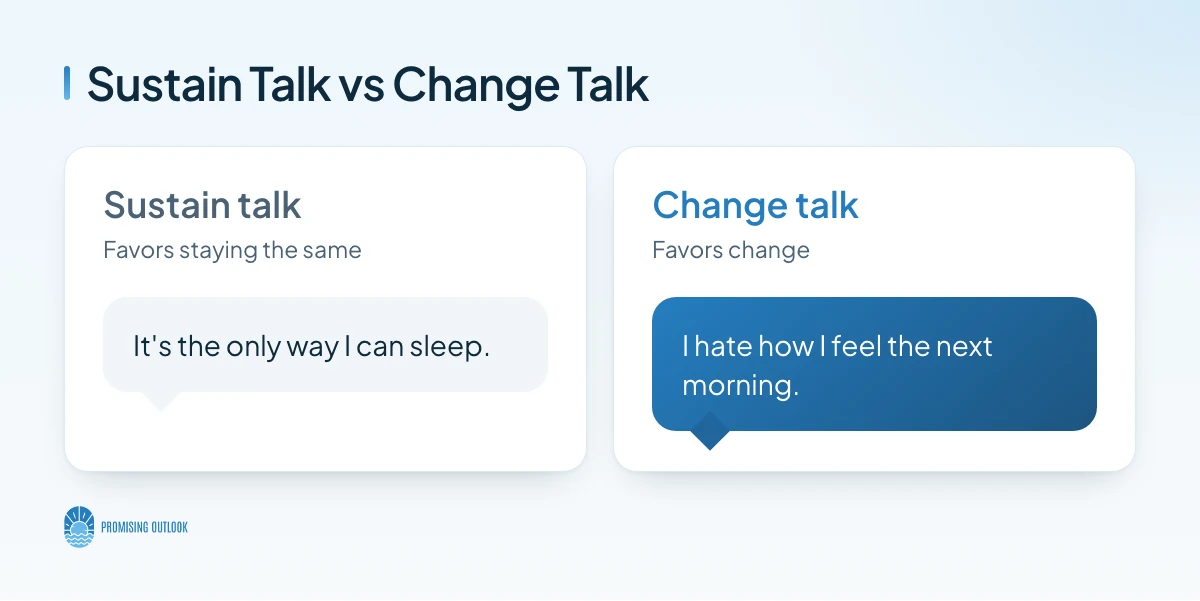
Both are true for the client. Both are sides of the same ambivalence. The counselor doesn't argue with the sustain talk. They notice the change talk, reflect it back, and ask for more of it. Over time, the client hears their own reasons out loud, and their own motivation, what researchers call intrinsic motivation, gets stronger than the external pressure from a spouse, a boss, or a court. Internal motivation lasts. Outside pressure fades.
What It Sounds Like
Here's a short example.
Client: My wife thinks I have a problem. I don't drink any more than my friends do.
Counselor: It doesn't feel fair to be singled out.
Client: Right. But I did miss my son's game last month. That one bothered me.
Counselor: Being there for your son matters to you, and drinking got in the way of that.
Client: Yeah. I don't want to be that dad.
Nobody told him he has a problem. He said what matters to him, and he heard himself say it. That gap between a person's current behavior and what they care about is the engine of motivational interviewing. Behavior change that comes from the client's own values tends to last longer than change that was forced on them.
The Spirit of Motivational Interviewing
Miller and Rollnick are clear that motivational interviewing isn't a bag of tricks. It's a way of being with a person, and SAMHSA calls this spirit the foundation of the counseling skills. No specific techniques matter as much as the spirit behind them. It has four parts.
- Partnership. The counselor and client work side by side. This collaborative nature is what builds a strong therapeutic relationship.
- Acceptance. The counselor respects the client's autonomy and self-determination. The client decides what to do with their life.
- Compassion. The counselor puts the client's well-being first.
- Evocation. The counselor draws out the client's own reasons and strengths. The client's motivation is already in there. The approach is meant to empower clients, not manage them.
Principles of Motivational Interviewing
The original description of MI laid out basic principles that counselors still use as a guide. These core principles show up in every conversation and in all the MI techniques that follow.
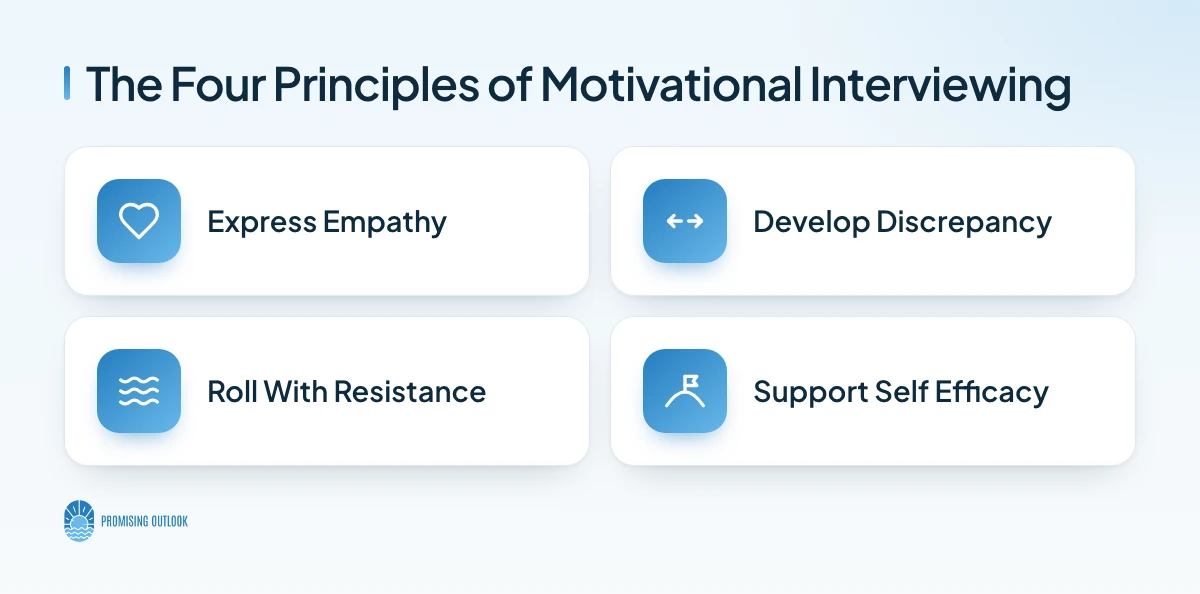
Expressing Empathy
Expressing empathy means working to understand the client's perspective and showing that you do. It isn't agreeing and it isn't pity. A client who feels understood stops defending and starts thinking.
Developing Discrepancy
Developing discrepancy means helping a person see the gap between where they are and where they want to be. The counselor doesn't point it out like a prosecutor. They ask about the client's personal values and goals and let the client connect the dots.
Rolling With Resistance
When a client pushes back, the counselor doesn't push harder. They treat pushback as information, change direction, and keep the conversation going. Arguing for change tends to produce more arguing against it.
Supporting Self Efficacy
Self-efficacy is a person's belief that they can do something. Wanting to change isn't enough if you don't believe you can. Counselors point to the client's strengths, past successes, and the client's efforts so far, so that change starts to look possible. MI encourages clients to notice the positive changes they've already made, however small. Self-efficacy grows with each small win.
Motivational Interviewing Techniques
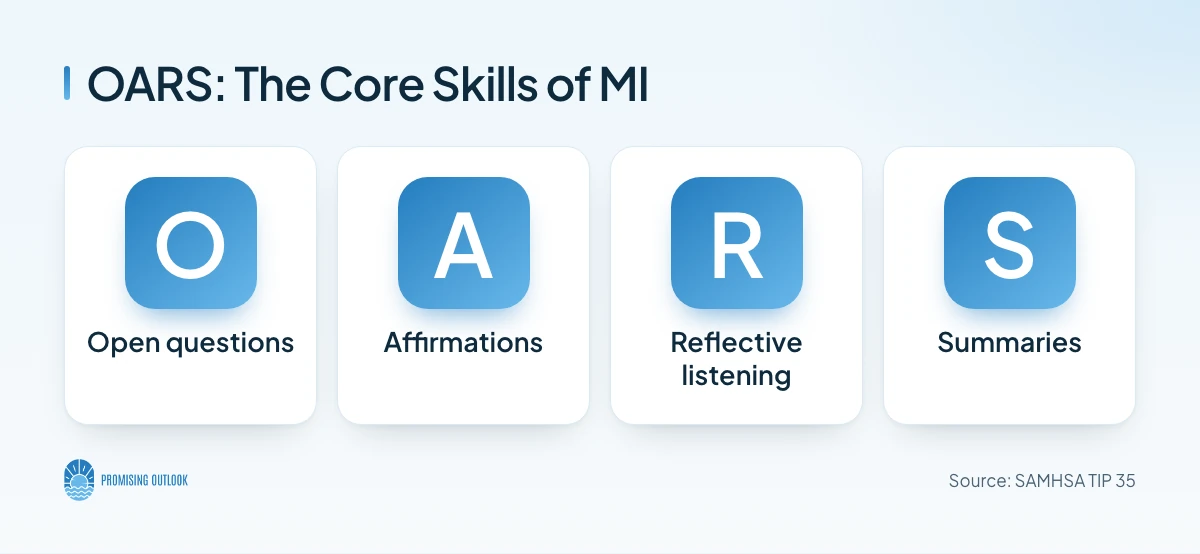
SAMHSA describes four core skills of MI, often remembered as OARS. These motivational interviewing techniques are what a counselor uses to guide clients toward change talk.
| Skill | What it is | Example |
|---|---|---|
| Open questions | Questions that can't be answered with yes or no | "What worries you about your drinking?" |
| Affirmations | Statements that recognize the client's strengths and effort | "It took a lot to call today." |
| Reflective listening | Saying back what the client means, to show understanding | "You're tired of feeling this way." |
| Summaries | Pulling together what the client has said, especially change talk | "So on one hand it helps you relax, and on the other it's costing you sleep and time with your kids." |
Reflective listening is the hardest of the MI techniques and the most important. It's more than active listening. The counselor has to guess at the meaning under the client's statements and offer it back in a way that moves the conversation forward.
The Four Processes
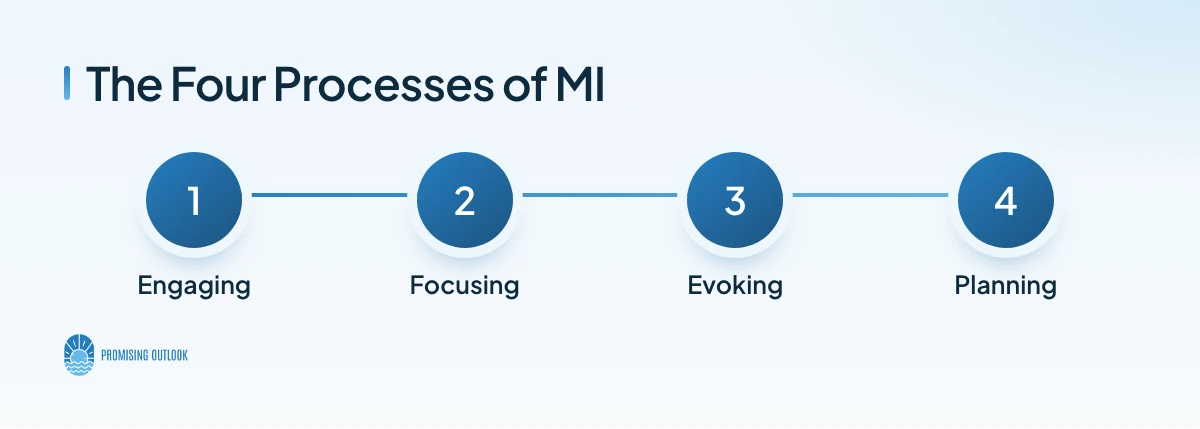
SAMHSA also describes four processes that give an MI conversation its shape.
- Engaging: building trust and a working relationship.
- Focusing: agreeing on what to talk about.
- Evoking: drawing out the client's own reasons for change.
- Planning: deciding on next steps when the client is ready.
The order matters. Planning before a person is ready is one of the most common mistakes in addiction treatment, and it's the one MI is designed to prevent.
What Motivational Interviewing Is Used For
MI started in treatment for alcohol problems and is now used across substance use disorders and well beyond them. It's found in many treatment settings, from addiction programs to mental health clinics to primary care, and it fits any situation where behavior change is the goal and mixed feelings are in the way.
- Substance use. Helping people decide to cut down, stop, or start treatment. This is where MI is used most, and it's often the first conversation in our virtual IOP for substance abuse.
- Mental health. Helping people with depression, anxiety, and other mental health conditions engage with therapy, stick with a plan, or take medication as prescribed. Mental health counselors also use it when a client feels stuck.
- Co-occurring conditions. When someone is living with both, such as depression and substance abuse, MI helps them decide where to start.
- Health behaviors. Doctors and nurses use it to support behavioral changes like quitting smoking, eating differently, and exercising.
It's also used with people who didn't choose to come. If a court, an employer, or a family member sent you, MI doesn't pretend otherwise. It starts with what you want, even if that's just to get everyone off your back. Whatever got you here is a good enough reason.
A related approach, motivational enhancement therapy, uses the MI style with people who have substance use disorders in a short, set number of meetings that include feedback from an assessment.
Does Motivational Interviewing Work
The research on the effectiveness of motivational interviewing (MI) in addiction and mental health care is large, and it's worth reading carefully. A Cochrane review looked at 93 studies involving 22,776 people who used alcohol, drugs, or both. In most of those studies, the counselor and client met only one to four times for about an hour. This short form is sometimes called brief motivational interviewing. People were assigned by chance to MI or to a control group that got no treatment or a different treatment.
The review found that motivational interviewing may reduce substance use compared with no treatment, at least in the short term. Compared with other active treatments, it made little to no difference, which means MI did about as well as the therapies it was tested against.
That's a fair picture. MI isn't a cure on its own, and nobody who uses it well claims it is. What it does is help people start making positive changes in very little time. For someone who would otherwise walk away, a few good conversations can be the difference between starting treatment and not starting.
That's why MI is rarely used alone. It opens the door, and other therapies do the longer work of sustained behavior change and better mental health. Like most behavioral interventions, MI works best as one part of a larger treatment process, where a strong therapeutic alliance and continued care carry the gains forward. In our programs, it sits alongside cognitive behavioral therapy, which teaches the skills to change, and DBT, which teaches coping strategies for strong emotions.
What to Expect From a Counselor Who Uses MI
If your addiction or mental health counselor uses motivational interviewing, a few things will stand out.
- You'll do most of the talking.
- You won't be labeled, lectured, or told what you have to do.
- Your doubts will be taken seriously, not argued with.
- You'll be asked what you want, what matters to you, and what positive changes would look like.
- Any plan will be one you had a hand in making.
It can feel surprisingly ordinary, like a good conversation with someone who's really listening. That's the point. The therapeutic relationship does a lot of the work. People who come in braced for a fight often leave having said things they hadn't admitted to themselves.
Motivational interviewing takes real skill. Counselors need adequate training, practice, and ongoing supervision to do it well, so it's fair to ask a program how its staff is trained. At Promising Outlook, our counselors and therapists use motivational interviewing with adults across California who are working on addiction, mental health, or both, in group and one-on-one. If you're not sure you're ready, that's a fine place to start. Call (951) 307-9554. A real person will answer, day or night, and nobody will pressure you.
When You're Not Sure You Want to Change
Most people don't start treatment certain. They start curious, tired, or pushed. If you're reading this for yourself, you don't need to have made up your mind. Big behavioral changes usually begin as small ones. You can read about how to get into rehab without committing to anything, or look at the benefits of therapy and decide if any of them matter to you.
If you're reading this for someone you love, MI has a lesson for you too. Pushing harder usually makes people dig in. Asking what they want and listening to the answer gets you further. Positive changes usually start with feeling heard.
When you're ready to talk, we're here. We're in network with Aetna, Blue Shield, Cigna, Health Net, Tricare, and United. Call (951) 307-9554 or verify your insurance, and see how we approach virtual addiction treatment.
Frequently Asked Questions
What is motivational interviewing in simple terms?
Motivational interviewing is a client-centered approach to counseling, a way of talking with someone that helps them find their own reasons to make positive changes. The counselor asks open questions, listens carefully, and reflects back what the person says, without lecturing or pressuring. It's designed for people who have mixed feelings about changing a behavior such as drinking or drug use.
What are the four principles of motivational interviewing?
The four core principles are expressing empathy, developing discrepancy, rolling with resistance, and supporting self-efficacy. Together, they mean understanding the client's point of view, helping them see the gap between their behavior and their goals, not arguing when they push back, and building their belief that they can change.
What does OARS stand for in motivational interviewing?
OARS stands for open questions, affirmations, reflective listening, and summaries. These are the four core skills of motivational interviewing. Counselors use them to build trust, understand what the client means, and draw out the client's own statements in favor of change.
What is change talk?
Change talk is anything a client says that favors change, such as "I'm tired of feeling this way" or "I want to be there for my kids." Its opposite is sustain talk, which favors staying the same. In motivational interviewing, the counselor listens for change talk and helps the client say more of it. Change talk is a sign of growing intrinsic motivation.
Is motivational interviewing effective for addiction?
Research on the effectiveness of motivational interviewing is encouraging. A Cochrane review of 93 studies and 22,776 people found that motivational interviewing may reduce substance use compared with no treatment in the short term and performs about the same as other active treatments. It usually takes only one to four meetings, which makes it a useful first step into addiction treatment.
How is motivational interviewing different from CBT?
Motivational interviewing helps a person decide whether and why to change. Cognitive behavioral therapy teaches the skills for how to change. MI is brief and focuses on resolving ambivalence. CBT is longer and focuses on thoughts and behaviors. Many programs use MI first and CBT after.
How long does motivational interviewing take?
Motivational interviewing is brief. In research studies, the counselor and client usually meet one to four times for about an hour each. In a treatment program, counselors also use the MI style throughout care, in individual and group conversations, for addiction and mental health alike, whenever a client feels stuck or unsure.
What is the therapist's role in motivational interviewing?
The therapist's role is to guide, not direct. They listen with empathetic understanding, ask about the client's goals, and guide clients toward their own reasons for change. The fundamental principle is that an individual's motivation has to come from the individual. The therapist supports self-direction and helps the client overcome obstacles as they come up.
Sources
- Substance Abuse and Mental Health Services Administration. Enhancing Motivation for Change in Substance Use Disorder Treatment, Chapter 3: Motivational Interviewing as a Counseling Style. TIP 35, 2019.
- Cochrane. Does motivational interviewing help people reduce their use of alcohol, drugs, or both?
