


Dialectical behavior therapy (DBT) is a type of talk therapy that teaches people how to manage intense emotions, get through a crisis without making it worse, and keep healthy relationships. It grew out of cognitive behavioral therapy and adds one big idea: you have to accept yourself as you are and work to change at the same time. DBT teaches four sets of skills: mindfulness, distress tolerance, emotion regulation, and interpersonal effectiveness.
This chapter explains what DBT is, how it works, what the skills are, and how it compares to CBT. It's part of our guide to the common types of therapy.
What Is DBT Therapy
DBT therapy is a structured, skills-based treatment. Most therapy is a conversation. Dialectical behavior therapy is closer to a course with a coach. You learn specific skills, you practice them in everyday life, and you come back and report what happened.
It was originally developed by psychologist Marsha Linehan, who was trying to help people with borderline personality disorder (BPD) whose pain was so strong that standard therapy wasn't reaching them. A clinical review of DBT describes what she found: focusing only on change left out something essential, which was acceptance. People who were told to change, change, change heard that they were the problem, and they stopped coming.
So Linehan built a therapy that holds both. That's what "dialectical" means. Two things that seem opposite can both be true. You're doing the best you can. You also need to do better. DBT focuses on finding the balance between those two sentences.
How DBT Works
Dialectical behavior therapy starts from the idea that some people feel emotions faster, stronger, and longer than others. If you're one of them, a comment that would roll off someone else can wreck your day. When emotions hit that hard, people reach for whatever stops the feeling fastest: a drink, a fight, shutting down, or something riskier. Those behaviors work for a few minutes and cost a lot afterward.
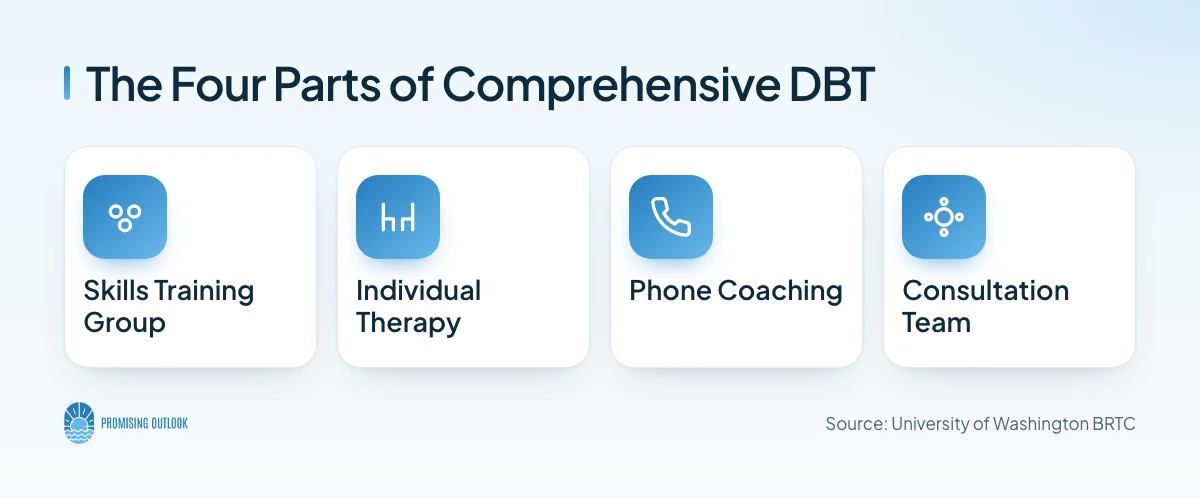
DBT replaces them with skills. The University of Washington center that Linehan founded describes four components of comprehensive DBT.
- Skills training group. The group runs like a class. The leader teaches a skill and gives homework assignments so clients practice it in their everyday lives.
- Individual therapy. You meet one on one, usually weekly, to apply the skills to what's happening in your own life.
- Phone coaching. In the moment coaching on how to use a skill when a hard situation comes up between appointments.
- Consultation team. DBT therapists meet weekly as a team to support each other so they can give the best treatment possible.
In comprehensive DBT, the weekly individual therapy session lasts about an hour and the DBT skills training group runs about an hour and a half to two and a half hours. A standard DBT program runs about six months to a year. Comprehensive DBT involves all four components. Many programs, including ours, don't run all four. They teach DBT skills inside a broader program alongside other therapies. That still gives you the part most people are looking for, which is the skills.
The Four DBT Skills
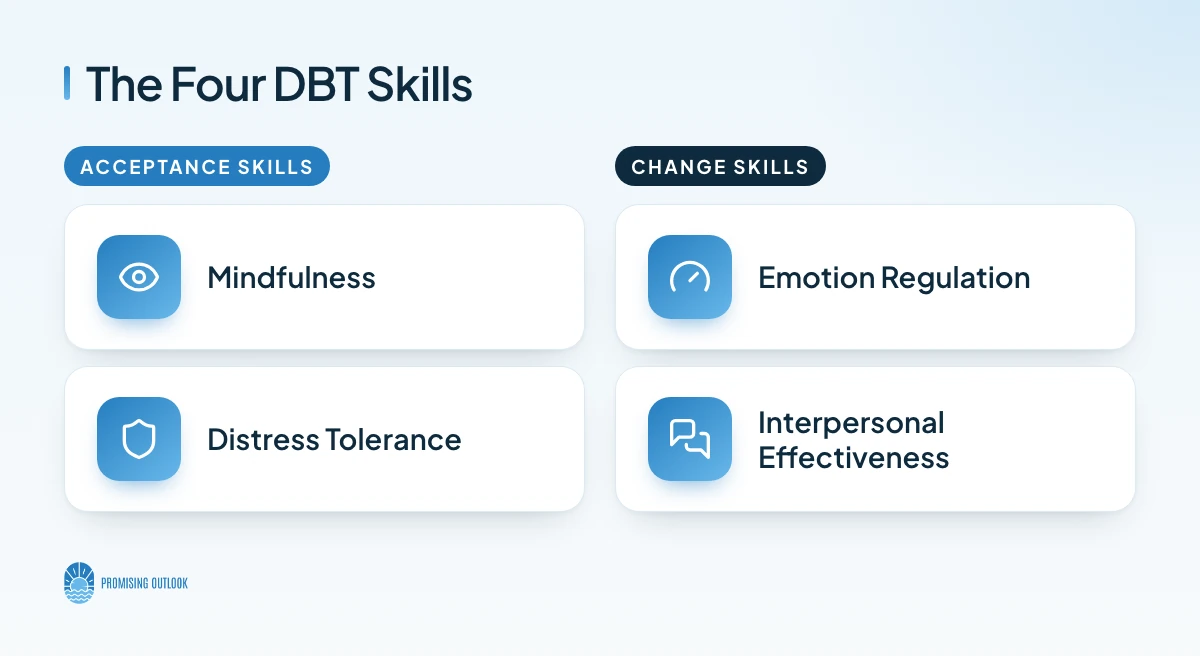
Dialectical behavior therapy teaches new skills in four modules. Two are about acceptance, and two are about change.
Mindfulness
Mindfulness skills are the foundation. To practice mindfulness is to pay attention to the present moment, on purpose, without judging what you find. In DBT, that means noticing "I'm angry and my chest is tight" before the anger decides what you do next. Every other skill depends on this one, because you can't use a skill on a feeling you haven't noticed.
Distress Tolerance
Distress tolerance skills are for the worst moments. The goal isn't to feel good. The goal is to tolerate distress and get through the next hour without doing something that makes things worse. That includes ways to calm your body fast, ways to distract yourself on purpose, and a skill called radical acceptance, which means you stop fighting the fact that something happened.
Emotion Regulation
Emotion regulation skills help you understand your emotions and turn the volume down. You learn to name what you feel, to see what set it off, and to lower your vulnerability to negative emotions by taking care of basics like sleep, food, and movement. You also learn "opposite action," which means doing the opposite of what the emotion is pushing you to do when the emotion doesn't fit the facts.
Interpersonal Effectiveness
Interpersonal effectiveness skills are about other people. You learn to ask for what you need, to say no, and to handle conflict in a way that protects the relationship and your self-respect. For people whose relationships have been stormy, this module often changes the most.
What DBT Helps With
Dialectical behavior therapy (DBT) is an evidence-based treatment, and the strongest evidence is for borderline personality disorder. A Cochrane review found that DBT is the most studied therapy for BPD, and that therapy for BPD reduced symptom severity and improved psychological functioning compared with treatment as usual. Early trials summarized in the clinical review found that people in dialectical behavior therapy had greater reductions in suicide attempts, psychiatric hospital stays, and emergency room visits than people in comparison treatments.
The research has widened since then. The clinical review cited above reported promising results for people with BPD and substance use disorders, where those in DBT showed greater reductions in drug use during a year of treatment, and for binge eating disorder. Today DBT skills are used for many mental health conditions where regulating emotions is the core struggle, including:
- Borderline personality disorder and other personality disorders
- Addiction, when using has become the way to cope with feelings
- Depression and anxiety that haven't responded well to other therapy
- Trauma and post-traumatic stress
- Anger that keeps damaging relationships
You don't need a BPD diagnosis to benefit. If your emotions regularly run the show, the skills apply to you. They pair well with what we teach in our guides on ways to cope with stress and how to manage anger.
For people in recovery, DBT answers a question that willpower can't: what do I do with this feeling if I don't drink over it? Our online DBT therapy page explains how we use DBT for addiction and mental health together.
DBT vs CBT
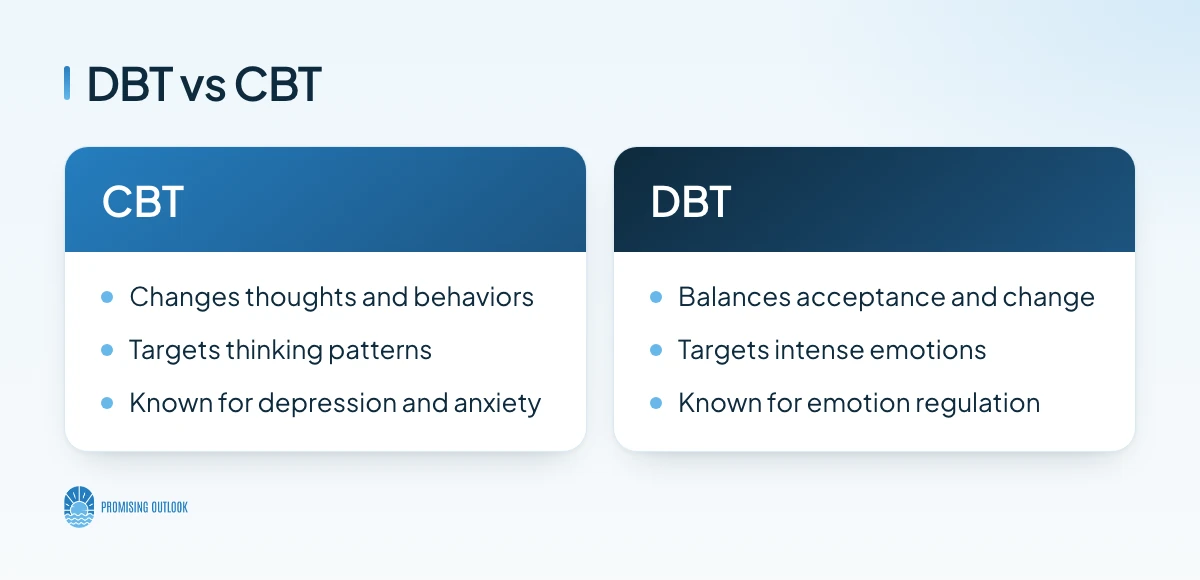
DBT is a form of cognitive behavioral therapy, so the two overlap. Both are structured, both teach skills, and both expect practice between appointments. The difference is emphasis.
| CBT | DBT | |
|---|---|---|
| Core idea | Change unhelpful thoughts and behaviors | Balance acceptance and change |
| Main target | Thinking patterns | Intense emotions and the behaviors they drive |
| Best known for | Depression and anxiety | Borderline personality disorder and emotion regulation |
| Typical format | Individual or group | Skills group plus individual therapy |
| Signature tools | Catching and testing thoughts | Mindfulness, distress tolerance, opposite action |
A simple way to choose: if your main problem is the story your mind tells you, CBT is usually the place to start. If your main problem is how hard your feelings hit and what you do when they do, DBT was built for that. Plenty of people use both. Our chapter on what cognitive behavioral therapy is covers the CBT side.
What a DBT Group Is Like
People expect group therapy where everyone shares their story. A dialectical behavior therapy (DBT) skills group is different. It's taught. The leader introduces one skill, explains when to use it, and walks through examples. Then the group talks about how last week's practice went: what worked, what didn't, and what got in the way.
That structure is a relief for many clients. You aren't put on the spot to talk about your worst day. You're there to learn something you can use tonight.
At Promising Outlook, DBT skills are part of our virtual groups and individual therapy for adults in California. Groups meet Monday through Friday over live video, with morning, midday, and evening times. If you want to know whether it fits what you're dealing with, call (951) 307-9554. A real person will answer, day or night.
How to Find a DBT Therapist
Dialectical behavior therapy should be delivered by a licensed mental health professional with specific training, and not everyone who mentions DBT has that training. When you talk to a potential DBT therapist or program, ask a few plain questions.
- What training do you have in DBT?
- Do you teach all four skill modules?
- Is it skills training only, or individual therapy too?
- How long do you ask clients to commit?
- What happens if I'm struggling between appointments?
A good answer is specific. If someone is unsure about change in the first place, DBT may not be the first step. Our chapter on what motivational interviewing is explains the approach built for that. And if you're still weighing whether therapy is worth it, read about the benefits of therapy.
We're in network with Aetna, Blue Shield, Cigna, Health Net, Tricare, and United. Call (951) 307-9554 or verify your insurance, and a real person will tell you what your plan covers.
Frequently Asked Questions
What does DBT stand for?
DBT stands for dialectical behavior therapy. "Dialectical" means that two ideas that seem opposite can both be true. In DBT, those two ideas are acceptance and change: accepting yourself and your feelings as they are, and working to change the behaviors that are hurting you.
What are the four skills of DBT?
The four DBT skills are mindfulness, distress tolerance, emotion regulation, and interpersonal effectiveness. Mindfulness and distress tolerance are acceptance skills. Emotion regulation and interpersonal effectiveness are change skills. Together they help people notice their emotions, survive hard moments, lower emotional intensity, and communicate clearly.
What is DBT used for?
DBT was originally developed for borderline personality disorder and has the strongest research for it. It's also used for other mental health conditions, including substance use disorders, depression, anxiety, trauma, and binge eating, and for anger. In general, DBT fits people who feel emotions very intensely and act on them in ways they later regret.
What is the difference between DBT and CBT?
CBT focuses on changing unhelpful thoughts and behaviors. DBT is a type of CBT that adds acceptance and mindfulness and focuses on managing intense emotions. CBT is best known for depression and anxiety. DBT is best known for borderline personality disorder and problems with emotion regulation.
How long does DBT take?
A standard DBT program usually lasts about six months to a year, which is the time it takes to learn and practice all four skill modules. Some people repeat the modules. Programs that teach DBT skills as one part of treatment may follow a different timeline based on the client's needs.
Does DBT work for addiction?
Research on DBT for people with both borderline personality disorder and a substance use disorder found greater reductions in drug use during a year of treatment compared with usual care. DBT skills help people handle cravings and strong feelings without using, which is why many addiction programs teach them.
Can you do DBT online?
Yes. DBT skills groups and individual therapy can both be delivered over live video. The skills, the practice between appointments, and the group discussion all work the same way. Clients join from a phone or computer.
Sources
- Chapman AL. Dialectical Behavior Therapy: Current Indications and Unique Elements. Psychiatry (Edgmont), 2006.
- University of Washington Behavioral Research and Therapy Clinics. Dialectical Behavior Therapy.
- Storebø OJ, et al. Psychological therapies for people with borderline personality disorder. Cochrane Database of Systematic Reviews, 2020.
