


Yes, insurance covers rehab in most cases. Under federal law, most individual and small group health plans must cover substance use disorder and mental health treatment, and parity rules stop plans from making that coverage harder to use than medical care. In California, state law goes further. What you pay still depends on your plan, your network and your level of care.
This guide explains how coverage works and the terms that decide your bill. It also shows how to check your benefits, what to do if a claim is denied, and how to pay for rehab when insurance doesn't cover everything. If you're ready to see which plans we work with, our page on insurance options for online rehab lists every plan we're in network with and how to check yours.
Key Takeaways
- Most health plans cover addiction and mental health treatment, including therapy, outpatient programs and inpatient care.
- Federal parity law says plans can't put tighter limits on mental health and substance use care than on medical care.
- California's SB 855 requires state-regulated plans to cover medically necessary mental health and substance use treatment, including intensive outpatient care.
- Your out-of-pocket cost comes down to your deductible, copays, coinsurance, out-of-pocket limit and whether the program is in network.
- Many plans require prior authorization before treatment starts, so check your benefits first.
- If a claim is denied, you have the right to appeal and, in many cases, to an outside review.
Does Insurance Cover Rehab
Insurance covers rehab for many people who have a health plan, but the details vary from plan to plan. Coverage usually includes counseling and therapy, outpatient and intensive outpatient programs, partial hospitalization, inpatient care, and medicine for opioid or alcohol use disorder. What changes from plan to plan is how much you pay, which programs you can use, and what approvals are needed first.
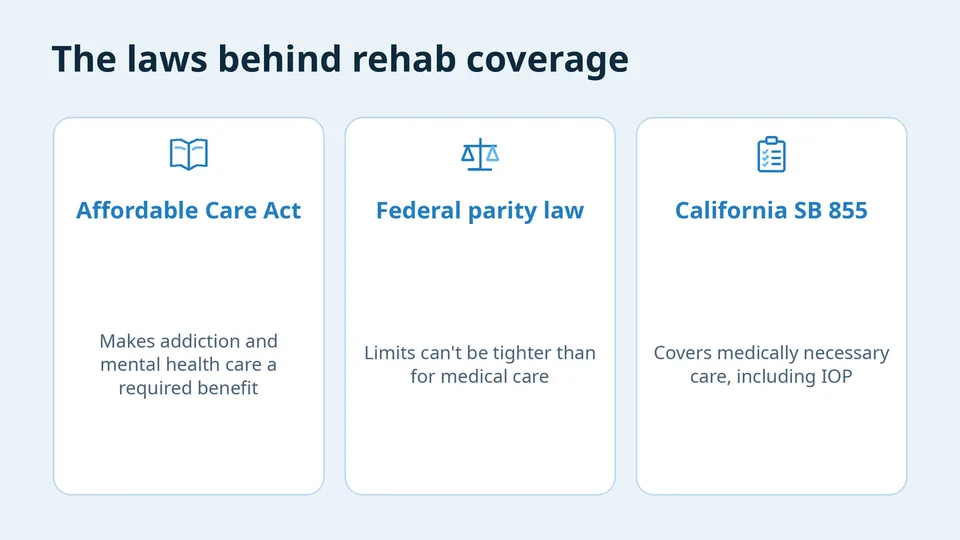
The reason coverage is so common comes down to two federal laws and, for Californians, one state law. The Affordable Care Act made mental health and substance use treatment a required benefit in most individual and small group plans. The Mental Health Parity and Addiction Equity Act stops plans from treating that care worse than medical care. California's SB 855 adds stronger rules for plans regulated by the state.
That doesn't mean every plan covers every program. Short-term health plans, some older "grandfathered" plans and some employer plans follow different rules. The only way to know what your plan pays is to check your benefits, which this guide walks through step by step.
Is Rehab Covered by Insurance Under Federal Law
Rehab is covered by insurance under federal law for most people who buy their own plan or get coverage through a small employer. Two laws work together here, and it helps to know what each one does and doesn't require.
The Affordable Care Act
The Affordable Care Act lists mental health and substance use disorder treatment as one of ten essential health benefits. HealthCare.gov says every Marketplace plan must cover behavioral health treatment such as psychotherapy and counseling, mental and behavioral health inpatient care, and substance use disorder treatment.1 The same rule applies to non-grandfathered individual and small group plans sold outside the Marketplace.2
The law also protects people with a history of addiction or mental illness. Marketplace plans can't deny you coverage or charge you more because of a pre-existing condition, and they can't set yearly or lifetime dollar limits on essential health benefits. A past stay in treatment does not stop you from getting a plan.
The Mental Health Parity and Addiction Equity Act
The Mental Health Parity and Addiction Equity Act, passed in 2008, is the federal parity law. It says that when a plan covers mental health or substance use treatment, it can't put less favorable limits on that care than it puts on medical and surgical care. The rules compare mental health and substance use benefits with medical and surgical benefits within the same benefit category, such as in-network outpatient care.
Parity covers three kinds of limits. The table below shows each one with the examples federal agencies use:
| Type of Limit | Examples | What Parity Means |
|---|---|---|
| Financial requirements | Deductibles, copays, coinsurance, out-of-pocket limits | Can't be higher for addiction or mental health care than for comparable medical care |
| Treatment limits | Caps on the number of visits or days covered | Can't be tighter than caps on medical care |
| Care management rules | Prior authorization before treatment starts | Can't be stricter or applied more often than for medical care |
There's one important limit to the parity law. It doesn't require a plan to cover mental health or substance use treatment in the first place, and it doesn't apply directly to small group plans, which generally means employers with 50 or fewer workers. Those small plans are covered by the Affordable Care Act's benefit rule instead.
California's Mental Health Parity Law
California has its own parity law that reaches further than federal rules. Senate Bill 855 took effect for plans that began or renewed in 2021. It requires state-regulated commercial health insurance to cover all medically necessary care to prevent, diagnose or treat mental health conditions and substance use disorders.3
The California Department of Insurance lists intensive outpatient treatment, residential treatment and hospital stays among the benefits that must be covered. The law also bars insurers from limiting coverage to treating only acute symptoms, and it says the length of treatment can't be subject to arbitrary limits. When a network provider can't offer timely care nearby, the insurer must arrange care from an out-of-network provider.
SB 855 applies to plans regulated by the state. Some large employers pay claims themselves through what is called a self-funded plan, and those plans follow federal rules instead. Your benefits booklet or HR department can tell you which kind of plan you have.
Does Health Insurance Cover Rehab at Every Level of Care
Health insurance covers rehab across most levels of care, but each level has its own rules. Plans pay for the level a clinician decides is medically necessary, so a plan may approve an intensive outpatient program for one person and residential care for another. A person's level can also change during treatment, and coverage usually follows that change when the clinical records support it.
The table below shows the main levels of care and how coverage usually works for each one. Your plan's documents have the final word.
| Level of Care | What It Is | How Plans Usually Cover It |
|---|---|---|
| Detox | Medical care while a substance leaves your body | Covered when medically necessary; often needs approval |
| Residential or inpatient | You live at the treatment center | Covered; prior authorization is common |
| Partial hospitalization (PHP) | Treatment most of the day while you live at home | Covered; prior authorization is common |
| Intensive outpatient (IOP) | Treatment several days a week while you live at home | Covered; may need prior authorization |
| Outpatient therapy | Weekly or less frequent counseling | Covered with a copay or coinsurance |
| Medication for addiction | Medicine such as buprenorphine or naltrexone | Covered as a prescription or medical benefit |
If you're trying to figure out which level fits, our guide to inpatient vs outpatient rehab compares them side by side. For a closer look at the most common outpatient option, read what an IOP is and how a week in one works. Intensive outpatient programs also have their own coverage questions, from how many weeks a plan approves to how therapy visits are billed. Our chapter on whether insurance covers IOP goes through them in detail.
Does Insurance Cover Virtual Rehab
Insurance usually covers virtual rehab the same way it covers in-person care. Virtual programs bill for the same levels of care, such as intensive outpatient or partial hospitalization, and plans review them with the same medical necessity rules. The difference is where you sit during group, not what kind of treatment you get.
California law backs this up. Assembly Bill 744 requires state-regulated health plans to cover care appropriately delivered through telehealth and to pay for it on the same basis and to the same extent as in-person care.4 For plans issued or renewed on or after January 1, 2021, your copay or coinsurance for telehealth can't be higher than it would be for the same care in person.
Plans aren't required to cover out-of-network telehealth, so network status still matters for a virtual program. Self-funded employer plans follow federal rules rather than this state law, which is another reason to check your benefits before you start. If you're wondering whether virtual care works as well as in-person care, our chapter on whether online therapy is effective looks at the research.
Insurance Terms That Decide What You Pay
A handful of insurance terms decide how much of the bill lands on you. Knowing them makes it much easier to read your benefits and to understand what a program tells you when it checks your coverage. These are the terms that matter most, using the definitions from HealthCare.gov:5
- Premium: what you or your employer pay each month to have the plan.
- Deductible: the amount you may owe for covered care each year before the plan starts paying.
- Copayment: a set dollar amount, such as $15, you pay for a covered visit.
- Coinsurance: your percentage share of the cost, such as 20%, usually after the deductible.
- Out-of-pocket limit: the most you pay in a year for covered care, after which the plan usually pays 100%.
- Allowed amount: the most your plan will pay for a covered service, sometimes called the negotiated rate.
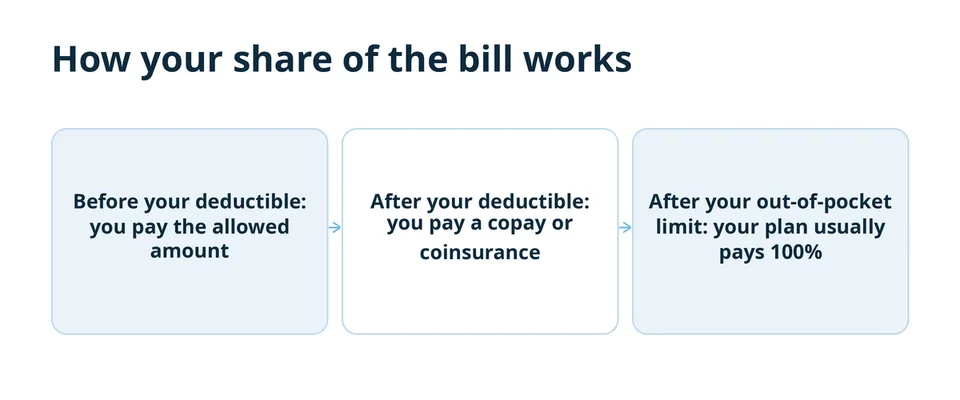
Here's how those pieces fit together. Early in the year, before you meet your deductible, you may pay the full allowed amount for treatment. After the deductible, you pay your copay or coinsurance. Once you hit your out-of-pocket limit, the plan usually pays the rest for covered care for the rest of the year. Premiums don't count toward that limit, and neither does anything you pay for care your plan doesn't cover. That's why the month you start treatment can change your bill: starting late in the year, after you've already met your deductible, often costs less than starting in January.
The cost of an intensive outpatient program depends on how these terms line up with where you are in your plan year. Our chapter on how much IOP costs with insurance walks through worked examples.
In Network and Out of Network
Whether a program is in network is often the single biggest factor in what you pay. An in-network provider has a contract with your plan and has agreed to its rates. An out-of-network provider has no contract, and you usually pay more to use one.5
Network status also protects you from surprise bills. Balance billing is when a provider bills you for the gap between its charge and what your plan allows, and network providers generally can't do that for covered care. Some plans, such as HMOs and EPOs, don't pay for out-of-network care at all except in emergencies.
Our chapter on in network vs out of network explains how to check a program's status and what each choice costs. Promising Outlook is in network with Aetna, Blue Shield, Cigna, Health Net, Tricare and United.
Prior Authorization and Medical Necessity
Prior authorization is your plan's decision, made before treatment starts, that a treatment is medically necessary. Many plans require it for residential care, partial hospitalization and intensive outpatient programs. HealthCare.gov notes that approval is usually required before care begins and doesn't guarantee the plan will pay.5
Medically necessary means care that is needed to prevent, diagnose or treat a condition and that meets accepted standards of care. The program you choose usually handles the request by sending your plan an assessment that shows why a level of care fits. Under parity rules, your plan can't use stricter approval rules for addiction or mental health care than for comparable medical care.1
In practice, prior authorization is mostly paperwork the program does for you. It can take a day or more, which is one reason it helps to call early. A good admissions team will tell you what was approved, for how long, and when the next review is.
How Coverage Works With Specific Insurance Companies
Every insurance company runs its behavioral health benefits a little differently, even when the law sets the floor. Some insurers manage mental health and addiction care in house, and others hand it to a separate company. Knowing who manages your benefits tells you who to call and whose network to check.
We've written chapters on the plans California families ask about most:
- Does Aetna cover mental health care, telehealth and virtual programs
- How Blue Shield telehealth and behavioral health benefits work
- How veterans and military families can get a VA intensive outpatient program covered through community care or Tricare
- How Optum rehab coverage works for UnitedHealthcare members
Each chapter covers what that insurer's plans generally include and what to ask before you start. Plans vary even within one company, so treat these chapters as a starting point, not a promise of coverage.
How to Check Your Coverage Before You Start
Checking your coverage before treatment starts saves you from surprises later. You can do it yourself, or a treatment program can do it for you with your insurance card. Many people do a bit of both.
The U.S. Department of Labor suggests starting with your plan's documents and the phone number on your insurance card.6 Work through these steps:
- Find your Summary of Benefits and Coverage, which lists your deductible, copays and out-of-pocket limit.
- Call the member services number on the back of your card and ask for behavioral health or substance use benefits.
- Ask whether the program you're considering is in network and whether intensive outpatient care needs prior authorization.
- Ask how much of your deductible you've already met this year.
- Write down the name of the person you spoke with, the date and a reference number.
You also have the right to ask your plan for the criteria it uses to decide medical necessity and prior authorization. The Department of Labor says plans must provide those documents within 30 days of your request. That can help if you're comparing options or preparing an appeal.
The faster route is to let the program check for you. When you verify your insurance with us, a real person calls your plan, finds out what's covered, and explains it to you before you commit to anything. You'll know your deductible, your share of the cost and whether approval is needed before your first group.
What to Do If Your Claim Is Denied
If your plan denies a claim or a request for treatment, you can appeal. A denial is not the end of the conversation, and a plan may change its decision once it sees more information from your treatment team. For most employer plans, the Department of Labor lays out these timelines:6
| Step | Your Deadline | The Plan's Deadline |
|---|---|---|
| Internal appeal to your plan | Usually 180 days from the denial | Generally 60 days to decide |
| External review by an independent reviewer | Generally within four months under the federal process. State review deadlines can differ. | 45 days to decide |
Ask your plan for the denial in writing and for the criteria it used. Then ask your treatment team to send records that show why the care is medically necessary. If you think your plan is applying stricter rules to addiction or mental health care than to medical care, parity law may protect you, and your state insurance regulator can help.
In California, plans regulated by the Department of Managed Health Care and the Department of Insurance must follow SB 855. That law requires coverage of medically necessary care and bars arbitrary limits on how long treatment lasts.3
How to Pay for Rehab Without Full Coverage
If insurance doesn't cover all of your treatment, there are still ways to pay for rehab. Start by asking the program what your share will be once your plan pays its part. Many people find that their costs drop sharply once they meet their deductible or out-of-pocket limit.
These are the options many people look at when insurance falls short:
- A sliding-fee scale, where the price depends on how much you make, which many providers offer7
- A payment plan that spreads your share over several months
- An employer assistance program, which some jobs offer for counseling and referrals
- State and county programs for people with no insurance or public coverage
- Getting a health plan through Covered California or your employer if you don't have one now
If you have Medi-Cal or another Medicaid plan, we're not the right fit, because Promising Outlook doesn't accept Medicaid or Medi-Cal. When someone with that coverage calls us, a real person helps them find a program that can take their plan. SAMHSA's National Helpline is another free, confidential place to get referrals, 24 hours a day.8
Money is a real worry, but it shouldn't be the reason someone waits. Our post on how to get sober covers the first steps you can take while you sort out coverage.
How Insurance Works at Promising Outlook
At Promising Outlook, a real person handles the insurance part with you. When you call or check your coverage online, a real person calls your plan, finds out what your benefits include, and walks you through it. Someone will sit with you and help with any form, and if we don't know an answer, we'll say so and go find it.
We're a Joint Commission accredited program in Riverside, licensed and in network for both addiction and mental health treatment. Our virtual IOP in California meets over live video five days a week, with groups at 9:00 a.m., 12:00 p.m. and two at 5:00 p.m. We treat virtual addiction treatment and virtual mental health treatment together, so people living with both get care for both.
Your treatment timeline depends on your care plan and benefits. Ask admissions what options are available if coverage ends before you finish treatment. Our page on how admissions works explains the steps, and same-day admission is possible once your coverage is confirmed.
Call us to talk about your plan. A real person will answer, day or night. We're in network with Aetna, Blue Shield, Cigna, Health Net, Tricare and United, and we're currently out of network with Anthem.
Frequently Asked Questions
Does insurance cover rehab?
Yes, for many people with a health plan. The Affordable Care Act requires most individual and small group plans to cover substance use disorder and mental health treatment, and parity law bars tighter limits than for medical care. Your actual costs depend on your plan, your deductible and whether the program is in network.
Is rehab covered by insurance if I have a job-based plan?
Usually, yes. Most employer plans cover mental health and substance use treatment, and when they do, federal parity law says the limits can't be stricter than for medical care. Large self-funded plans follow federal rules, while state-regulated plans in California must also follow SB 855.
Does health insurance cover outpatient rehab?
Yes. Most plans cover outpatient therapy, intensive outpatient programs and partial hospitalization when a clinician finds them medically necessary. Some plans require prior authorization for intensive outpatient and partial hospitalization programs. You'll usually pay a copay or coinsurance after your deductible is met.
How do I pay for rehab without insurance?
Ask programs about sliding-fee scales and payment plans, look into state and county treatment programs, and check whether your employer offers an assistance program. If you're eligible, enrolling in a health plan through Covered California or your job can make treatment far more affordable.
What is prior authorization for rehab?
Prior authorization is your plan's approval, before treatment starts, that a level of care is medically necessary. The treatment program usually sends the request with your assessment. Approval can take a day or more and doesn't guarantee payment, so it helps to start early.
What can I do if my insurance denies rehab?
Ask for the denial and the plan's criteria in writing, then file an internal appeal, usually within 180 days. Your treatment team can send records showing why care is needed. If the plan still says no, check the denial notice for external review eligibility, the deadline and where to file.
Does insurance cover virtual rehab?
Usually, yes. Virtual intensive outpatient and partial hospitalization programs are billed as the same levels of care as in-person programs. In California, AB 744 requires state-regulated plans to cover appropriate telehealth care on the same basis as in-person care, with cost sharing no higher than an in-person visit.
Does Promising Outlook accept Medi-Cal?
No. Promising Outlook doesn't accept Medi-Cal or Medicaid. If you call with that coverage, a real person will help you find a program that can take your plan. We're in network with Aetna, Blue Shield, Cigna, Health Net, Tricare and United.
Sources
- HealthCare.gov. Mental health and substance abuse health coverage options.
- Centers for Medicare and Medicaid Services. The Mental Health Parity and Addiction Equity Act (MHPAEA).
- California Department of Insurance. Fact Sheet on Senate Bill 855.
- California Legislature. Assembly Bill 744, Health care coverage: telehealth (Chapter 867). 2019.
- HealthCare.gov. Glossary of Health Coverage and Medical Terms.
- U.S. Department of Labor, Employee Benefits Security Administration. Understanding Your Mental Health and Substance Use Disorder Benefits.
- Substance Abuse and Mental Health Services Administration. Free and Low Cost Treatment Options for Mental Health and Substance Use.
- Substance Abuse and Mental Health Services Administration. SAMHSA's National Helpline.
