


Healthy ways to cope with stress include slowing your breathing, moving your body, talking to someone you trust, writing down what's bothering you and tackling one small piece of the problem. Unhealthy ways, like drinking, using drugs or shutting everyone out, bring quick relief but make stress worse over time. Having a few healthy options ready is what makes the difference on a hard day.
This chapter is part of our guide to stress management skills. Many of the tools below come from cognitive behavioral therapy, and our CBT for addiction teaches them in a structured way for adults across California.
Key Takeaways
- Healthy coping calms your body, shifts your thinking or changes the situation, without creating new problems.
- The CDC lists increased alcohol and substance use among common reactions to stress.
- Research shows stress and negative mood are linked to stronger cravings and a higher risk of alcohol relapse.
- Having a short list of go-to coping skills makes it easier to use them in the moment.
- Stress management in recovery is a core part of staying sober.
Healthy vs Unhealthy Ways to Cope With Stress
Everyone copes with stress somehow. The question is whether the way you cope helps over time or just for the next hour. Healthy coping lowers stress and leaves you better able to handle what's next. Unhealthy coping numbs stress briefly, then adds to it. The table below shows the difference.
| Healthy Coping | Unhealthy Coping | Why It Matters |
|---|---|---|
| Slow breathing or a short walk | A drink or a pill to calm down | Substances bring rebound anxiety and can lead to dependence |
| Calling a friend | Isolating and avoiding everyone | Isolation makes stress feel bigger and harder to solve |
| Writing the problem down and planning one step | Avoiding the problem completely | Avoidance lets the problem grow |
| Steady sleep and meals | Skipping sleep and meals to get more done | A tired, hungry body reacts more strongly to stress |
| Limiting news and scrolling | Hours of doomscrolling | Constant bad news keeps your stress system switched on |
Many people use some of both. The goal isn't perfection. It's to reach for the healthy options more often, especially when stress is high. Knowing what causes stress in your own life makes it easier to pick the right tool.
Ways to Cope With Stress in the Moment
When stress spikes, you need tools that work fast. These quick skills calm your body and buy you enough space to think before you react. They're worth practicing on easy days, so they're ready on hard ones:
- Slow your breathing. Breathe in for four counts and out for six, for two to three minutes.
- Ground yourself. Name five things you can see, four you can hear and three you can touch.
- Move. Walk around the block, stretch or climb a flight of stairs.
- Change your setting. Step outside, go to another room or take a short break.
- Splash cool water on your face or hold something cold. It can help reset an overloaded body.
- Reach out. Text or call someone and say you're having a hard moment.
- Write it down. Put the worry on paper so it's not just spinning in your head.
The CDC recommends healthy ways to unwind, like deep breathing, stretching, meditation and doing things you enjoy.1 The National Institute of Mental Health also suggests apps with relaxation exercises as an easy way to practice.2
Tips for Dealing With Stress Day to Day
Quick skills help in the moment, but daily habits lower your stress level over time. People who take care of the basics tend to bounce back faster when something goes wrong. These tips for dealing with stress come from federal health guidance:
- Keep a regular sleep schedule and aim for seven or more hours a night.1
- Build up to about two and a half hours of physical activity a week.
- Eat regular, balanced meals.2
- Cut back on caffeine.
- Limit alcohol and avoid tobacco and vaping.
- Take breaks from news and social media.
- Notice and challenge negative, unhelpful thoughts.
- Stay connected with people you trust.
Pick one or two to start, rather than all eight. A small habit you keep every day does more than a big plan you abandon in a week. Our chapter on how to reduce stress goes deeper on building these habits over time.
Change the Thought to Change the Stress
How you think about a stressful situation shapes how stressed you feel. The NIMH recommends identifying and challenging negative and unhelpful thoughts.2 That's the heart of cognitive behavioral therapy.
Here's a simple way to try it. When you notice a stressful thought, like "I'm going to get fired," write it down. Ask what evidence supports it and what evidence doesn't. Then write a more balanced thought, like "My boss is frustrated about this project, and I can fix the parts that went wrong." The situation hasn't changed, but your stress usually drops a notch.
Skills from dialectical behavior therapy help too, especially when emotions run high. DBT teaches distress tolerance, which means getting through a painful moment without making it worse. Our chapter on what dialectical behavior therapy is explains these skills.
Stress and Addiction
Stress and addiction are tightly linked. Many people first started drinking or using as a way to cope with stress, and for a while it seemed to work. The CDC lists increased use of alcohol, tobacco and other substances among the common reactions to stress.1
Long-term heavy drinking can change how the body responds to stress. A review in the NIAAA journal Alcohol Research: Current Reviews explains that long-term heavy drinking causes changes in the brain's stress and reward systems.3 The same review notes that stress has long been known to raise the risk of alcohol relapse, and that negative mood and stress are linked to stronger cravings.
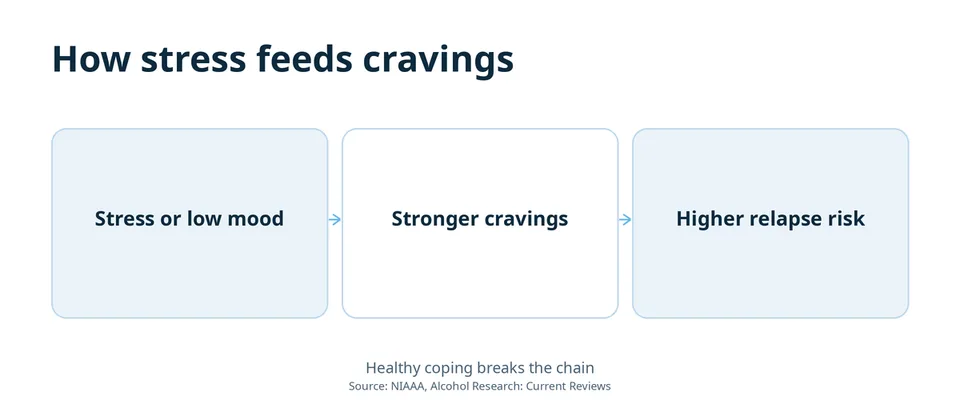
In other words, the thing that once seemed to ease stress ends up making you more sensitive to it. That's why learning new ways to cope isn't optional in recovery. It's one of the main jobs.
Stress Management in Recovery
Stress management in recovery works best when it's built into your relapse prevention plan. Name your biggest stressors, the early signs that stress is building and the specific skills you'll use. Then share that plan with your therapist or group so they can help you stick to it.
A few habits are especially helpful in recovery. A quick HALT check catches stress before it turns into cravings. Ask yourself if you're hungry, angry, lonely or tired, then deal with that need first. Calling someone from your group when stress builds keeps you from facing it alone. And steady routines for sleep, meals and movement keep your baseline stress lower. Our chapter on how to stay sober covers these habits across each stage of recovery.
It also helps to expect stress during big changes. Getting a new job, ending a relationship, moving or even celebrating a sobriety milestone can all stir up stress. Planning ahead for those moments makes them far less risky.
When Coping Isn't Enough
Sometimes stress is more than everyday coping skills can handle. The NIMH says that if you're struggling to cope or your symptoms don't go away, it may be time to talk with a professional.2 Consider getting help if stress is affecting your work or relationships, keeping you up most nights or pushing you toward drinking or using.
Structured care can make a big difference. Our virtual IOP for mental health helps people whose stress has turned into anxiety or depression, and our virtual addiction treatment treats substance use and stress together in the same plan.
Coping With Stress at Promising Outlook
At Promising Outlook, coping skills are practiced every day in group. You learn a skill, try it during the week and bring back what worked and what didn't. Groups meet Monday through Friday at 9:00 a.m., 12:00 p.m. and 5:00 p.m., by live video for adults across California.
Individual therapy, family therapy and medication management are built in. Treatment length varies. Clients leave with an aftercare plan and a relapse prevention plan that includes their stress triggers and coping skills.
Call us and a real person will answer, day or night. Same-day starts are often possible. You can also verify your insurance online. We're in network with Aetna, Blue Shield, Cigna, Health Net, Tricare and United.
Frequently Asked Questions
What are healthy ways to cope with stress?
Healthy ways include slow breathing, grounding, a short walk, talking to someone you trust, writing down what's bothering you and tackling one small step of the problem. Over time, steady sleep, regular exercise, balanced meals, less caffeine and limits on news and social media lower your overall stress.
What are some quick tips for dealing with stress?
Breathe in for four counts and out for six for a few minutes. Name five things you can see, step outside or change rooms, splash cool water on your face or text a friend. These quick tools calm your body and give you space to think before you react.
How are stress and addiction connected?
Many people start drinking or using to cope with stress. Over time, heavy use changes the brain's stress and reward systems, making people more sensitive to stress. Research shows stress and negative mood are linked to stronger cravings and higher relapse risk, so healthy coping is central to recovery.
How do you manage stress in recovery?
Build stress into your relapse prevention plan by naming your stressors, early warning signs and go-to coping skills. Run a HALT check when moods dip, call someone from your group when stress builds, keep steady routines and plan ahead for big life changes. Share your plan with your therapist.
Is drinking a healthy way to cope with stress?
No. Alcohol may feel calming at first, but it brings rebound anxiety, disrupts sleep and can lead to dependence. Long-term heavy drinking changes how the brain handles stress, which can make stress harder to manage. The CDC recommends limiting alcohol as part of coping with stress.
When should I get help for stress?
Get help if you're struggling to cope, if symptoms don't go away, or if stress is affecting your work, relationships or sleep. Reach out right away if you're drinking or using to cope. A therapist or structured program can teach skills and treat any anxiety or depression underneath.
Sources
- Centers for Disease Control and Prevention. Managing Stress.
- National Institute of Mental Health. I'm So Stressed Out! Fact Sheet.
- Sinha R. How Does Stress Lead to Risk of Alcohol Relapse? Alcohol Research: Current Reviews, 2012.
