


To get into rehab, call a treatment program, have your insurance checked, complete a short assessment and pick a start date. Many programs can do all of that in one phone call, and some offer same day rehab admission, so you can start treatment the day you decide you're ready. The hardest part is usually making the first call.
This chapter is part of our guide to inpatient vs outpatient rehab. If you're ready now, virtual addiction treatment at Promising Outlook lets you start from home in California, often the same day you reach out.
Key Takeaways
- Getting into rehab usually takes one call, an insurance check and an assessment.
- Same day rehab admission is possible at many outpatient programs when you're medically stable.
- If you drink heavily every day or use benzodiazepines, you may need medical detox first.
- NIDA says treatment does not have to be voluntary to work.
- Federal law may protect your job and the privacy of your treatment records.
How to Get Into Rehab Step by Step
The process is shorter than many people expect. You don't need a referral from a doctor for most programs, and you don't need to have everything figured out before you call. These are the usual steps from first call to first day:
- Call a program, or fill out a form online, and say you want help.
- Share your insurance information so the program can check your benefits.
- Complete an assessment by phone or video about your use, health and safety.
- Agree on a level of care, such as detox, residential, PHP, IOP or outpatient.
- Pick a start date and time, and get the details for your first group.

A good admissions team walks you through each step and explains what they find. At Promising Outlook, our admissions team handles the insurance check and assessment while you're on the phone, so you're not left waiting for a callback.
What to Have Ready Before You Call
You don't need much to start, and none of it should stop you from calling. Having a few things nearby makes the call faster and helps the team give you clear answers about cost and timing. Try to have these on hand:
- Your insurance card, front and back, or the name of your plan.
- A list of medicines you take, including doses.
- A rough idea of what you use, how much and how often.
- When you last drank or used, and whether you've had withdrawal before.
- Any mental health diagnoses or past treatment.
- The days and times you're free for treatment.

Be honest about your use, even if it feels hard to say out loud. The admissions team isn't there to judge you. They need accurate answers to keep you safe, especially about withdrawal, and to place you in the right level of care.
How Same Day Rehab Admission Works
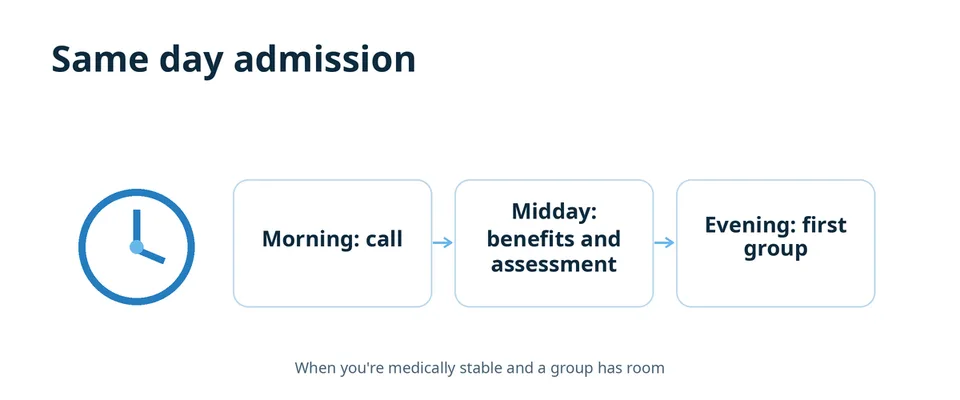
Same day rehab means you can call in the morning and be in treatment that afternoon or evening. It's most common in outpatient and intensive outpatient programs, especially those that meet by video, because there's no bed to wait for and no travel to arrange. Your benefits check, assessment and first group can all happen the same day.
Same day rehab admission depends on two things. First, you need to be medically stable, which means you're not at risk of dangerous withdrawal. Second, the program needs an open spot. An assessment, required paperwork and any insurance approval can also affect when you start.
If you need medical detox first, then how to get into rehab immediately starts with getting into detox immediately. Our chapter on detox vs rehab explains who needs detox and why. A good outpatient program can help you find a detox bed and plan your start with them for when you finish.
Questions to Ask a Rehab Program
Not every program is the same, and a few questions can tell you a lot. The NIAAA's Alcohol Treatment Navigator suggests ten questions to ask any program before you commit.1 The table below groups the most useful ones with what a good answer sounds like.
| Question | Why It Matters | What a Good Answer Sounds Like |
|---|---|---|
| How soon could I start? | Waiting can cost momentum | Today or within a few days |
| Will my insurance cover it, and what will I pay? | Avoids surprise bills | A clear estimate after a benefits check |
| Is the program licensed and accredited? | Shows outside review of quality | Yes, with the name of the accrediting body |
| Do you start with a full assessment? | Care should fit you | Yes, and the plan is built from it |
| Can you arrange medication if it fits? | Medication helps many people | Yes, with a prescriber on the team |
| How do you treat mental health needs? | Depression and anxiety often come along | Both are treated together by the same team |
| What happens if I relapse? | Setbacks are common | Treatment adjusts, and you aren't dismissed |
| What happens after treatment? | Recovery continues after discharge | A written aftercare plan and ongoing support |
Promising Outlook is accredited by The Joint Commission, which reviews health care organizations against national standards. You can ask us any of these questions on your first call.
How to Pay for Rehab
Cost is one of the biggest worries people have, and it's also one of the easiest to sort out early. Most health plans cover addiction treatment, and an admissions team can check your benefits in a few minutes. You can also verify your insurance online before you call.
Some plans require prior authorization before treatment starts. HealthCare.gov notes that preauthorization is not a promise your plan will cover the cost, so it's worth asking the program what they've confirmed.2 Our guide to insurance for rehab covers deductibles, copays and network status in detail.
If you don't have insurance, there are still options. SAMHSA's National Helpline at 1-800-662-4357 is a free, confidential treatment referral and information service available 24 hours a day, every day of the year, and it can point you toward programs that fit your situation.3
Will Getting Into Rehab Affect Your Job
Many people put off treatment because they're afraid of losing their job. Federal law may help. The Family and Medical Leave Act can give eligible employees up to 12 weeks of job-protected leave a year for treatment of a serious health condition, and that can include treatment for substance use from a health care provider.4 Leave covers treatment, not absences caused by using.
Your treatment records also have strong privacy protections. Federal rules known as 42 CFR Part 2 limit how identifiable substance use treatment records from covered programs can be used and shared.5 If you choose evening or midday groups by video, you may be able to get care without taking time off at all.
How to Help Someone Else Get Into Rehab
Helping someone you love get into treatment is hard, and it rarely goes perfectly the first time. Start with a calm, private conversation at a time when they're sober. Talk about specific things you've seen and how they've affected you, and avoid labels or blame. Then offer concrete help, like making the call together.
It helps to have a program lined up before the talk, so you can act while they're open to it. Motivational interviewing, a counseling approach that helps people find their own reasons to change, can guide how you listen and respond. Our chapter on what motivational interviewing is explains how it works.
If they say no, it's not the end of the story. NIDA notes that treatment does not need to be voluntary to be effective, and pressure from family, employers or the courts can increase how many people enter and stay in treatment.6 Keep the door open, take care of yourself and try again.
Not sure whether your own drinking or someone else's has crossed a line? Our post do I have a drinking problem walks through the signs.
Choosing the Right Level of Care
Your assessment will point toward a level of care, and knowing the options helps you understand the recommendation. Rehab ranges from 24-hour care to a few hours a week. Many people move through more than one level as they get stronger, and the main options look like this:
- Medical detox for safe withdrawal, usually for a few days.
- Residential treatment, where you live at the facility.
- Partial hospitalization, several hours a day on most weekdays.
- Intensive outpatient, three or more days a week while you live at home.
- Standard outpatient, usually weekly therapy or group.
Our chapter on what outpatient treatment is explains the outpatient levels in more depth. You can also see our virtual treatment programs to compare what each level looks like at Promising Outlook.
Getting Into Rehab at Promising Outlook
Promising Outlook offers partial hospitalization, intensive outpatient and outpatient care by live video for adults across California. We don't provide detox or residential care, but we'll help you find them if you need them first. Most clients who are medically stable can start the same day they call.
Groups meet Monday through Friday at 9:00 a.m., 12:00 p.m. and 5:00 p.m. Individual therapy, family therapy and medication management, including Suboxone and Vivitrol, are part of care. Treatment length varies. Clients leave with an aftercare plan and a relapse prevention plan.
Call us and a real person will answer, day or night. We'll check your benefits, complete your assessment and, if you're ready, get you into a group today. We're in network with Aetna, Blue Shield, Cigna, Health Net, Tricare and United.
Frequently Asked Questions
How do I get into rehab?
Call a treatment program or fill out its online form. The team will check your insurance, complete an assessment about your use, health and safety, and recommend a level of care. Then you pick a start date. Many outpatient programs can do all of this in one call and start you that day.
Can I get into rehab the same day?
Often, yes. Same day rehab admission is common in outpatient and intensive outpatient programs, especially virtual ones, because there's no bed to wait for. You need to be medically stable and not at risk of dangerous withdrawal. If you need detox first, the program can help you find it.
What should I bring or have ready for rehab admission?
Have your insurance card, a list of your medicines and doses, and a rough idea of what you use and when you last used. Mention any past withdrawal, mental health diagnoses or treatment. For virtual programs, you'll also need a private space and a phone, tablet or computer with a camera.
Do I need a doctor's referral to go to rehab?
Usually not. Most programs accept you directly after their own assessment, and you can call them yourself. Some insurance plans require prior authorization, which the program typically requests for you. If your plan needs a referral from a primary care doctor, the admissions team can tell you during the benefits check.
Can I lose my job for going to rehab?
Federal law may protect you. The FMLA can give eligible employees up to 12 weeks of job-protected leave a year for substance use treatment from a provider. It covers treatment, not absences caused by using. Evening or midday virtual groups may also let you get care without taking time off.
How can I get a loved one into rehab?
Talk with them calmly and privately when they're sober, share specific things you've noticed, and offer to make the call together. Have a program ready before you talk. If they refuse, keep the door open. NIDA notes treatment doesn't have to be voluntary to work, and outside pressure can help.
Sources
- National Institute on Alcohol Abuse and Alcoholism. Questions for Alcohol Treatment Programs. NIAAA Alcohol Treatment Navigator.
- HealthCare.gov. Glossary of Health Coverage and Medical Terms.
- Substance Abuse and Mental Health Services Administration. SAMHSA's National Helpline.
- U.S. Department of Labor. FMLA Advisor: Leave for Treatment of Substance Abuse.
- U.S. Department of Health and Human Services. Fact Sheet: 42 CFR Part 2 Final Rule. 2024.
- National Institute on Drug Abuse. Principles of Drug Addiction Treatment: A Research-Based Guide (Third Edition). 2018.
