


IOP can last several weeks to several months, depending on your needs. In one historical SAMHSA dataset, the median stay among people who completed substance use IOP in 2017 was 81 days. Each week, adults get at least nine hours of care, often about three hours a day, three days a week.
This chapter is part of our guide to what IOP is, and it covers the weeks, the weekly hours, a sample schedule and what decides how long you stay. At our virtual IOP in California, we describe IOP as a 9- to 12-week program. Your own timeline may vary.
Key Takeaways
- IOP can last several weeks to several months. Your treatment needs and progress help determine the length.
- Adults in IOP get at least nine hours of care a week, often three days a week for about three hours.
- NIDA says most people with addiction need at least three months of treatment to significantly cut back or stop.
- Length depends on progress, needs, insurance approval and life outside treatment.
- Many people step down to standard outpatient care after IOP instead of stopping all at once.
How Long Does IOP Last
IOP usually lasts somewhere between several weeks and several months. SAMHSA's data on adults who completed intensive outpatient treatment for substance use showed a median stay of 81 days in 2017.1 Median means half stayed longer and half stayed shorter, so many people's time in IOP falls well outside that number.
IOP also tends to run longer than a short inpatient stay. Inpatient care packs treatment into a few weeks away from home, while IOP spreads it out so you can practice skills in your real life between groups. A research review of substance use IOPs found them as effective as inpatient treatment for most people, which is part of why so many people choose the longer, at-home route.2
The research also points to a minimum that matters. The National Institute on Drug Abuse says remaining in treatment for an adequate period is critical, and that most people with addiction need at least three months to significantly reduce or stop their drug use.3 NIDA adds that the best outcomes come with longer treatment.
How Many Hours a Week Is IOP
For adults, IOP provides at least nine hours of care each week. SAMHSA sets that minimum in its guidance on intensive outpatient treatment, built from individual counseling, group therapy, family education and case management.1 Many programs meet three days a week for about three hours a day, though some meet more often or for longer.
Here's how IOP's weekly hours compare with the levels of care around it:
| Level of Care | Hours per Week | Typical Pattern |
|---|---|---|
| Standard outpatient | Fewer than 9 | One or two visits a week |
| Intensive outpatient (IOP) | 9 to 19 | About three hours a day, three or more days a week |
| Partial hospitalization (PHP) | 20 or more | Several hours a day, most weekdays |
Those ranges follow the ASAM Criteria, the standard framework for levels of addiction care.4 If you need more hours than IOP offers, our chapter on PHP vs IOP compares the next level up.
What an IOP Schedule Looks Like
An IOP schedule is built around group times, with individual therapy and other care fit around them. Most programs offer a few group times so you can pick one that fits your life. At Promising Outlook, groups run Monday through Friday with a morning group at 9:00 a.m., a midday group at 12:00 p.m. and two evening groups at 5:00 p.m., and IOP clients attend three days a week.
Here's a sample week for someone in a morning IOP. It's an example to show how the pieces fit, and your own plan may differ.
| Day | Program | Rest of the Day |
|---|---|---|
| Monday | Group at 9:00 a.m. | Work in the afternoon |
| Tuesday | Individual therapy | Work, practice a skill from group |
| Wednesday | Group at 9:00 a.m. | Work in the afternoon |
| Thursday | No group | Family time or a recovery meeting |
| Friday | Group at 9:00 a.m. | Plan for the weekend |
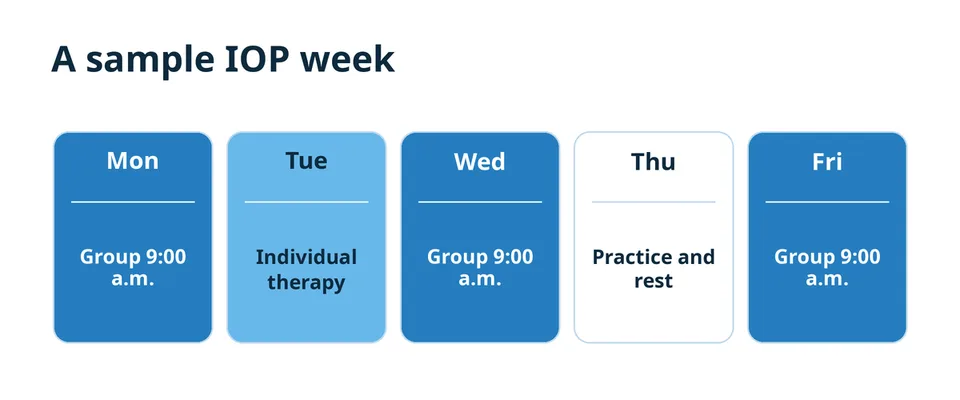
Inside each group day, the routine is steady. Group starts with a check-in, moves through two topic blocks of 45 to 50 minutes with breaks between them, and ends with 15 to 20 minutes to close out and decide together what to talk about tomorrow. Groups also work by video for many people, as our chapter on whether online therapy is effective explains. If evenings work better for you, our chapter on evening IOP covers working while in treatment.
What Decides How Long IOP Lasts
How long IOP lasts depends on several things at once, and no program can tell you an exact end date on day one. Length is a clinical decision that gets revisited as treatment goes on. These are the factors that usually matter most:
- How you're doing: whether symptoms, cravings and daily life are improving
- What you came in with: addiction, mental health conditions or both
- How much support you have at home and at work
- Whether you've stepped down from a higher level of care
- What your insurance approves at each review
Insurance plays a bigger role than many people expect. Plans usually approve IOP in blocks and review progress before approving more time. Our chapter on how much IOP costs with insurance explains how the length of a program affects what you pay.
Why Staying Long Enough Matters
Staying in IOP long enough is one of the most important things you can do for your recovery. NIDA's principles of treatment put it plainly: an adequate length of treatment is critical, and longer treatment is linked to better outcomes.3 Leaving early, even when you feel better, can mean leaving before new habits are strong enough to hold under stress.
Relapse is also part of the picture. NIDA notes that relapse rates for addiction are similar to those for other chronic illnesses like high blood pressure and asthma, and that a relapse is a sign to resume, change or add treatment, not proof that treatment failed.5 A program that's long enough gives you time to practice handling setbacks with support close by.
That's why we don't rush people out. At Promising Outlook, clients usually stay until their covered treatment days run out, and when those days end in the middle of a month, we let clients finish the month. We also don't keep people longer than they need to be here.
What Happens When IOP Ends
When IOP ends, many people don't stop treatment all at once. They step down to standard outpatient care, with fewer hours each week but the same structure and often the same group. Our outpatient program is where many of our clients go next.
Before you leave IOP, you should have a written plan. These are the pieces a good discharge plan includes:
- A relapse prevention plan that names your triggers and what you'll do about them.
- An aftercare plan that says where you'll keep getting support.
- A list of people to call, including your treatment team.
- Follow-up for any medication you take.
- A date to check back in.
The habits that carry you after IOP matter as much as the program itself. Our chapter on how to stay sober covers the daily routines that help recovery hold over the long run.
How Long IOP Lasts at Promising Outlook
At Promising Outlook, the length of treatment depends on your needs and the levels of care you use. IOP clients attend three days a week over live video, choosing morning, midday or evening groups, with individual therapy and one-on-one counseling available every week. Family therapy and medication management are part of the program when you need them.
Your length of stay isn't set by a calendar. Your counselor, therapist and prescriber review how you're doing, talk with you about what's next and stay in touch between groups. Before you leave, you'll have an aftercare plan and a relapse prevention plan. Not a pamphlet. A plan.
Call us and a real person will answer, day or night. If you're ready, you can start today. You can also verify your insurance to see how many treatment days your plan may cover.
Frequently Asked Questions
How long is IOP?
IOP can last several weeks to several months. SAMHSA reported a median stay of 81 days among people who completed substance use IOP in 2017. Each week includes at least nine hours of care. Your actual length depends on your progress, needs and insurance approval.
How many days a week is IOP?
Most IOPs meet three to five days a week. Many programs meet three days a week for about three hours a day, which adds up to the nine-hour weekly minimum for adults. At Promising Outlook, IOP clients attend three days a week.
How long does IOP last each day?
An IOP day is usually about three hours. That often includes a check-in, two group blocks of 45 to 50 minutes with breaks in between, and a short close-out. Some programs run longer days or add individual therapy on the same day.
Can IOP be shorter than 30 days?
Some people finish IOP in a few weeks, but research suggests that longer is usually better. NIDA says most people with addiction need at least three months of treatment to significantly reduce or stop their drug use. Ending early can mean leaving before new habits are strong.
What happens after IOP?
Some people step down to standard outpatient care, with fewer hours each week but continued support. Before you leave IOP, you should have a relapse prevention plan, an aftercare plan, a list of people to call and follow-up for any medication you take.
Does insurance limit how long IOP lasts?
Insurance often approves IOP in blocks of days or weeks and reviews progress before approving more. That can shape how long you stay. In California, state-regulated plans can't put arbitrary limits on how long mental health and substance use treatment lasts.
Sources
- Substance Abuse and Mental Health Services Administration. Clinical Issues in Intensive Outpatient Treatment for Substance Use Disorders. Advisory, 2021.
- McCarty D, et al. Substance Abuse Intensive Outpatient Programs: Assessing the Evidence. Psychiatric Services, 2014.
- National Institute on Drug Abuse. Principles of Drug Addiction Treatment: A Research-Based Guide (Third Edition). 2018.
- American Society of Addiction Medicine. The ASAM Criteria, Fourth Edition, Volume 1: Adults (Overview).
- National Institute on Drug Abuse. Drugs, Brains, and Behavior: The Science of Addiction, Treatment and Recovery. 2020.
