


How much IOP costs with insurance depends on four parts of your plan: your deductible, your copay or coinsurance, your out-of-pocket limit, and whether the program is in network. Some people pay very little because they've already met their deductible. Others pay more early in the year. Your out-of-pocket limit caps what you pay for covered in-network care in a year.
This chapter is part of our guide to does insurance cover rehab, and it shows how to estimate your share before you start. If you're weighing options, our virtual IOP in California is in network with Aetna, Blue Shield, Cigna, Health Net, Tricare and United, and a real person will check your exact costs for you.
Key Takeaways
- Your IOP cost with insurance comes down to your deductible, copay or coinsurance, out-of-pocket limit and network status.
- You usually pay the most at the start of your plan year, before the deductible is met.
- For 2026 Marketplace plans, the out-of-pocket limit can't be more than $10,600 for one person or $21,200 for a family.
- Out-of-network care usually costs more and may not count toward your out-of-pocket limit.
- If you pay without insurance, you have the right to a written good faith estimate.
What Decides Your IOP Cost
Your IOP cost is decided less by the program's price than by how your plan splits the bill. The same program can cost two people very different amounts because their plans and their spending so far this year are different. Before you can estimate your share, you need four numbers from your plan.
Look these numbers up in your Summary of Benefits and Coverage, or ask your plan. Here's what each one means, using HealthCare.gov's definitions:1
- Your deductible, meaning what you pay each year before the plan starts paying
- Your copay, a set dollar amount per visit or per day
- Your coinsurance, a percentage of the allowed amount you pay after the deductible
- Your out-of-pocket limit, the most you pay in a year for covered care
The fifth factor is network status. An in-network program has agreed to your plan's rates, and network providers generally can't bill you for the difference between their charge and what your plan allows. Our chapter on in network vs out of network explains why that matters so much.
How Much Does IOP Cost Before and After Your Deductible
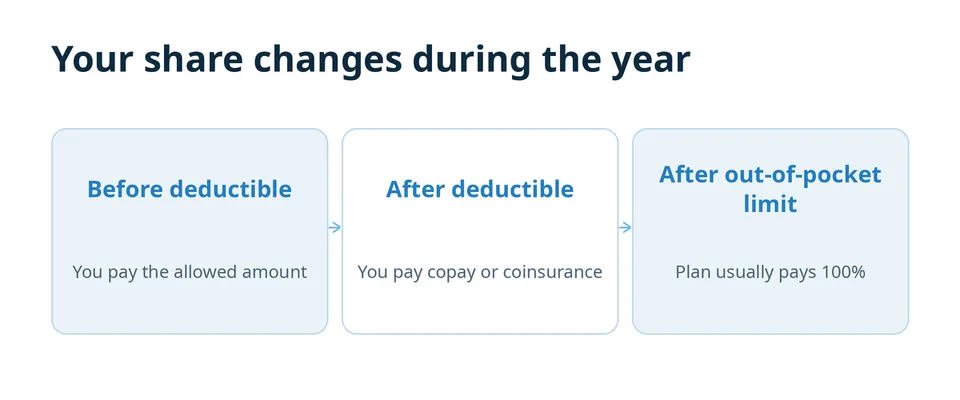
How much IOP costs changes as you move through your plan year. Before you meet your deductible, you may pay the full allowed amount for treatment. After the deductible, you pay only your copay or coinsurance. Once you reach your out-of-pocket limit, the plan usually pays 100% of covered in-network care for the rest of the year.2
The table below shows those three stages and who pays at each one:
| Stage of Your Plan Year | What You Pay | What Your Plan Pays |
|---|---|---|
| Before your deductible is met | Usually the full allowed amount | Usually nothing yet, except some covered visits with a copay |
| After your deductible is met | Your copay or coinsurance | The rest of the allowed amount |
| After your out-of-pocket limit is met | Usually nothing for covered in-network care | Usually 100% of the allowed amount |
Some plans let you pay a flat copay for outpatient mental health care even before the deductible is met. Others put intensive outpatient care under the deductible. That's why the same question gets different answers from different plans, and why it's worth asking your plan exactly how IOP is billed.
Worked Examples of IOP Cost With Insurance
The examples below use made-up numbers to show the math. They are not what Promising Outlook or any program charges, and they aren't typical prices. Your plan's numbers and the program's allowed amount will be different.
Example One: Early in the Year
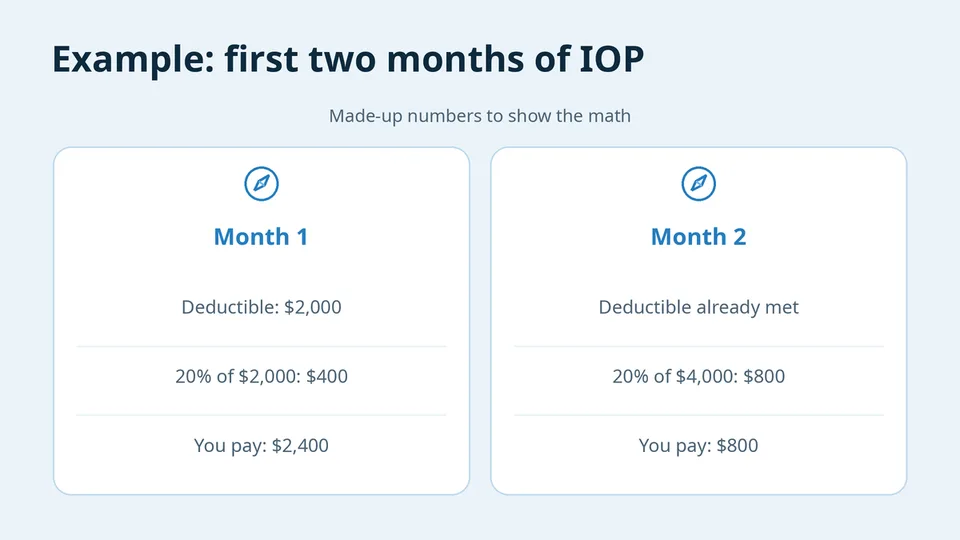
Say your plan has a $2,000 deductible, 20% coinsurance and a $6,000 out-of-pocket limit, and you haven't used it yet this year. If the allowed amount for your first month of IOP were $4,000, you'd pay the first $2,000 to meet your deductible. Then you'd pay 20% of the remaining $2,000, which is $400, for a first-month total of $2,400.
In the second month, with the deductible already met, you'd pay only the 20% coinsurance. On the same $4,000 allowed amount, that's $800. Your total for the two months would be $3,200, still under your $6,000 limit.
Example Two: Later in the Year
Now say it's September and you had surgery in the spring, so you've already met your deductible and paid $5,500 toward your $6,000 out-of-pocket limit. Using the same made-up $4,000 allowed amount, your 20% coinsurance would be $800. Because you have only $500 left before your limit, you'd pay $500, and your plan would pay the rest of covered in-network care through the end of the plan year.
Example Three: A Flat Copay
Some plans charge a flat copay per day of intensive outpatient care instead of coinsurance. If your plan charged a made-up $30 per program day and you attended three days a week, you'd pay $90 a week until you hit your out-of-pocket limit. Plans set these amounts very differently, so this is only a way to see how a copay adds up.
The Out-of-Pocket Limit Protects You
Your out-of-pocket limit is the most important number for a longer program. HealthCare.gov sets the 2026 limit for Marketplace plans at no more than $10,600 for an individual and $21,200 for a family, and many plans set lower limits than that.2 Once you reach your plan's limit, covered in-network care usually costs you nothing more for the rest of the year.
A few kinds of spending don't count toward the limit. HealthCare.gov lists these exceptions:
- Your monthly premiums
- Anything you pay for care your plan doesn't cover
- Out-of-network care, in most plans
- Charges above the allowed amount that a provider may bill you
This is one reason network status matters so much for an IOP that lasts several months. In network, your spending is capped. Out of network, it may not be.
What Else Affects How Much IOP Costs
A few other things can change your total IOP cost beyond the plan's basic numbers. Length is the biggest one. A program that lasts three months costs more in total than one that lasts six weeks, though your out-of-pocket limit still caps your share of covered care. Our chapter on how long IOP lasts explains what decides the length.
The level of care matters too. A partial hospitalization program meets for more hours a week than an IOP, so its allowed amount is usually higher. If you're deciding between the two, our chapter on PHP vs IOP compares them. Extra care such as medication management or individual therapy outside the program may be billed separately, with its own copay.
Finally, the plan itself matters. UnitedHealthcare members, for example, often have behavioral health benefits run by Optum, which has its own rules and network. Our chapter on Optum rehab coverage walks through how that works.
If You Pay Without Insurance
If you don't have insurance or choose not to use it, you have the right to know your costs ahead of time. Under the federal No Surprises Act, providers must give uninsured and self-pay people a written good faith estimate of expected charges when they ask for one or schedule care at least three business days ahead.3 If the final bill is at least $400 more than the estimate, you can dispute it.
Keep the estimate so you can compare it with your bill. Our pillar guide also covers other ways to pay, such as sliding-fee scales and payment plans, and what to do if you have coverage that a program doesn't accept. Veterans and military families have their own route through VA community care and Tricare, which our chapter on the VA intensive outpatient program explains.
How to Find Out Your Exact IOP Cost
Check your benefits with your plan or ask the program to help estimate your IOP costs. The final amount depends on the services you receive and how the plan processes your claims. You can call the member services number on your card, but a program that works with insurance every day can usually get clearer answers faster. When you or the program call your plan, ask these questions:
- Is intensive outpatient care covered, and is it under my deductible or a copay?
- How much of my deductible and out-of-pocket limit have I met this year?
- What is my coinsurance or copay for IOP?
- Is the program in network?
- Does IOP need prior authorization?
Whether your plan covers IOP at all is covered in our chapter on whether insurance covers IOP. Once you know it does, the answers above give you everything you need to estimate your share. Each insurer words its benefits a little differently, so our chapters on whether Aetna covers mental health care and how Blue Shield telehealth works can help you read your own plan.
How Costs Work at Promising Outlook
At Promising Outlook, a real person checks your benefits and explains your costs before you start. We call your plan, find out where you are on your deductible and out-of-pocket limit, handle any approval request, and tell you what you're likely to pay in plain words. If we don't know an answer, we'll say so and go find it.
Treatment length varies. Ask admissions what options are available if insurance coverage ends before you finish your care plan. You can see our full list of insurance options, and our virtual IOP meets Monday through Friday with groups at 9:00 a.m., 12:00 p.m. and 5:00 p.m.
Call us and a real person will answer, day or night. You can also verify your insurance online, and we'll walk you through your numbers.
Frequently Asked Questions
How much does IOP cost with insurance?
It depends on your deductible, copay or coinsurance, out-of-pocket limit and whether the program is in network. Some people pay little because they've met their deductible, while others pay more early in the year. Your out-of-pocket limit caps your share of covered in-network care for the plan year.
How much does IOP cost without insurance?
Prices vary widely by program, location and length of treatment, so ask each program directly. If you pay without insurance, federal law gives you the right to a written good faith estimate of expected charges before care starts, and you can dispute a bill that runs at least $400 over it.
Does IOP count toward my deductible?
Usually, yes. What you pay for covered intensive outpatient care generally counts toward your deductible and your out-of-pocket limit when the program is in network. Some plans charge a flat copay for IOP instead. Ask your plan how intensive outpatient care is billed under your benefits.
Why does IOP cost more at the start of the year?
Most plans reset deductibles at the start of each plan year. Until you meet the deductible, you may pay the full allowed amount for treatment. Once it's met, you pay only your copay or coinsurance, and after the out-of-pocket limit, usually nothing more for covered in-network care.
Is out-of-network IOP more expensive?
Usually, yes. Out-of-network programs haven't agreed to your plan's rates, so your share is often higher, and you may be billed for the gap between their charge and what your plan allows. Out-of-network spending may also not count toward your out-of-pocket limit.
Is PHP more expensive than IOP?
A partial hospitalization program usually has a higher allowed amount than IOP because it meets for more hours each week. Your actual share still depends on your deductible, coinsurance and out-of-pocket limit. Ask your plan how each level of care is billed under your benefits.
Sources
- HealthCare.gov. Glossary of Health Coverage and Medical Terms.
- HealthCare.gov. Out-of-pocket maximum/limit.
- Centers for Medicare and Medicaid Services. Notice of Uninsured (or Self-Pay) Individual's Right to Receive a Good Faith Estimate.
