


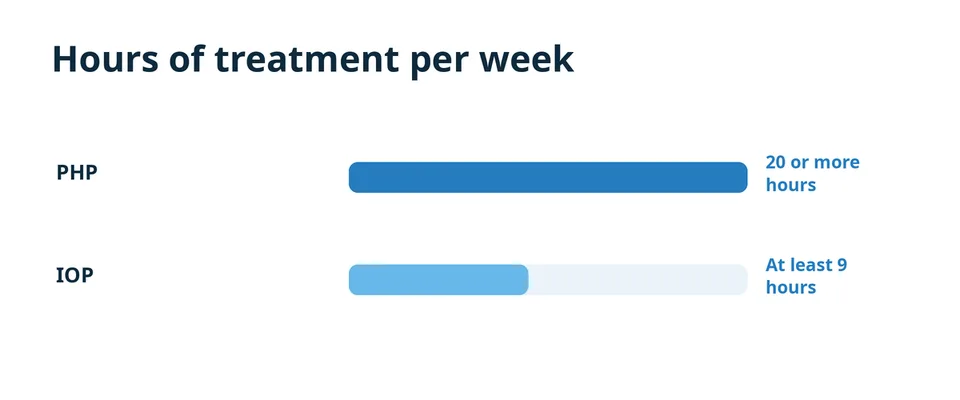
The main difference in PHP vs IOP is how much treatment you get each week. A partial hospitalization program (PHP) provides at least 20 hours of care a week, often most of the day, as an alternative to a hospital stay. An intensive outpatient program (IOP) provides at least nine hours a week. In both, you go home at night.
This chapter is part of our guide to what IOP is, and it compares the two levels side by side so you can see which one fits. If you need more structure than an IOP offers, our virtual PHP programs meet over live video while you recover from home.
Key Takeaways
- PHP provides at least 20 hours of treatment a week; IOP provides at least nine.
- PHP is designed as an alternative to inpatient care, while IOP is for people who need more than weekly therapy.
- In both, you live at home and go to treatment during set hours.
- Many people start in PHP and step down to IOP, then to outpatient care.
- A clinician's assessment decides which level fits, and insurance usually follows that decision.
PHP vs IOP at a Glance
PHP and IOP are neighboring levels of care, and they share the same basic idea: structured treatment during the day or evening, then home. What separates them is intensity. The table below compares them on the points people ask about most.1, 2, 3
| Feature | Partial Hospitalization (PHP) | Intensive Outpatient (IOP) |
|---|---|---|
| Hours per week | 20 or more | At least 9, often 9 to 19 |
| Typical day | Several hours, most weekdays | About three hours, several days a week |
| Main purpose | Alternative to inpatient care | More support than weekly therapy |
| Who it fits | Symptoms that need daily structure and close monitoring | Stable enough to manage most of the week on your own |
| Can you work? | Usually hard to work full time | Often yes, especially with evening groups |
| Where you sleep | At home | At home |
Both programs usually include group therapy, individual therapy, family involvement and medication management. The difference is how many hours of that care you get, and how closely your team watches how you're doing day to day.
What Is a Partial Hospitalization Program
A partial hospitalization program is a structured outpatient program that serves as an alternative to inpatient psychiatric care. Medicare describes it this way and notes that people in a PHP have a care plan showing they need at least 20 hours of therapeutic care each week, often in days that run four to eight hours.1
Earlier editions of the ASAM Criteria called Level 2.5 partial hospitalization. The fourth edition calls it high-intensity outpatient treatment. These programs provide at least 20 hours of clinical services a week.3 Medicare has separate certification requirements for PHP and IOP. For Medicare IOP, a physician must certify that you need at least nine hours of services each week.2
In plain terms, PHP is for people who are struggling enough that a few groups a week won't hold them, but who don't need to stay overnight in a hospital. It gives most of the support of inpatient care while letting you sleep at home.
What Is an Intensive Outpatient Program
An intensive outpatient program is one level below PHP. The ASAM Criteria place it at level 2.1, with 9 to 19 hours of weekly structured programming for adults.3 SAMHSA describes the core of IOP as individual counseling, group therapy, family education and case management, for a minimum of nine hours a week.4
IOP fits people who need more than a weekly therapy visit but can handle most of the week on their own. Research supports it: a review in Psychiatric Services rated the evidence for substance use IOPs as high and found them as effective as inpatient treatment for most people.5
Our pillar guide covers IOP in full, from a typical day to who it's for. If you're comparing programs, our virtual IOP in California page explains how ours runs.
What Is the Difference Between IOP and PHP in Daily Life
The difference between IOP and PHP shows up most in how your week feels. In PHP, treatment is the main thing you do on most weekdays. In IOP, treatment is one important part of a week that also includes work, family or school.
Here's a simple example. Someone in PHP might attend program most of the day, Monday through Friday, with individual therapy and a medication visit worked in. Someone in IOP might attend group three mornings or three evenings a week and spend the rest of the time at work, practicing what they learned.
That difference matters for planning. PHP often means taking time off work or arranging childcare. IOP is more likely to fit around a job, which is why evening groups are so common. Our chapter on evening IOP covers working while in treatment.
Who Should Choose PHP and Who Should Choose IOP
A clinician decides which level fits after an assessment, not the person or the program alone. Still, it helps to know the kinds of signs that usually point one way or the other. Signs that PHP may be the better starting point include:
- Symptoms that make it hard to get through a day without close support
- Stepping down from a hospital stay or residential treatment
- A recent relapse that IOP alone hasn't been able to stop
- A need for frequent medication changes and monitoring
Signs that IOP may be the better fit include stable housing and daily routine, a need for more than weekly therapy, and the ability to keep working or caring for family during treatment. Someone who needs medical detox or is in a crisis may need a higher level of care than either one, at least to start.
Stepping Down From PHP to IOP
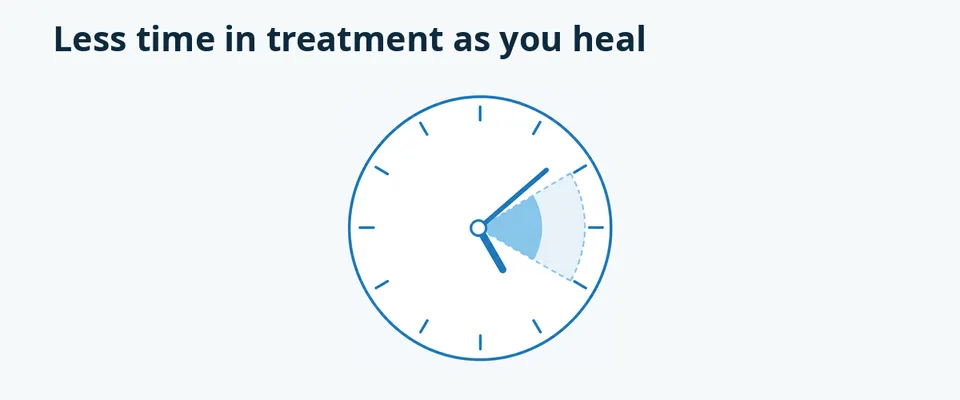
Stepping down means moving to a less intensive level of care as you get stronger. Many people start in PHP and move to IOP after a few weeks, then step down again to standard outpatient care. SAMHSA notes that IOP works best as part of that kind of continuum, where people step up or down as their needs change.4
How long each level lasts varies from person to person, and our chapter on how long IOP is explains what decides it. Stepping down isn't a reward for good behavior or a punishment for slipping. It's a clinical decision based on how you're doing. If things get harder, stepping back up is a normal part of care. Our outpatient program is where many clients finish, keeping the same group with fewer hours.
The typical path looks like this:
- Assessment decides your starting level.
- PHP for daily structure and stabilization, if needed.
- IOP as symptoms settle and life outside treatment picks back up.
- Outpatient care to keep the support going with fewer hours.
- An aftercare plan and relapse prevention plan before discharge.
How Insurance Treats PHP and IOP
Most health plans cover both PHP and IOP when a clinician finds them medically necessary. Because PHP is more intensive, its allowed amount is usually higher, and plans are more likely to require approval before it starts and to review progress often. Medicare, for example, requires a doctor's certification for PHP.2
Your share of the cost depends on your deductible, coinsurance and out-of-pocket limit. Our chapter on how much IOP costs with insurance shows how those numbers add up. For the bigger choice between living at home and living at a treatment center, see our guide to inpatient vs outpatient rehab.
PHP and IOP at Promising Outlook
Promising Outlook runs both levels over live video for adults across California, along with an outpatient program for step-down care. Groups meet Monday through Friday, with a morning group at 9:00 a.m., a midday group at 12:00 p.m. and two evening groups at 5:00 p.m. IOP clients attend three days a week, and PHP clients get more hours of support each week.
Both levels work over video for many people, and our chapter on whether online therapy is effective covers what the research shows. Moving between levels doesn't mean starting over. You keep the same team and often the same group members, and your counselor, therapist and prescriber stay in touch between groups. Before you leave, you'll have an aftercare plan and a relapse prevention plan.
Not sure which level fits? Call us and a real person will answer, day or night. We'll talk through what's going on and help you find the right starting point, and if you're ready, you can start today. You can also verify your insurance online.
Frequently Asked Questions
What is the difference between PHP and IOP?
The main difference is intensity. A partial hospitalization program provides at least 20 hours of treatment a week and serves as an alternative to inpatient care. An intensive outpatient program provides at least nine hours a week. In both, you live at home and attend treatment during set hours.
Is PHP or IOP better?
Neither is better for everyone. PHP fits people who need daily structure and close monitoring, while IOP fits people who are stable enough to manage most of the week on their own. A clinician's assessment decides which level fits, and many people use both, one after the other.
How many hours a day is PHP?
PHP days often run four to eight hours, adding up to at least 20 hours of therapeutic care a week. The exact schedule depends on the program and your treatment plan. IOP days are shorter, often about three hours, several days a week.
Can you work while in PHP?
It's usually hard to work full time during PHP because the program takes up much of the day on most weekdays. Many people take medical leave for PHP, then return to work when they step down to IOP, especially if the program offers evening groups.
Can you go from IOP back to PHP?
Yes. If symptoms get worse or a relapse happens, stepping back up to PHP is a normal part of care. Moving between levels is based on how you're doing. It isn't a judgment of you. The goal is to match the level of support to what you need right now.
Does insurance cover PHP and IOP?
Most health plans cover both when a clinician finds them medically necessary. PHP is more likely to need approval before it starts and is usually reviewed more often. Your costs depend on your deductible, coinsurance and whether the program is in network.
Sources
- Medicare.gov. Mental health care (partial hospitalization).
- Centers for Medicare & Medicaid Services. State Operations Manual, Appendix F.
- American Society of Addiction Medicine. The ASAM Criteria, Fourth Edition, Volume 1: Adults (Overview).
- Substance Abuse and Mental Health Services Administration. Clinical Issues in Intensive Outpatient Treatment for Substance Use Disorders. Advisory, 2021.
- McCarty D, et al. Substance Abuse Intensive Outpatient Programs: Assessing the Evidence. Psychiatric Services, 2014.
