


Yes, insurance covers IOP for many people with a health plan. An intensive outpatient program (IOP) is a recognized level of care for addiction and mental health, and most plans pay for it when a clinician finds it medically necessary. You'll usually share the cost through a deductible, copay or coinsurance, and many plans ask for approval before you start.
This chapter is part of our guide to does insurance cover rehab, and it focuses on intensive outpatient care and therapy. If you're comparing programs, our virtual IOP in California meets five days a week over live video and is in network with Aetna, Blue Shield, Cigna, Health Net, Tricare and United.
Key Takeaways
- Most health plans cover intensive outpatient programs for addiction and mental health.
- Coverage depends on medical necessity, which a clinician shows through an assessment.
- Many plans require prior authorization for IOP and review progress every few weeks.
- Federal parity law says your plan can't make IOP harder to get than comparable medical care.
- Therapy is covered by most plans too, usually with a copay or coinsurance.
Is IOP Covered by Insurance
IOP is covered by insurance in most plans because it is a standard level of care for substance use and mental health conditions. SAMHSA describes intensive outpatient treatment for adults as at least nine hours a week of scheduled care, including individual counseling, group therapy, family education and case management.1 Insurers recognize that structure and pay for it as its own benefit.
The Affordable Care Act requires Marketplace plans to cover substance use disorder treatment and behavioral health care such as psychotherapy and counseling.2 In California, state law adds a direct requirement: state-regulated plans must cover medically necessary intensive outpatient treatment for mental health and substance use disorders.3
Coverage isn't automatic, though. A plan pays for IOP when it agrees the program fits your needs, and it decides that through medical necessity rules. If you want a refresher on how a program is set up, read what an IOP is and who it's meant for.
How Medical Necessity Decides Coverage
Medical necessity is the test your plan uses to decide whether to pay for IOP. HealthCare.gov defines medically necessary care as care needed to diagnose or treat a condition that meets accepted standards of medicine.4 For IOP, that usually means you need more support than weekly therapy but don't need to live at a treatment center.
The program shows medical necessity through an assessment at intake. A clinician looks at your substance use, mental health, physical health, home life and readiness for change, then recommends a level of care. Plans often compare that assessment against published criteria before approving treatment.
These are the kinds of situations where plans commonly approve intensive outpatient care:
- Weekly therapy alone hasn't been enough to stop drinking or drug use
- Depression, anxiety or trauma symptoms are getting in the way of work or home life
- Someone is stepping down from residential care or a partial hospitalization program
- A person has a safe place to live and doesn't need medical detox
Medical necessity is also reviewed again during treatment. The American Psychological Association notes that insurers may check whether more care is needed after a set number of visits, and that this is generally allowed if the plan uses the same standards it applies to medical care.5
Prior Authorization for IOP
Prior authorization is your plan's approval before IOP begins. Many plans require it for intensive outpatient and partial hospitalization programs, though not every plan does. Approval confirms the plan sees the care as medically necessary, but HealthCare.gov notes it doesn't guarantee payment.4
Here's how the process usually goes when you start an intensive outpatient program:
- You or the program calls your plan to check IOP benefits and whether approval is needed.
- A clinician completes your assessment and recommends a level of care.
- The program sends the assessment to your plan with the approval request.
- The plan approves a set number of days or weeks.
- Before that period ends, the program sends an update showing your progress and what's still needed.

Most of that paperwork is done by the program, not by you. It can take a day or more, so calling early helps. When the approved period runs out, your plan reviews progress notes to decide whether to approve more time, which is one reason the length of IOP varies from person to person.
What Parity Law Means for IOP Coverage
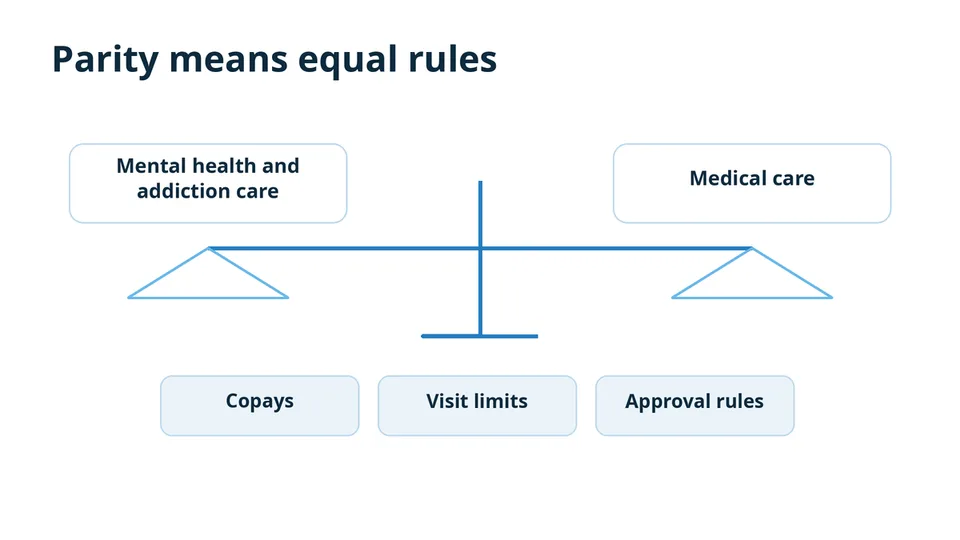
Federal parity law means your plan can't make IOP harder to use than similar medical care. The Mental Health Parity and Addiction Equity Act bars plans from putting less favorable limits on mental health and substance use benefits than on medical and surgical benefits.6 That applies to costs, visit caps and approval rules.
The table below shows how parity applies to the parts of an IOP benefit people ask about most:
| Part of Your Benefit | What Your Plan Can Do | What Parity Prevents |
|---|---|---|
| Copay or coinsurance | Charge a share of the cost | Charging more than for most comparable medical care |
| Number of days covered | Review whether more care is needed | Setting tighter caps than for medical care |
| Prior authorization | Require approval before treatment | Using stricter approval rules than for medical care |
| Network rules | Pay more for in-network programs | Applying tougher network rules to mental health care |
Parity has limits of its own. It doesn't require a plan to offer mental health or addiction benefits at all, and it doesn't apply directly to small employer plans with 50 or fewer workers. Those plans are still covered by the Affordable Care Act's benefit rule if they're non-grandfathered.
Does Insurance Cover Therapy
Yes, insurance covers therapy in most plans. HealthCare.gov lists psychotherapy and counseling among the behavioral health treatments every Marketplace plan must cover.2 Most employer plans cover outpatient therapy too, usually with a copay or coinsurance for each visit.
Therapy inside an IOP is usually billed as part of the program, so you don't pay separately for each group. One-on-one therapy outside the program, or after you finish, is billed as an outpatient visit. The APA's parity guide explains that a mental health copay can differ from a primary care copay. Parity generally compares the type and level of cost sharing with medical and surgical benefits in the relevant classification.5
At Promising Outlook, individual therapy with a therapist and one-on-one counseling with a counselor are available weekly to every client in our programs. Family therapy is available too, once you've signed a release.
What IOP Coverage Usually Includes
IOP coverage usually pays for the full program, not just the group hours. SAMHSA lists individual counseling, group therapy, family education and case management among the core parts of intensive outpatient care.1 Medicine management for mental health or for opioid and alcohol use disorder may be billed under the same plan as a separate benefit.
What you'll pay depends on where you are in your plan year. If you haven't met your deductible, you may pay more at the start. Our chapter on how much IOP costs with insurance walks through examples, and our chapter on in network vs out of network explains why network status changes the bill. Each insurer also runs its IOP benefit a little differently, which is why we wrote separate chapters on whether Aetna covers mental health care and how Blue Shield telehealth benefits work.
How Long Insurance Covers IOP
Insurance covers IOP for as long as the plan agrees it's medically necessary, which varies from person to person. Plans usually approve care in blocks and review progress before approving more. SAMHSA reported a median stay of 81 days for adults who completed intensive outpatient treatment in 2017.1
California's SB 855 says state-regulated plans can't put arbitrary limits on how long mental health and substance use treatment lasts or cover only acute symptoms.3 At Promising Outlook, your treatment timeline depends on your care plan and insurance benefits. Our chapter on how long IOP lasts covers what decides the length.
What to Do if Your Plan Denies IOP
If your plan denies IOP, ask for the decision in writing and appeal it. The Department of Labor says most people have 180 days from a denial to file an internal appeal, for many employer plans. If the denial stands, check the notice for external review eligibility and deadlines.7 Your treatment team can send records that show why intensive outpatient care is needed.
You can also ask your plan for the criteria it used to decide. Plans must send those documents within 30 days of your request, and the criteria can show whether your plan is applying stricter rules to mental health care than to medical care. Our pillar guide covers the appeal steps in more detail.
How Coverage Works at Promising Outlook
At Promising Outlook, a real person checks your coverage before you start. We call your plan, find out what your IOP benefit includes, handle any approval request, and explain what you'll pay in plain words. Someone will sit with you and fill out any form, and if we don't know an answer, we'll find out.
Our virtual intensive outpatient program meets Monday through Friday over live video, with groups at 9:00 a.m., 12:00 p.m. and two at 5:00 p.m. IOP clients attend three days a week, and individual therapy, family therapy and medication management are built in. See our insurance options for the full list of plans.
Call us to talk with a real person, day or night, or verify your insurance online. If your coverage is confirmed and you're ready, you can start the same day.
Frequently Asked Questions
Does insurance cover IOP?
Yes, most health plans cover intensive outpatient programs for addiction and mental health when a clinician finds them medically necessary. You'll usually pay a deductible, copay or coinsurance, and many plans require approval before you start. Coverage details depend on your specific plan and whether the program is in network.
Is IOP covered by insurance without prior authorization?
Some plans cover IOP without prior authorization, but many require it. The program usually sends the request with your assessment, and approval can take a day or more. Calling your plan or having the program check your benefits first tells you whether approval is needed.
Does insurance cover therapy?
Yes. Psychotherapy and counseling are required benefits in Marketplace plans, and most employer plans cover therapy as well. You'll usually pay a copay or coinsurance for each visit after your deductible. Under parity law, that cost can't be higher than what you pay for most comparable medical visits.
How many weeks of IOP will insurance cover?
There's no single number. Plans approve IOP in blocks and review progress before approving more time. SAMHSA reported a median stay of 81 days for adults who completed intensive outpatient treatment in 2017, and many people stay longer when the need is there.
Does insurance cover IOP done over video?
Usually, yes. An intensive outpatient program delivered by live video is billed as the same level of care as an in-person program. In California, state law requires state-regulated plans to cover appropriate telehealth care on the same basis as in-person care, though network status still matters.
What if my plan stops covering IOP before I'm ready?
Ask your treatment team to send updated records showing why more care is needed, and ask the plan for its criteria in writing. You can appeal a denial, usually within 180 days. Some programs also help clients step down to a less intensive level of care that the plan will cover.
Sources
- Substance Abuse and Mental Health Services Administration. Clinical Issues in Intensive Outpatient Treatment for Substance Use Disorders. Advisory, 2021.
- HealthCare.gov. Mental health and substance abuse health coverage options.
- California Department of Insurance. Fact Sheet on Senate Bill 855.
- HealthCare.gov. Glossary of Health Coverage and Medical Terms.
- American Psychological Association. A guide to the mental health parity law. 2014.
- Centers for Medicare and Medicaid Services. The Mental Health Parity and Addiction Equity Act (MHPAEA).
- U.S. Department of Labor, Employee Benefits Security Administration. Understanding Your Mental Health and Substance Use Disorder Benefits.
