
Treatment goals are the changes you want therapy or treatment to help you make, written clearly enough that you and your care team can tell when you've reached them. Good treatment goals are specific, measurable and realistic, they matter to you, and they're broken into small steps with a time frame. They give treatment direction and make progress easier to see, both for you and for the people helping you.
Setting goals is one of the first things you'll do with a therapist. In individual therapy at Promising Outlook, you and your therapist build goals together and review them as you go, by live video for adults across California.
Key Takeaways
- Goals describe what you want to change and how you'll know it's changed.
- Research suggests better therapy outcomes are associated with agreement on goals between the client and therapist.
- A treatment plan usually links each problem to a goal, objectives and the support you'll get.
- SMART goals are specific, measurable, achievable, relevant and time-bound.
- Plans should be reviewed often and changed when life or priorities change.
Why Treatment Goals Matter
Without goals, therapy can drift from week to week without a clear sense of progress. Goals give each meeting a purpose and help you notice change you might otherwise miss. They also make it easier to tell when something isn't working and needs to shift.
Agreement on goals seems to matter too. A meta-analysis by Tryon and colleagues found that across 54 studies, stronger agreement between client and therapist on goals was linked with better outcomes, a medium-sized effect.1 In other words, it helps when you and your therapist are working toward the same thing. Our chapter on the benefits of therapy covers other parts of therapy that make a difference.
How a Treatment Plan Is Built
Most treatment plans follow a similar structure. SAMHSA's guide to addiction counseling competencies describes treatment planning as something a counselor does with the client, not for them, working together on specific, measurable and realistic goals.2 It usually has four parts:
| Part | What It Means | Example |
|---|---|---|
| Problem | An issue that's getting in the way of your life | Conflict at home tied to drinking |
| Goal | The broad change you want | Rebuild trust with my family while staying sober |
| Objective | A specific, observable action toward the goal | Attend 3 family therapy meetings in the next 6 weeks |
| Intervention | What your care team does to help | Family therapy and relapse prevention skills in group |

The textbook offers a quick test for telling goals and objectives apart: if you could watch someone doing it, it's an objective; if you can't, it's a goal. "Reduce anxiety" is a goal. "Practice slow breathing for 5 minutes each morning" is an objective.
How to Set Treatment Goals Using SMART
A simple way to write treatment plan goals is the SMART method. Each letter is a check on whether a goal is clear enough to act on.2
- Specific: Say exactly what you'll do. "Feel better" is vague. "Go to bed by 11 p.m. on weeknights" is specific.
- Measurable: Include how often or how many, so you can track it.
- Achievable: Make it challenging but realistic for where you are now.
- Relevant: Connect it to something that matters to you, not just what others want.
- Time-bound: Set a date to check in on it.

A University of Minnesota goal-setting guide for clinicians adds a useful question: how will we both know when this goal has been achieved?3 If you can't answer that, the goal probably needs more detail. Try rewriting it until a friend reading it would know exactly what you plan to do and when.
Write Goals About What You Will Do
It's natural to frame goals around stopping something, like "stop drinking" or "stop yelling at my kids." Those matter, but the same guide recommends writing goals as things you'll do rather than things you'll avoid.3 For example, "call a friend when I feel lonely" gives you an action to take, while "don't drink when lonely" only tells you what not to do.
Positive goals also build something to replace the old habit. Sobriety leaves time and space in your life. Goals that fill that space with connection, structure and purpose help sobriety last.
Break Big Goals Into Small Steps
Big goals can feel overwhelming, especially early in treatment. The Minnesota guide suggests breaking long-term goals into short-term goals, and those into even smaller steps.3 It offers a "Rule of 6s" as a rough guide: about 6 months to a year for a long-term goal, 6 weeks for a short-term goal and 6 days for a single step.
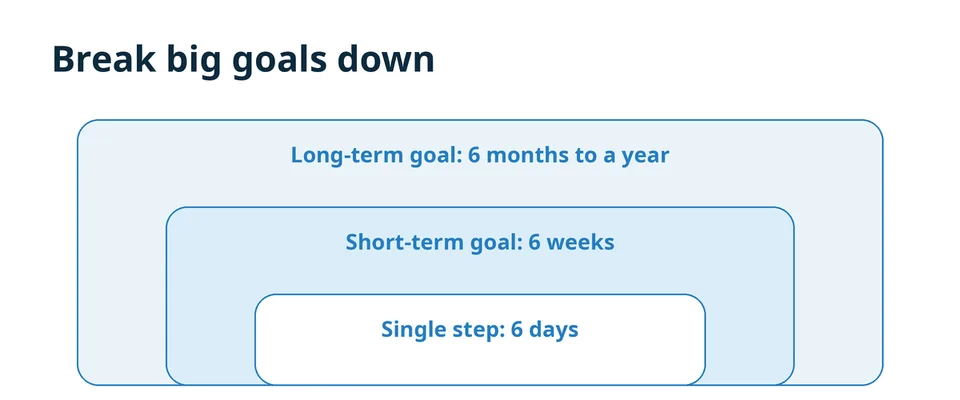
Small steps also build confidence. Each one you complete is proof that change is possible, which makes the next step easier to take.
Examples of Therapy Goals
Here are some examples of therapy goals across different areas of life. Yours will be different, but these can help you get started.
| Area | Broad Goal | Specific Step |
|---|---|---|
| Sobriety | Stay sober and lower relapse risk | Write a relapse prevention plan with my therapist in the next 4 weeks |
| Mood | Feel less depressed | Take a 15 minute walk 4 days a week |
| Anxiety | Manage anxiety at work | Use slow breathing before every meeting for 2 weeks |
| Relationships | Rebuild trust with my partner | Have one honest check-in conversation each week |
| Anger | Handle anger without yelling | Take a 10 minute time-out when I notice anger rising |
| Daily life | Build a steady routine | Wake up at the same time every weekday for a month |
| Support | Grow my sober support network | Attend 2 support meetings a week and get 3 phone numbers |
What If You Don't Know Your Goals
Many people start treatment without clear goals. Some feel unsure they even want to change, or they only know that things aren't working. That's normal and not a reason to wait.
A good therapist can help you find goals by asking what matters to you, what you'd like your life to look like in a year and what's getting in the way. Our chapter on motivational interviewing explains one approach therapists use to help people sort through mixed feelings about change. Your goals can also grow out of the bigger question of who you want to be, which we cover in our post on how to find yourself in recovery.
Track and Review Your Progress
Goals work best when you check on them often. The Minnesota guide suggests tracking goals on a simple sheet and reviewing them weekly in individual therapy.3 When a step works, build on it. When it doesn't, look at what got in the way and adjust.
It also helps to remember that any progress counts. Missing a step isn't failure. It's information about what needs to change. Goals should be updated as you grow, and new ones will come up as old ones are met.
Setting Treatment Goals at Promising Outlook
At Promising Outlook, goal setting starts on day one and continues through treatment. You and your therapist build a plan together, and your goals shape what you work on in individual therapy, group therapy, family therapy and medication management. Our virtual IOP meets 3 days a week by live video for adults across California.
Groups meet Monday through Friday at 9:00 a.m., 12:00 p.m. and 5:00 p.m. Treatment length varies. Clients leave with an aftercare plan and a relapse prevention plan built around their goals.
Call us and a real person will answer, day or night. Same-day starts are often possible. You can also verify your insurance online. We're in network with Aetna, Blue Shield, Cigna, Health Net, Tricare and United.
Frequently Asked Questions
What are treatment goals?
They're the changes you want therapy or treatment to help you make. They're written clearly enough that you and your care team can tell when you've reached them, and they're usually broken into smaller steps with a time frame.
What are examples of treatment plan goals?
Examples include staying sober and writing a relapse prevention plan, feeling less depressed and walking 4 days a week, managing anxiety with daily breathing practice and rebuilding trust with family through weekly honest conversations.
What are SMART goals in therapy?
SMART goals are specific, measurable, achievable, relevant and time-bound. Using SMART helps turn a vague wish like "feel better" into a clear step like "go to bed by 11 p.m. on weeknights for the next month."
Who sets the goals in therapy?
You and your therapist set goals together. Your therapist brings ideas based on your assessment, but the goals should reflect what matters to you. Research suggests therapy tends to go better when you both agree on the goals.
How often should treatment goals be reviewed?
Many therapists check in on goals weekly or every few meetings. Formal treatment plans also have set review dates. Goals should be updated whenever they're met, aren't working or no longer fit your life.
What if I don't know what my therapy goals are?
That's common. A therapist can help by asking what you want your life to look like and what's getting in the way. Starting with one small goal is fine, and more will come as treatment goes on.
Sources
- Tryon GS, Birch SE, Verkuilen J. Meta-analyses of the relation of goal consensus and collaboration to psychotherapy outcome. 2018.
- Center for Substance Abuse Treatment. TAP 21: Addiction Counseling Competencies: The Knowledge, Skills, and Attitudes of Professional Practice. SAMHSA.
- Rohovit J. Guide to Goal Setting and Tracking. University of Minnesota School of Social Work, Practice Transformation.