


The main difference in inpatient vs outpatient rehab is where you live during treatment. Inpatient and residential rehab means living at a treatment facility with care around the clock. Outpatient rehab means living at home and going to treatment on a schedule, from weekly therapy to several hours a day. Both work. The right one depends on your health, safety and support.
This guide compares every level of care, explains who each one fits, walks through what research shows, and helps you answer the hardest question first: do you need rehab at all? Promising Outlook offers outpatient levels of care by video, and our virtual treatment programs page explains each one. When someone needs detox or residential care instead, we say so and help them find it.
Key Takeaways
- Inpatient and residential rehab provide 24-hour care where you live; outpatient rehab treats you while you live at home.
- The American Society of Addiction Medicine defines four basic levels: outpatient, intensive outpatient or partial hospitalization, residential, and intensive inpatient.
- Outpatient care often fits people with a stable home, support and relatively good health.
- Inpatient care often fits people with severe symptoms, unstable housing, serious health problems or risky withdrawal.
- Studies report comparable outcomes for intensive outpatient and inpatient care among people with substance use disorders whose needs can be met in intensive outpatient care.
- Many people use more than one level, stepping down as they get stronger.
Inpatient vs Outpatient Rehab at a Glance
Inpatient vs outpatient rehab is really a question about how much structure you need and where you need it. Inpatient rehab gives you a full-time setting away from daily life. Outpatient rehab brings treatment into your daily life, so you practice new skills in the same places where old habits started.
The table below compares the two on the points people ask about most:
| Question | Inpatient or Residential Rehab | Outpatient Rehab |
|---|---|---|
| Where you live | At the treatment facility | At home |
| Hours of care | Around the clock | From one visit a week to most of the day |
| Typical length | Several days to several weeks | Usually several months |
| Work and family | Usually on pause | Often continue during treatment |
| Medical monitoring | Available on site, especially in hospital programs | Scheduled visits; no overnight monitoring |
| Who it fits | Severe symptoms, unsafe home, medical needs | Stable health and home, support nearby |
The NIAAA describes residential programs as places where people live for several weeks while in treatment, and outpatient programs as care one or more days a week, usually for several months.1 Neither is better across the board. They do different jobs.
The Levels of Care in Rehab
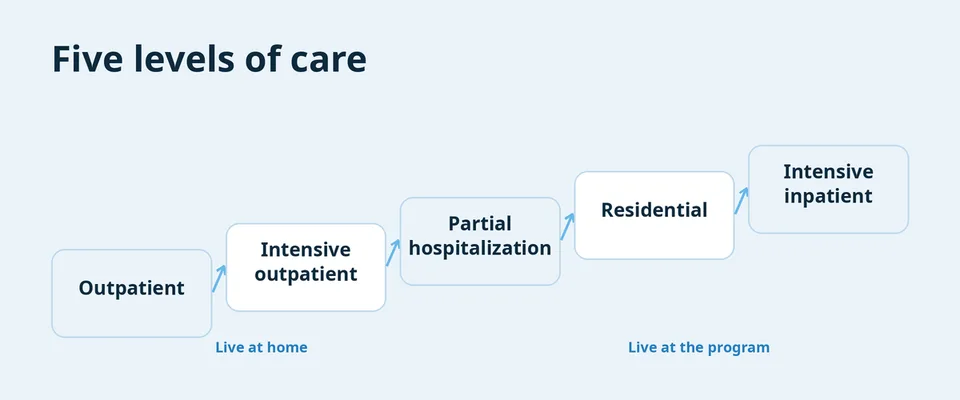
Rehab isn't one thing. The American Society of Addiction Medicine sorts treatment into levels of care, and the NIAAA summarizes four basic ones: outpatient, intensive outpatient or partial hospitalization, residential, and intensive inpatient.2 Each level fits a different amount of need.
Here's how the levels compare, using descriptions from the NIAAA and the ASAM Criteria:3
| Level of Care | What It Is | Hours or Setting |
|---|---|---|
| Outpatient | Regular visits for counseling, medication or both | Fewer than 9 hours a week |
| Intensive outpatient (IOP) | Coordinated outpatient care for complex needs | 9 to 19 hours a week |
| Partial hospitalization (PHP) | Day treatment with closer monitoring | 20 or more hours a week |
| Residential | Low or high intensity programs in a 24-hour setting | Live at the program |
| Intensive inpatient | Medically directed 24-hour care; may manage withdrawal | Hospital-based |
The first three levels are outpatient: you go home at night. The last two are inpatient or residential: you stay. Our guide to what IOP is covers the middle of that range in depth, and our chapter on PHP vs IOP compares the two most intensive outpatient levels.
How Does Outpatient Rehab Work
Outpatient rehab works by treating you on a schedule while you keep living at home. You attend counseling, group therapy or a structured program at set times, then go back to work, family and daily life. The time between visits is part of treatment, because that's when you practice the skills you're learning.
Most outpatient programs include a mix of these:
- Group therapy, where much of the skill-building and support happens
- Individual therapy or counseling
- Family therapy or education
- Medication for opioid or alcohol use disorder, or for depression and anxiety
- Relapse prevention and aftercare planning
The NIAAA notes that outpatient care can happen in an office or through virtual and telehealth visits, with no overnight stay.4 Our chapter on what outpatient treatment is explains the kinds of outpatient care and the evidence behind them.
How Inpatient and Residential Rehab Work
Inpatient and residential rehab work by giving you a full-time, structured setting with staff available day and night. You live at the program, follow a daily schedule of therapy, groups and activities, and step away from the people, places and routines tied to substance use. For someone whose home life makes recovery hard, that break can be essential.
There are two main kinds. Residential programs offer low or high intensity care in a 24-hour setting, often for several weeks.1, 2 Intensive inpatient programs are medically directed and hospital-based, and they're designed for people with significant medical issues or withdrawal that needs close management.
Inpatient care is valuable and sometimes lifesaving. It isn't a lesser or greater form of treatment than outpatient care; it's the right tool when the situation calls for round-the-clock support. Promising Outlook doesn't offer residential or inpatient care, and when someone needs it, we say so plainly and help them find a program.
Outpatient vs Inpatient Rehab and Who Each One Fits
The NIAAA gives a clear guide to who each setting tends to fit. Outpatient treatment may suit someone with a less severe disorder, a stable living situation, supportive friends and family, access to transportation and relatively good health.5 Residential or inpatient care may be better for someone with a more severe disorder, unstable housing, limited transportation, few sober peers or other health problems.
These signs usually point toward outpatient rehab:
- You have a safe, stable place to live
- You're not at risk of dangerous withdrawal
- You have at least a few people who support your recovery
- Your physical health is relatively stable
- You need or want to keep working or caring for family
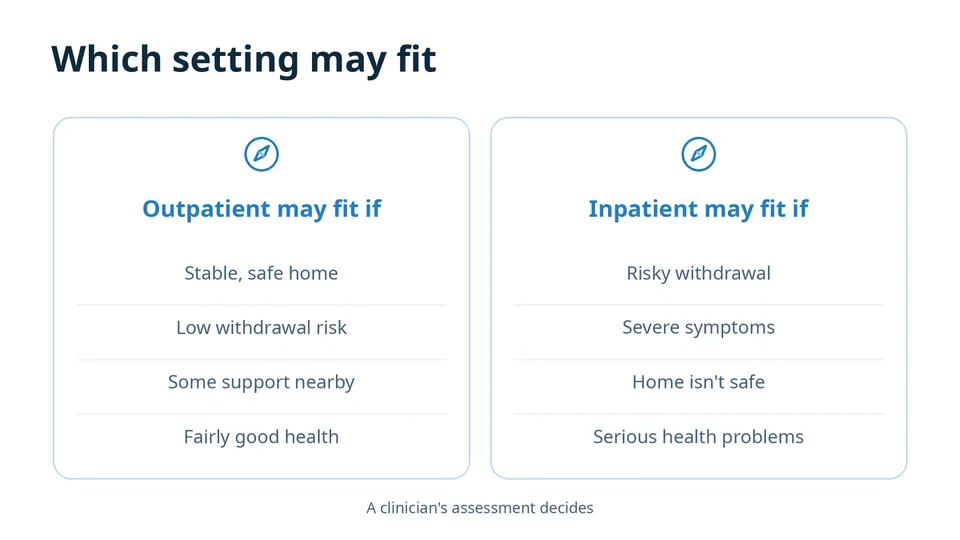
These signs usually point toward inpatient or residential care, at least to start: heavy daily drinking or benzodiazepine use that could cause dangerous withdrawal, serious medical or psychiatric problems, a home where others use or where you're not safe, and past attempts at outpatient care that haven't held. A clinician's assessment is what decides, and the decision can change as you improve.
Does Outpatient Rehab Work as Well as Inpatient
For most people, yes. A review in Psychiatric Services looked at randomized trials and real-world studies comparing intensive outpatient programs with inpatient or residential care for substance use disorders.6 It found comparable outcomes, rated the evidence as high, and concluded that IOPs are as effective as inpatient treatment for most people.
SAMHSA reaches a similar conclusion, noting that for clients who are appropriately placed, IOP outcomes are comparable to residential care.7 "Appropriately placed" is the important phrase. Outpatient care works as well for people whose needs fit it, not for everyone.
The research also shows that length matters more than setting for many people. The National Institute on Drug Abuse says most people need at least three months of treatment to significantly reduce or stop their drug use, and that longer treatment tends to bring better results.8 Outpatient programs often last that long or longer, partly because they fit around daily life.
Do I Need Rehab
You may need rehab if alcohol or drugs keep causing problems and you haven't been able to stop or cut back on your own. Clinicians use a list of 11 symptoms to diagnose alcohol use disorder, and two or more in the past year is enough for a diagnosis.4 Two to three symptoms is mild, four to five is moderate and six or more is severe.
These questions, adapted from the NIAAA's list, can help you think it through. This isn't a diagnosis, but answering yes to several is a reason to talk with a professional:
- Have you ended up drinking or using more, or for longer, than you meant to?
- Have you tried to cut down or stop and couldn't?
- Have you had strong cravings?
- Has your use caused problems at work, at home or with people you love, and you kept using anyway?
- Have you had withdrawal symptoms when the effects wore off?
Rehab doesn't have to mean leaving home for a month. For many people, the right first step is an outpatient assessment. If you're wondering specifically about alcohol, our post on whether you have a drinking problem walks through the signs in more detail.
When Detox Comes First
Some people need detox before any kind of rehab. Stopping heavy, long-term drinking can cause dangerous withdrawal, including seizures, and the NIAAA advises getting medical help to plan a safe recovery.4 Withdrawal from benzodiazepines can also be dangerous, and opioid withdrawal is often eased with medication.
Detox is a starting point. It works best when treatment follows. NIDA says medically assisted detox is only the first stage of addiction treatment and by itself does little to change long-term drug use.8 After detox, people usually move into residential or outpatient rehab to work on what led to the use.
Our chapter on detox vs rehab explains how long detox takes, how it works and how it connects to the next step. Promising Outlook doesn't provide detox, and when someone needs it, we help them find a safe program first.
What a Day Looks Like in Each Setting
A day in inpatient rehab and a day in outpatient rehab feel very different, even when the therapy inside them is similar. Picturing both can make the choice clearer. The examples below are typical, not exact schedules for any one program.
In a residential program, the day usually starts with breakfast on site, followed by a morning group, individual therapy, an afternoon group or activity, meals with other residents and an evening meeting. Phones and visits may be limited, especially early on. Everything happens in one place, which removes daily triggers but also removes daily life.
In outpatient rehab, the day is your own with treatment set into it. Someone in our morning group, for example, joins a Google Meet link at 9:00 a.m., checks in with the group, works through two group blocks with breaks, helps pick tomorrow's topic, and then goes to work or picks up the kids. The skills from group get tested that same afternoon, and the group hears how it went the next day.
How Families Fit Into Each Setting
Family involvement looks different in each setting. In residential care, families often join a family program or visiting day, and the person comes home after treatment to a household that may not have changed. In outpatient care, the family is part of daily life from the start, which can be harder in the moment but more realistic.
Either way, family therapy helps. NIDA lists family counseling among the behavioral therapies most commonly used in addiction treatment.8 At Promising Outlook, family therapy is available once a client signs a release, so the people at home understand the plan and can help keep their loved one accountable.
Common Worries About Choosing Outpatient Rehab
People often worry that outpatient rehab isn't "real" treatment or won't be strong enough. For people whose needs fit it, research doesn't support that worry: the review in Psychiatric Services found outpatient intensive programs as effective as inpatient care for most people.6 What matters is matching the level to the need and staying long enough.
Another common worry is being around the same triggers. That's a fair concern, and it's one reason outpatient programs focus so much on relapse prevention and on building support at home. If triggers at home are too strong, starting in a residential program and stepping down later can be the safer route.
Some people worry about privacy, especially in a small town or a close-knit workplace. Outpatient care by video can help, because there's no building to be seen walking into. Our chapter on whether online therapy is effective looks at how virtual care compares.
Stepping Down Between Levels
Many people don't stay at one level of care for their whole recovery. They start at the level that fits their needs and step down as they get stronger. SAMHSA notes that intensive outpatient treatment works best as part of a continuum where people move up or down as needed.7
A common path looks like this:
- Detox, if withdrawal needs medical care.
- Residential or inpatient treatment, if a full-time setting is needed.
- A partial hospitalization program for daily structure while living at home.
- An intensive outpatient program several days a week.
- Standard outpatient care, with fewer hours but continued support.

Not everyone needs every step. Many people start directly in outpatient care. Our virtual PHP programs, virtual IOP in California and outpatient program cover the outpatient steps, so clients can move between them without changing teams.
Treating Addiction and Mental Health Together
Many people who need rehab are also living with depression, anxiety or trauma. NIDA says effective treatment addresses a person's whole range of needs, not just their drug use.8 Both inpatient and outpatient programs can treat both at once, but it's worth asking any program whether it's licensed and staffed to do so.
Our guide to co-occurring disorders explains why treating both together matters. Promising Outlook is licensed for both virtual addiction treatment and virtual mental health treatment, so people living with both get care for both in the same program.
What Happens After Rehab Ends
Recovery keeps going after any level of care ends, and the plan for that time matters as much as the program itself. The NIAAA notes that setbacks are common for people overcoming alcohol problems and that ongoing follow-up with a provider can help.4 A good program plans for that before you leave, whether you finish in a residential setting or an outpatient one.
That plan usually includes a step down to a lower level of care, regular check-ins, support groups or a sponsor if you choose, and a written relapse prevention plan that names your triggers and what you'll do about them. Our guide to relapse prevention explains how to build one. For people leaving residential care, an outpatient program is often the bridge back into daily life.
How Insurance Covers Inpatient and Outpatient Rehab
Most health plans cover both inpatient and outpatient rehab when a clinician finds the level medically necessary. Inpatient and residential care almost always need approval before admission, and many plans also require it for partial hospitalization and intensive outpatient care. Your share depends on your deductible, coinsurance and whether the program is in network.
Our guide to whether insurance covers rehab explains the federal and California laws behind coverage and how to check your benefits. A real person on our team can also check your plan before you decide.
Questions to Ask Any Rehab Program
Whichever level you choose, a few questions help you tell a good program from a weak one. The NIAAA suggests asking about availability, cost and insurance, and the program's treatment approach and levels of care.9 These questions build on that list:
- How soon can I start, and what happens at the first appointment?
- Are you in network with my insurance, and what will I pay?
- Which levels of care do you offer, and how do you decide which fits?
- Do you treat mental health conditions along with addiction?
- Do you offer medication for opioid or alcohol use disorder?
- What happens when treatment ends, and will I have an aftercare plan?

Listen for specific answers. A program that can tell you exactly what a week looks like, who will be in the room and what happens after discharge is usually a program that has thought it through. Be wary of any program that promises a cure, quotes outcome numbers it can't explain or source, or pressures you to decide on the first call before you've had time to think.
How to Get Started
Getting started is often faster than people expect. Many programs can assess you within a day or two, and some can admit you the same day. Our chapter on how to get into rehab walks through the steps, from the first call to the first day.
If you're not sure where to start, call one program and ask for an assessment. A good program will tell you honestly whether it's the right fit, and if it isn't, it will help you find one that is. Our post on how to get sober covers the first steps you can take on your own while you arrange care.
Outpatient Rehab at Promising Outlook
Promising Outlook is a Joint Commission accredited virtual program based in Riverside, serving adults 18 and older across California. We offer intensive outpatient, partial hospitalization and outpatient programs, all over live video. Groups meet Monday through Friday over live video, with a morning group at 9:00 a.m., a midday group at 12:00 p.m. and two evening groups at 5:00 p.m.
Individual therapy, family therapy and medication management are part of care. Ask the team about Suboxone for opioid use disorder or Vivitrol for alcohol use disorder or relapse prevention after opioid detoxification. Treatment length varies. Before you leave, you'll have an aftercare plan and a relapse prevention plan. We don't offer detox or residential care, and we refer out for both.
A real person answers every call. Call us, day or night, and we'll talk through what's going on and which level of care fits. If outpatient care is right for you and you're ready, our same-day admission means you can start today. We're in network with Aetna, Blue Shield, Cigna, Health Net, Tricare and United, and you can verify your insurance online.
Frequently Asked Questions
What is the difference between inpatient and outpatient rehab?
Inpatient and residential rehab mean living at a treatment facility with care around the clock, usually for several days to several weeks. Outpatient rehab means living at home and attending treatment on a schedule, usually for several months. Inpatient fits people who need a full-time setting; outpatient fits people who are stable at home.
Is outpatient rehab as effective as inpatient?
For most people, yes. A research review found intensive outpatient programs produced outcomes comparable to inpatient or residential care for substance use disorders and rated the evidence as high. The key is placement: outpatient care works best for people whose health, home and support fit it.
How does outpatient rehab work?
You live at home and attend treatment at set times, from weekly therapy to several hours a day. Programs usually combine group therapy, individual therapy, family involvement, medication when needed and relapse prevention planning. The time between visits is when you practice what you learn.
How do I know if I need rehab?
If alcohol or drugs keep causing problems and you haven't been able to stop or cut back on your own, it's worth getting an assessment. Clinicians diagnose alcohol use disorder when someone has two or more of 11 symptoms in the past year. A professional can help you decide on a level of care.
Should I go to inpatient or outpatient rehab?
It depends on your health, safety and support. Outpatient may fit if you have a stable home, support and relatively good health. Inpatient may be better if withdrawal could be dangerous, symptoms are severe or home isn't safe. A clinician's assessment should guide the choice.
Can I work while in outpatient rehab?
Many people do. Outpatient programs, especially those with evening groups, are designed to fit around work and family. Partial hospitalization is harder to combine with a full-time job because it takes up much of the day, so some people take medical leave for that stage.
Is outpatient rehab cheaper than inpatient rehab?
Usually, yes. Inpatient and residential programs include round-the-clock staffing, meals and a place to live, so their allowed amounts are typically higher. What you actually pay depends on your plan's deductible, coinsurance and out-of-pocket limit, and on whether the program is in network.
Does Promising Outlook offer inpatient rehab?
No. Promising Outlook offers virtual outpatient levels of care: partial hospitalization, intensive outpatient and outpatient programs. We don't provide detox or residential care. When someone needs either, we say so plainly and help them find a program, and many people step down to our care afterward.
How long is inpatient rehab compared with outpatient?
Residential programs often last several weeks, and hospital-based inpatient care is usually shorter. Outpatient programs usually last several months because they spread treatment out while you live at home. NIDA says most people need at least three months of treatment overall.
Sources
- National Institute on Alcohol Abuse and Alcoholism. Step 1: Search Trusted Sources to Find Providers. NIAAA Alcohol Treatment Navigator.
- National Institute on Alcohol Abuse and Alcoholism. What Types of Alcohol Treatment Are Available? NIAAA Alcohol Treatment Navigator.
- American Society of Addiction Medicine. The ASAM Criteria, Fourth Edition, Volume 1: Adults (Overview).
- National Institute on Alcohol Abuse and Alcoholism. Treatment for Alcohol Problems: Finding and Getting Help.
- National Institute on Alcohol Abuse and Alcoholism. Why Do Different People Need Different Options? NIAAA Alcohol Treatment Navigator.
- McCarty D, et al. Substance Abuse Intensive Outpatient Programs: Assessing the Evidence. Psychiatric Services, 2014.
- Substance Abuse and Mental Health Services Administration. Clinical Issues in Intensive Outpatient Treatment for Substance Use Disorders. Advisory, 2021.
- National Institute on Drug Abuse. Principles of Drug Addiction Treatment: A Research-Based Guide (Third Edition). 2018.
- National Institute on Alcohol Abuse and Alcoholism. Questions for Alcohol Treatment Programs. NIAAA Alcohol Treatment Navigator.
