


Outpatient treatment is care for addiction or mental health that you receive while living at home, without staying overnight at a facility. You attend counseling, group therapy or a structured program on a set schedule, then return to work, family and daily life. It ranges from one visit a week to several hours a day, and it can last several weeks to several months or longer, depending on your needs.
This chapter is part of our guide to inpatient vs outpatient rehab, and it covers the kinds of outpatient care, the benefits and the evidence. Clients who are stable often finish their care in our outpatient program, which keeps the structure and the group with fewer hours.
Key Takeaways
- Outpatient treatment means getting care while you keep living at home.
- It includes standard outpatient care, intensive outpatient programs and partial hospitalization.
- NIDA notes outpatient care costs less than residential care and often suits people with jobs or strong support.
- Group counseling is a major part of many outpatient programs.
- Research finds intensive outpatient programs as effective as inpatient care for most people with substance use disorders.
What Is Outpatient Rehab
Outpatient rehab is the same idea as outpatient treatment, applied to recovery from drugs or alcohol. You live at home and go to treatment at scheduled times. The National Institute on Drug Abuse notes that outpatient treatment varies in the types and intensity of care it offers, and that in many programs, group counseling is a major part.1
The NIAAA describes outpatient care as regular visits for counseling, medication support or both, and notes it can happen in an office or through virtual and telehealth visits.2 That flexibility is a big part of why outpatient care is the most common way people get help. It fits around a job, children and the rest of life.
The same model is also used for mental health conditions like depression, anxiety and trauma, often at the same time as addiction. Many programs, including ours, treat both together.
The Kinds of Outpatient Treatment
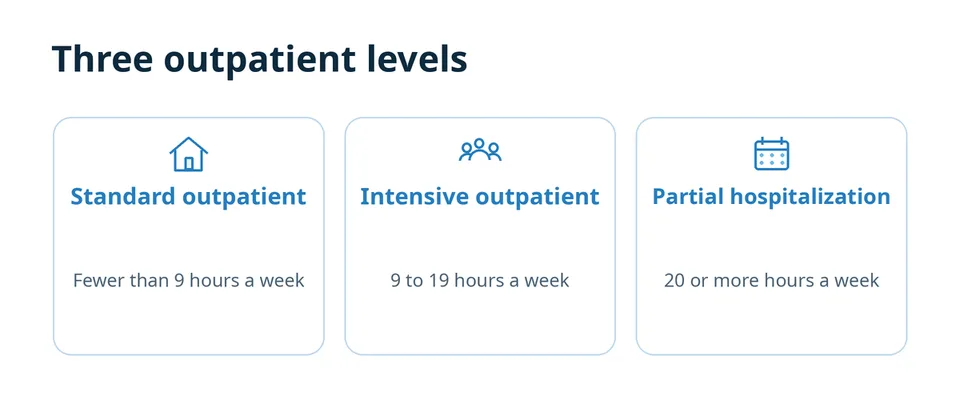
Outpatient treatment comes in a few levels, each with more hours and structure than the one before. The ASAM Criteria, the standard framework for levels of addiction care, define them by weekly hours.3 The table below compares them.
| Type | Hours per Week | What It Looks Like | Who It Often Fits |
|---|---|---|---|
| Standard outpatient | Fewer than 9 | Weekly therapy, group or medication visits | Milder symptoms or stepping down |
| Intensive outpatient (IOP) | 9 to 19 | Several group days a week plus individual therapy | Needs more than weekly care, stable at home |
| Partial hospitalization (PHP) | 20 or more | Several hours a day, most weekdays | Needs daily structure but not 24-hour care |
Each level has its own chapter in our guides. Read what IOP is for the middle level, and see PHP vs IOP for how the two most intensive outpatient levels compare.
What Happens in Outpatient Treatment
A typical plan combines a few kinds of care. Group is often the center, because it gives you support, accountability and a place to practice new skills with people working on the same things. Individual therapy and other care fill in around it, and a typical outpatient plan includes most of these:
- Group therapy or group counseling
- Individual therapy or one-on-one counseling
- Family therapy or family education
- Medication for opioid or alcohol use disorder, or for depression and anxiety
- Relapse prevention and aftercare planning
Proven therapies such as cognitive behavioral therapy and motivational interviewing are often used in those groups and visits, because they teach skills you can use right away. The NIAAA lists cognitive behavioral therapy, motivational enhancement and family counseling among the behavioral treatments led by health professionals.4
Benefits of Outpatient Rehab
The benefits of outpatient rehab come mostly from the fact that you stay in your own life while you get better. That has practical advantages, and it has clinical ones too: you practice new skills in the same places where old habits started. These are the main benefits people point to:
- You can keep working, going to school or caring for family.
- Treatment usually costs less than residential care, which NIDA confirms.1
- You practice skills right away in real situations and bring back what happened.
- Family can be part of treatment from the start.
- Many programs offer morning, midday and evening times, and some meet by video.
NIDA also notes that outpatient treatment often suits people with jobs or strong social support. The NIAAA adds that many outpatient options let people keep their regular routines and their privacy if they want.2
Does Outpatient Rehab Work
Yes, outpatient rehab works for most people whose needs fit it. A review in Psychiatric Services examined randomized trials and real-world studies of intensive outpatient programs for substance use disorders and rated the level of evidence as high.5 Every study reported reductions in alcohol and drug use.
The same review found that outcomes from intensive outpatient programs were comparable to inpatient or residential care, and concluded that IOPs are as effective as inpatient treatment for most people. That's an important finding for anyone worried that staying home means getting less effective care.
Results depend on a few things. Staying in treatment long enough matters, and NIDA says most people with addiction need at least three months to significantly reduce or stop their drug use.1 Fit matters too: someone with dangerous withdrawal or an unsafe home may need a higher level of care first.
Who Outpatient Treatment Fits
This kind of care fits people who are safe and stable enough to live at home while they get care. The NIAAA describes a good fit as someone with a less severe disorder, a stable living situation, supportive friends and family, access to transportation and relatively good health.6
It may not be the right first step for someone who needs medical detox, has serious medical or psychiatric problems, or lives where others are using. The NIAAA notes that people with a more severe disorder, unstable housing or other health problems may do better in residential or inpatient care. Many of them step down to outpatient care afterward.
Here's a short example. Someone who has been drinking every night, has a stable home and a supportive spouse, and has never had withdrawal symptoms may be a good fit for an intensive outpatient program. Someone who has had shaking and sweating when they stop drinking needs a medical plan for withdrawal first. Our chapter on detox vs rehab explains why.
How Long Outpatient Treatment Lasts
Many people stay in outpatient care for several months. The NIAAA describes outpatient programs as meeting one or more days a week, usually for several months.7 The length depends on how you're doing, which level you're in and what your insurance approves.
Many people move through more than one level over that time. They might start in an intensive outpatient program, then step down to standard outpatient care as they get stronger. Before leaving, they should have a written plan for staying well, and our guide to relapse prevention explains what goes in one.
How to Start Outpatient Treatment
Starting outpatient treatment is usually straightforward. Ask when the program can assess you and when treatment could begin. Timing depends on availability and your needs. These are the usual steps:
- Call a program and talk with a real person about what's going on.
- Have your insurance checked so you know what's covered.
- Complete an assessment to decide which outpatient level fits.
- Choose group times that work with your schedule.
- Join your first group and meet your treatment team.
Our chapter on how to get into rehab covers each step in more detail, including how to help someone else get started.
Outpatient Treatment at Promising Outlook
Promising Outlook offers every outpatient level by live video for adults across California: partial hospitalization, intensive outpatient and outpatient programs. Groups meet Monday through Friday, with a morning group at 9:00 a.m., a midday group at 12:00 p.m. and two evening groups at 5:00 p.m. Our virtual IOP in California is our core program.
Individual therapy and one-on-one counseling are available every week, and family therapy and medication management are built in. Treatment length varies. Clients can move between levels without changing teams and leave with an aftercare plan and a relapse prevention plan.
Call us and a real person will answer, day or night. If outpatient care is right for you, you can start today. You can also verify your insurance online. We're in network with Aetna, Blue Shield, Cigna, Health Net, Tricare and United.
Frequently Asked Questions
What is outpatient treatment?
Outpatient treatment is care for addiction or mental health that you receive while living at home. You attend counseling, group therapy or a structured program on a set schedule and go home afterward. It ranges from weekly visits to several hours a day and usually lasts several months.
What is the difference between outpatient and intensive outpatient?
Standard outpatient care usually means fewer than nine hours a week, often one or two visits. Intensive outpatient care means nine to 19 hours a week, built around group therapy several days a week. People often step down from intensive outpatient to standard outpatient care as they improve.
Does outpatient rehab work?
Yes, for people whose needs fit it. A research review rated the evidence for intensive outpatient programs as high, found that all studies reported reduced alcohol and drug use, and concluded IOPs are as effective as inpatient treatment for most people with substance use disorders.
What are the benefits of outpatient rehab?
You can keep working and caring for family, treatment usually costs less than residential care, and you practice new skills in real situations right away. Family can be involved from the start, and many programs offer flexible times, including evenings and care by video.
Is outpatient treatment right for me?
It may be if you have a stable, safe home, some support, relatively good health and no risk of dangerous withdrawal. If withdrawal could be dangerous, symptoms are severe or home isn't safe, a higher level of care may be better first. An assessment can help you decide.
How many days a week is outpatient treatment?
It depends on the level. Standard outpatient care is often one or two days a week. Intensive outpatient programs usually meet three or more days a week, and partial hospitalization meets most weekdays for several hours.
Sources
- National Institute on Drug Abuse. Principles of Drug Addiction Treatment: A Research-Based Guide (Third Edition). 2018.
- National Institute on Alcohol Abuse and Alcoholism. What Types of Alcohol Treatment Are Available? NIAAA Alcohol Treatment Navigator.
- American Society of Addiction Medicine. The ASAM Criteria, Fourth Edition, Volume 1: Adults (Overview).
- National Institute on Alcohol Abuse and Alcoholism. Treatment for Alcohol Problems: Finding and Getting Help.
- McCarty D, et al. Substance Abuse Intensive Outpatient Programs: Assessing the Evidence. Psychiatric Services, 2014.
- National Institute on Alcohol Abuse and Alcoholism. Why Do Different People Need Different Options? NIAAA Alcohol Treatment Navigator.
- National Institute on Alcohol Abuse and Alcoholism. Step 1: Search Trusted Sources to Find Providers. NIAAA Alcohol Treatment Navigator.
