


Co-occurring disorders means having a mental health condition and a substance use disorder at the same time. Depression with alcohol use disorder, anxiety with benzodiazepine misuse and PTSD with opioid addiction are common examples. The two conditions can affect each other, which is why it helps to assess and address both.
This kind of dual diagnosis is common, and it's treatable. Research points to the same answer again and again: care works best when providers treat both conditions together through a coordinated plan. At Promising Outlook, our virtual dual diagnosis treatment does exactly that, by live video for adults across California.
This guide explains what co-occurring disorders are, the pairings that show up most often, why they happen together, the signs to watch for and how they're diagnosed and treated. Two chapters go deeper: one on integrated treatment for co-occurring disorders and one on depression and substance abuse.
Key Takeaways
- A co-occurring disorder means having a mental health condition and a substance use disorder at the same time.
- NIDA reports that about half of people who have a mental illness during their lives will also have a substance use disorder, and the reverse is also true.
- Anxiety, depression, PTSD, bipolar disorder and ADHD are among the conditions that most often occur with addiction.
- The two conditions share risk factors, and each one can make the other worse.
- NIDA says treating both at the same time works better than treating them separately.
- Many people with both conditions get no treatment for either one.
What Is a Co-Occurring Disorder
A co-occurring disorder is the presence of at least one mental health condition and at least one substance use disorder in the same person at the same time. NIDA defines co-occurring conditions as mental disorders or other health conditions a person has at once, which may interact and affect symptoms and health outcomes.1 In everyday terms, it means the addiction and the mental health problem are tangled together.
You may hear other names for the same thing. Dual diagnosis is the most common one, and clinicians also use comorbidity, which means two or more conditions in one person. The co occurring disorders definition doesn't require a particular pair. Any mental health diagnosis plus any substance use disorder counts, from depression and alcohol to ADHD and stimulants.
Having both doesn't mean one caused the other, and it doesn't mean you're more broken than someone with one diagnosis. It means your care needs to account for both. That's the main idea behind everything else in this guide.
How Common Are Co-Occurring Disorders
Having both conditions at once is far more common than many people realize. Several national surveys reviewed by NIDA found that about half of people who experience a mental illness during their lives will also experience a substance use disorder, and the reverse is also true.2 The same report notes that about 1 in 4 people with a serious mental illness also has a substance use disorder.
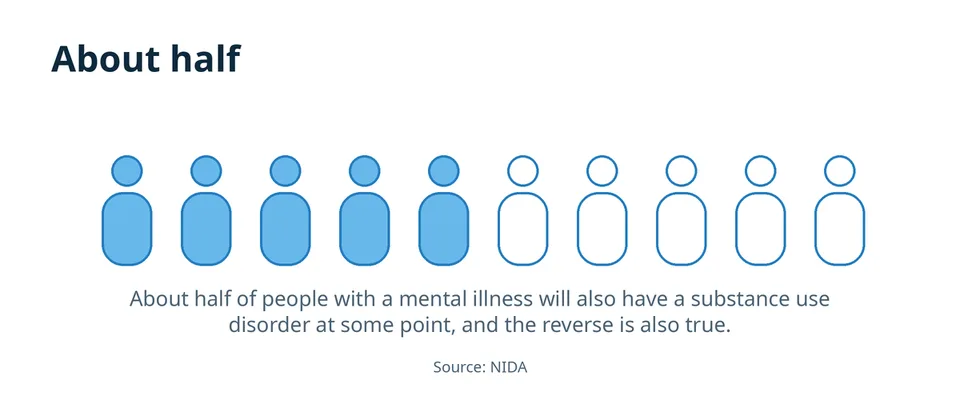
NIDA describes the overlap between mental health conditions and substance use disorders as common.1 A Case Western Reserve University research brief also describes gaps in access to integrated care.3
The 2025 National Survey on Drug Use and Health estimated that 18.5 million U.S. adults had both conditions in the prior year. About 43% of them received neither type of treatment. Many others get help for only one side. When the mental health condition is treated and the addiction isn't, or the other way around, the untreated condition often pulls the person back.
Dual Diagnosis Examples
Some pairings show up much more often than others. NIDA lists anxiety disorders, depression, PTSD, psychotic disorders, borderline and antisocial personality disorders and ADHD among the mental health conditions that commonly occur with substance use disorders.1 Its 2018 research report adds bipolar disorder to that list.2 The table below shows common dual diagnosis examples and how the two conditions tend to interact.
| Mental Health Condition | Substances Often Involved | How They Interact |
|---|---|---|
| Depression | Alcohol, opioids, cannabis | Drinking or using numbs low mood for a while, then deepens it |
| Anxiety and panic disorder | Alcohol, benzodiazepines, cannabis | Substances calm nerves short term, and withdrawal brings anxiety back stronger |
| PTSD | Alcohol, opioids, benzodiazepines | Substances blunt memories and hyperarousal, and trauma cues trigger cravings |
| Bipolar disorder | Alcohol, cocaine, stimulants | Use can worsen mood swings, and NIDA notes cocaine may worsen bipolar symptoms |
| ADHD | Stimulants, cannabis, alcohol | Impulsivity raises risk, and some people misuse stimulant medicine |
| Chronic pain | Prescription opioids | NIDA notes almost half of people with opioid use disorder also have chronic pain |
These are common patterns rather than fixed rules, and many people have more than two conditions at once. NIDA notes that using more than one substance is a growing factor in health risks, including fatal overdose. A good assessment looks at everything you're dealing with, not just the most obvious problem.
Trauma deserves its own mention. NIDA reports that one analysis estimated more than 30% of adults with a substance use disorder experienced childhood trauma. Our chapter on trauma and substance abuse explains that link in depth.
Why Mental Illness and Addiction Happen Together
There isn't one single cause, and the order isn't always clear. NIDA and the National Institute of Mental Health both describe three main pathways that explain why the two conditions show up together so often.2, 4 Many people's stories involve more than one of them:
- Shared risk factors. Genetics, stress, trauma and a hard environment can raise the risk of both conditions at once.
- Mental illness leading to substance use. People may use substances to cope with anxiety, depression or pain, and some mental disorders change the brain in ways that make substances feel more rewarding.
- Substance use leading to mental illness. Long-term use can change areas of the brain involved in mood, anxiety and impulse control, which can bring on or worsen a mental health condition.
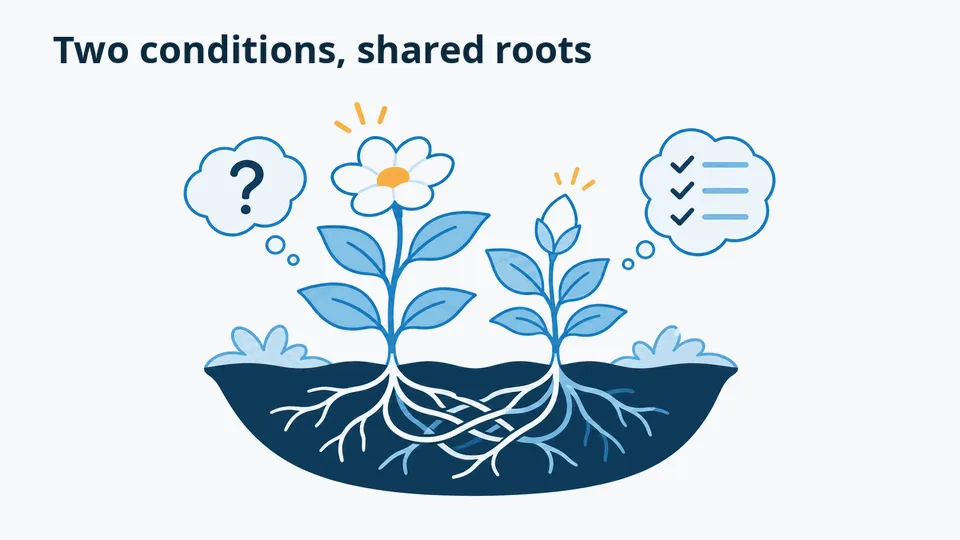
NIDA cautions that it's often hard to prove which came first. Symptoms may start quietly long before anyone gives them a name. For treatment, the order matters less than the fact that both conditions are active now and both need care.
The Self-Medication Cycle
Self-medication is one of the most common ways a dual diagnosis takes hold. NIDA explains that people with anxiety, stress, depression or pain may use drugs to feel better, especially when they don't have access to mental health care.1 The relief is real at first, and that's what makes the pattern so hard to break.
Over time, the substance stops working the way it used to and starts making symptoms worse. NIDA notes that substances can ease symptoms for a while but often worsen them over time. The person then uses more to get the same relief, and the cycle tightens.
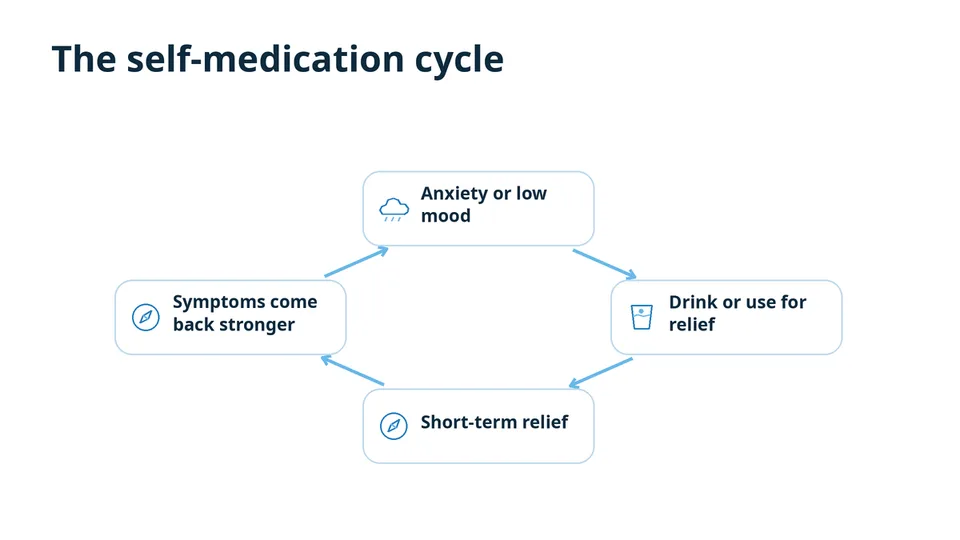
Here's how it often looks. A woman with untreated anxiety starts having two glasses of wine at night to settle her mind. Within a year it's most of a bottle, she wakes at 3 a.m. with her heart racing, and her anxiety during the day is worse than before. She now has two problems that each keep the other going, and treating only one won't hold.
Signs of a Co-Occurring Disorder
A dual diagnosis can be hard to spot from the outside, and even from the inside. Many signs overlap with either condition alone, and people often notice one problem while missing the other. These signs suggest that both a mental health condition and a substance problem may be present:
- Drinking or using to calm anxiety, lift a low mood or get to sleep.
- Mood, anxiety or sleep problems that get worse after drinking or using, or when stopping.
- Mental health symptoms that started before the substance use or stayed during sober stretches.
- Past treatment for one problem that didn't stick because the other was still there.
- Pulling away from friends, family or activities you used to enjoy.
- Trouble keeping up at work, school or home.
- Thoughts of hopelessness, self-harm or suicide alongside heavy use.
If you see several of these in yourself or someone you love, it's worth getting a full assessment. You don't need to know which came first, or even be sure both are there, to ask for help.
Why a Dual Diagnosis Is Hard to Spot
The biggest challenge is overlap. The National Institute of Mental Health notes that accurate diagnosis is key because symptoms of substance use and mental disorders may overlap.4 Alcohol withdrawal can look like an anxiety disorder, stimulant crashes can look like depression and heavy cannabis use can blur the signs of several conditions.
Timing adds another layer. Some symptoms fade once a person has been sober for a few weeks, while others stay or even get stronger. Clinicians often watch how symptoms change during early recovery to tell the difference between effects of the substance and an independent mental health condition.
Severity matters too. NIDA notes that people with both conditions often have symptoms that are more persistent, severe and resistant to treatment than people with either one alone.2 That's one reason missed diagnoses are costly, and why the right assessment at the start can change the whole course of care.
How Co-Occurring Disorders Are Diagnosed
Diagnosis starts with screening for both conditions, no matter which one brought you in. NIDA recommends that people entering treatment for one condition be screened for the other.1 The National Institute of Mental Health adds that clinicians with experience in both areas can use comprehensive assessment tools to reduce the chance of a missed diagnosis.4 A thorough assessment usually covers these steps:
- A conversation about your substance use, including what, how much, how often and when it started.
- Questions about mood, anxiety, sleep, trauma, attention and thoughts of self-harm.
- Your personal and family history of mental health conditions and addiction.
- A review of medicines, medical conditions and past treatment.
- Standard screening questionnaires for depression, anxiety, PTSD and substance use.
- Follow-up over the first weeks of treatment to see which symptoms stay as use stops.
Be as honest as you can during this process. Clinicians aren't there to judge, and accurate answers lead to the right plan. If you're in California, our team can complete this assessment by phone or video, often the same day.
Why Treating Both at Once Matters
For years, many people were told to get sober first and deal with their mental health later, or the other way around. That approach left gaps, because the untreated condition kept pulling them back. Current research points in a different direction.
The 2018 research report states that integrated treatment for co-occurring drug use disorders and mental illness has been found to be consistently superior to treating each disorder separately.2 NIDA's current guidance says it's usually better to treat these conditions at the same time, and that doing so can make all the treatments more effective.1
The research isn't perfectly uniform, and it's fair to say so. The Case Western brief notes that one Cochrane review found no clear difference between integrated and standard care, while other reviews found integrated care led to greater drops in psychiatric symptoms and better overall outcomes.3 The same brief describes integrated treatment as widely seen as the gold standard and reports that researchers strongly advise against delaying PTSD treatment until someone is abstinent.
Our chapter on what integrated treatment means explains how this kind of care is set up and what to look for in a program.
Treatment Options for Co-Occurring Disorders
Treatment usually combines therapy, medication when it fits, and support for daily life. The National Institute of Mental Health describes integrated care as combining mental health and substance use treatment, which may include therapy, medication, care management or a mix.4 It names several behavioral therapies that help people build coping skills:
- Cognitive behavioral therapy helps you spot and change thoughts and actions that drive both symptoms and use.
- Motivational interviewing helps you find your own reasons for change and work through mixed feelings.
- Contingency management uses rewards to reinforce staying sober.
- Family-based approaches help the people at home understand and support recovery.
Medication can play a big role too. The National Institute of Mental Health notes that medications can effectively treat addiction to opioids and alcohol and lessen the symptoms of many other mental disorders, and some may help with more than one condition. Our guide to common types of therapy explains the therapies above in more detail.
Daily coping skills matter as much as anything learned in a group. Stress is a common trigger for both mental health symptoms and use, so learning to handle it is part of treatment. Our chapter on healthy ways to cope with stress is a good place to start.
Levels of Care for a Dual Diagnosis
The right level of care depends on how severe both conditions are, how safe you are at home and whether you need medical support for withdrawal. Many people move through more than one level as they improve. The table below shows the main options.
| Level of Care | What It Involves | Often Fits When |
|---|---|---|
| Medical detox | Supervised withdrawal, usually for days | Withdrawal from alcohol or benzodiazepines could be dangerous |
| Inpatient or residential | Living at a facility with 24-hour care | Symptoms are severe, there's a safety risk or home isn't stable |
| Partial hospitalization (PHP) | Several hours a day on most weekdays | You need daily structure but can sleep at home safely |
| Intensive outpatient (IOP) | Group therapy three or more days a week, plus individual care | You're stable at home but need more than weekly therapy |
| Outpatient | Weekly therapy, groups or medication visits | Symptoms are milder or you're stepping down |
Many people with both conditions do well in outpatient settings when they're medically stable. The key is that both conditions are treated in the same plan, at every level. Our guide to what an intensive outpatient program is explains the middle level, where many people with a dual diagnosis spend most of their treatment.
What to Look for in a Program
Not every program that treats addiction is ready to treat mental health conditions well, and the reverse is also true. A program that says it handles both should be able to explain how. These questions help you tell the difference between real integrated care and two separate programs under one roof:
- Does the same team treat both my mental health and my substance use?
- Is there a psychiatric prescriber who can manage medication for both?
- Will I be screened for both conditions at the start, even if I only called about one?
- Do groups cover mood, anxiety and trauma as well as cravings and triggers?
- How do you handle a relapse or a mental health crisis during treatment?
- What does the aftercare plan include for both conditions?
Clear, specific answers are a good sign. Vague answers, or being told to get sober before your depression or anxiety will be addressed, suggest the program may not be set up for a dual diagnosis. Accreditation from a body like The Joint Commission also shows the program has been reviewed against national standards.
Format matters for some people too. If you work, care for children or live far from a treatment center, a program that meets by live video can make it possible to attend consistently. Our virtual IOP in California was built for that, with morning, midday and evening groups.
What Recovery Looks Like
Recovery from a dual diagnosis is rarely a straight line. Mood may improve before cravings fade, or the reverse. Some weeks feel like real progress and others feel like going backward. That's normal, and it's a reason to stay in care, not a sign that it isn't working.
Over time, many people learn to recognize early warning signs in both areas. A few bad nights of sleep, a slump in mood or a sudden urge to drink can all be signals to reach out. Treatment teaches you to treat those signals as information and to use a plan instead of a substance.
Recovery also means building a life that supports both sides of your health. That includes sleep, movement, steady routines, people you trust and ongoing care after an intensive program ends. A written relapse prevention plan that covers mental health symptoms and substance use together helps keep that life on track, and our guide to relapse prevention shows what goes into one.
How to Help a Loved One With a Dual Diagnosis
Watching someone you love struggle with both mental illness and addiction is exhausting. It's easy to blame the substance for everything, or to blame the mental illness and excuse the use. In reality, both need attention, and your support works best when it acknowledges both.
A few approaches tend to help more than others. These steps can make a hard conversation more likely to lead somewhere good:
- Learn about both conditions so you can recognize what's driving what.
- Talk when they're sober and calm, and describe specific things you've seen.
- Avoid labels and focus on how you've been affected and that you care.
- Offer specific help, like finding a program or making the first call together.
- Take care of yourself with your own support or therapy.
If there's ever an immediate risk of self-harm or overdose, get emergency help right away. Otherwise, keep the door open. People often say no the first time and yes later.
Co-Occurring Disorders Treatment at Promising Outlook
Promising Outlook treats both conditions together, by live video, for adults across California. The same clinical team handles both your mental health and your recovery, so you're not passed between separate programs. Our virtual mental health treatment and virtual addiction treatment run as one plan, not two.
Care includes group therapy, individual therapy, family therapy and psychiatric medication management, along with Suboxone and Vivitrol when they fit. Groups meet Monday through Friday at 9:00 a.m., 12:00 p.m. and 5:00 p.m. Clients in our intensive outpatient program attend three days a week. Treatment length depends on your care plan.
Before you finish, you leave with an aftercare plan and a relapse prevention plan built around both conditions. Not a pamphlet. A plan. Promising Outlook is accredited by The Joint Commission. We don't provide detox or residential care, but we'll help you find them if you need them first.
Call us and a real person will answer, day or night. If you're medically stable, you can often start the same day. You can also verify your insurance online. We're in network with Aetna, Blue Shield, Cigna, Health Net, Tricare and United.
Frequently Asked Questions
What is a co-occurring disorder?
A co-occurring disorder means having at least one mental health condition and at least one substance use disorder at the same time. Common examples include depression with alcohol use disorder, anxiety with benzodiazepine misuse and PTSD with opioid use. The conditions often affect each other, so treatment works best when it covers both.
What is the difference between co-occurring disorders and dual diagnosis?
They mean the same thing. Dual diagnosis is an older, everyday term for having a mental health condition and a substance use disorder together. Co-occurring disorders is the term most federal agencies and clinicians use now, and comorbidity is a broader medical word for any two conditions in one person.
What are some dual diagnosis examples?
Common examples include depression with alcohol use disorder, generalized anxiety or panic disorder with benzodiazepine or alcohol misuse, PTSD with alcohol or opioid use, bipolar disorder with stimulant or cocaine use, and ADHD with stimulant or cannabis use. Chronic pain with opioid use disorder is also common.
How common are co-occurring disorders?
Very common. NIDA reports that about half of people who experience a mental illness during their lives will also experience a substance use disorder, and the reverse. In the 2025 National Survey on Drug Use and Health, about one in three U.S. adults with a mental illness also had a substance use disorder in the past year.
Which comes first, mental illness or addiction?
Either can come first, and sometimes they start together. Shared risk factors like genetics, stress and trauma can raise the risk of both. Mental illness can lead to using substances to cope, and substance use can change the brain in ways that bring on mental health symptoms.
Can co-occurring disorders be treated at the same time?
Yes, and that's usually the best approach. NIDA says treating both conditions at the same time is generally better than treating them separately and can make all the treatments more effective. Integrated care combines therapy, medication when it fits and support from one coordinated team.
Can you treat co-occurring disorders in outpatient care?
Often, yes. Many people with co-occurring disorders do well in partial hospitalization, intensive outpatient or outpatient programs when they're medically stable and safe at home. People who need medical detox or have severe symptoms or safety risks may need a higher level of care first.
Will treating my addiction fix my depression or anxiety?
Sometimes symptoms improve once use stops, but often they don't go away on their own. Some mood and anxiety symptoms come from the substance, while others are an independent condition that needs its own care. A full assessment and close follow-up in early recovery help sort that out.
Sources
- National Institute on Drug Abuse. Co-Occurring Disorders and Other Health Conditions.
- National Institute on Drug Abuse. Common Comorbidities with Substance Use Disorders Research Report. 2018.
- Case Western Reserve University, Ohio Substance Use Disorders Center of Excellence. Integrated Treatment for Co-occurring Mental Health and Substance Use Disorders: Research Brief. 2025.
- National Institute of Mental Health. Substance Use and Co-Occurring Mental Disorders.
